Committee hears renewal request for 'Getting to Work' vehicle grants
March 19, 2026 | 2026 Legislature MN, Minnesota
This article was created by AI summarizing key points discussed. AI makes mistakes, so for full details and context, please refer to the video of the full meeting. Please report any errors so we can fix them. Report an error »
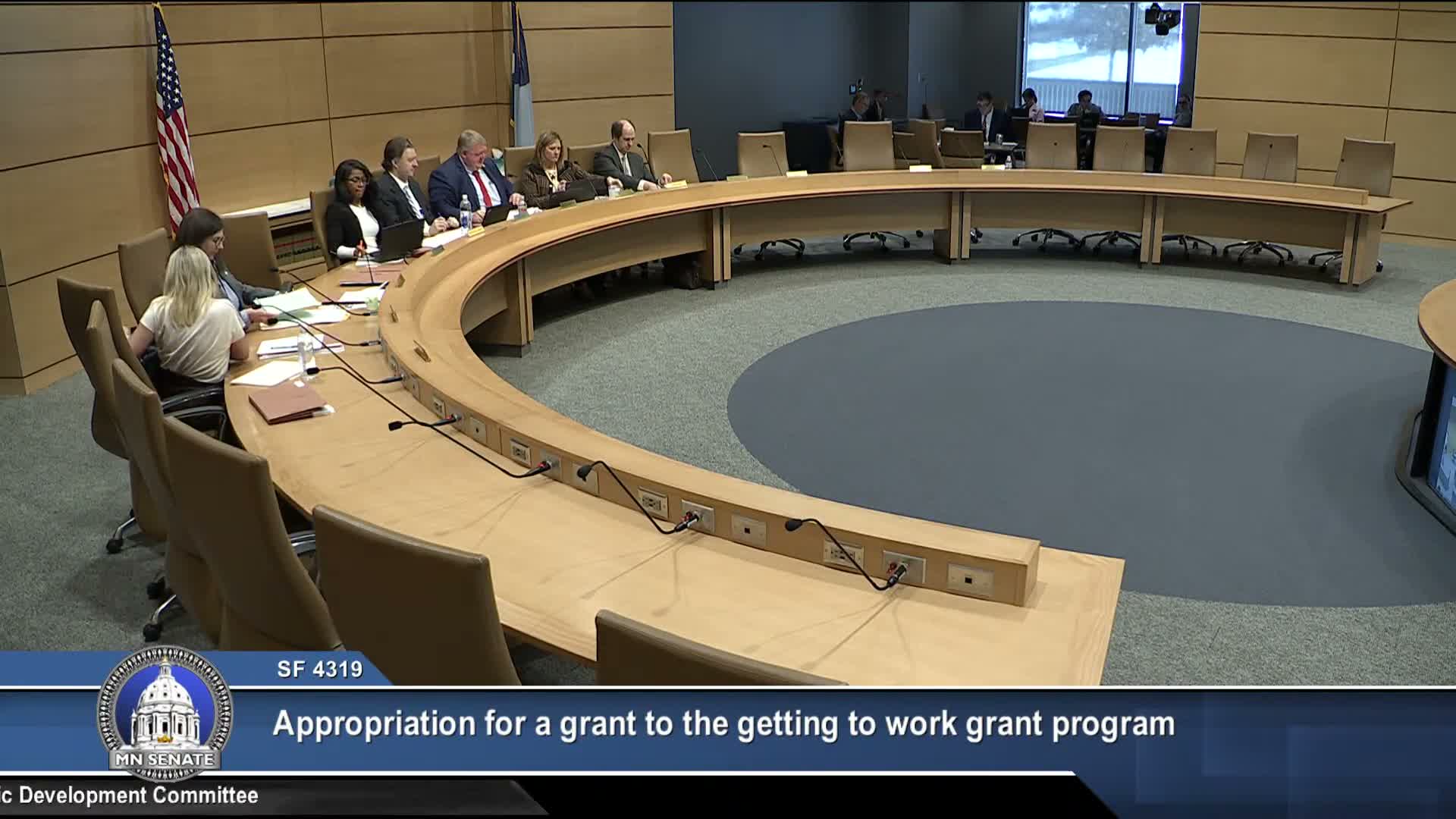
Senator Hur introduced Senate File 4319 to renew the Getting to Work grant program, describing it as a competitive Department of Employment and Economic Development grant that supports nonprofit programs providing affordable car repair, low-interest vehicle loans or donated vehicles to people who need transportation to find or keep a job.
Anna Odegaard, volunteer advocate with the Minnesota Community Action Partnership, told the committee the program began as a pilot in 2017, was established in 2022 and "has grown from 62 participants in that year to over 800 in 2025." She said recipients must be over 18, hold a valid license and insurance, demonstrate need, and that awardees must leverage at least 50% matching funds to stretch state dollars. "Making sure someone has a safe and reliable vehicle that they need to get to their job is primarily a benefit to that family," Odegaard said, adding the funding also supports financial-literacy and vehicle-maintenance programming.
Kendra Krolick, chief strategy and advancement officer at the Community Action Partnership of Hennepin County, said a recent community needs assessment listed transportation costs among top rising household costs (117 respondents) and described how repairs, insurance and registration expenses can "cascade" into lost employment and missed appointments. Krolick said CAPHC used the grant to help 167 low-income residents in 2024–25 and shared a participant testimony about regaining employment after receiving vehicle repairs.
During committee consideration, a member moved the A1 amendment, which shifts the appropriation from the general fund to workforce development and makes it a one‑time appropriation; the committee adopted the amendment by voice vote. Senate File 4319, as amended, was laid over for possible inclusion, with no final committee disposition on funding or appropriation details.
The committee packet includes a recent DEED report detailing the 12 programs funded in the last round, the counties served, and program outcomes; advocates urged legislators to preserve the program’s match requirement and wraparound supports to maximize effects on employment and community economic activity.
Next steps: SF 4319 was laid over for possible inclusion.
Anna Odegaard, volunteer advocate with the Minnesota Community Action Partnership, told the committee the program began as a pilot in 2017, was established in 2022 and "has grown from 62 participants in that year to over 800 in 2025." She said recipients must be over 18, hold a valid license and insurance, demonstrate need, and that awardees must leverage at least 50% matching funds to stretch state dollars. "Making sure someone has a safe and reliable vehicle that they need to get to their job is primarily a benefit to that family," Odegaard said, adding the funding also supports financial-literacy and vehicle-maintenance programming.
Kendra Krolick, chief strategy and advancement officer at the Community Action Partnership of Hennepin County, said a recent community needs assessment listed transportation costs among top rising household costs (117 respondents) and described how repairs, insurance and registration expenses can "cascade" into lost employment and missed appointments. Krolick said CAPHC used the grant to help 167 low-income residents in 2024–25 and shared a participant testimony about regaining employment after receiving vehicle repairs.
During committee consideration, a member moved the A1 amendment, which shifts the appropriation from the general fund to workforce development and makes it a one‑time appropriation; the committee adopted the amendment by voice vote. Senate File 4319, as amended, was laid over for possible inclusion, with no final committee disposition on funding or appropriation details.
The committee packet includes a recent DEED report detailing the 12 programs funded in the last round, the counties served, and program outcomes; advocates urged legislators to preserve the program’s match requirement and wraparound supports to maximize effects on employment and community economic activity.
Next steps: SF 4319 was laid over for possible inclusion.
View the Full Meeting & All Its Details
This article offers just a summary. Unlock complete video, transcripts, and insights as a Founder Member.
✓
Watch full, unedited meeting videos
✓
Search every word spoken in unlimited transcripts
✓
AI summaries & real-time alerts (all government levels)
✓
Permanent access to expanding government content
30-day money-back guarantee
