Committee advances bill on congregate care concentration after testimony from cities and disability advocates
March 19, 2026 | 2026 Legislature MN, Minnesota
This article was created by AI summarizing key points discussed. AI makes mistakes, so for full details and context, please refer to the video of the full meeting. Please report any errors so we can fix them. Report an error »
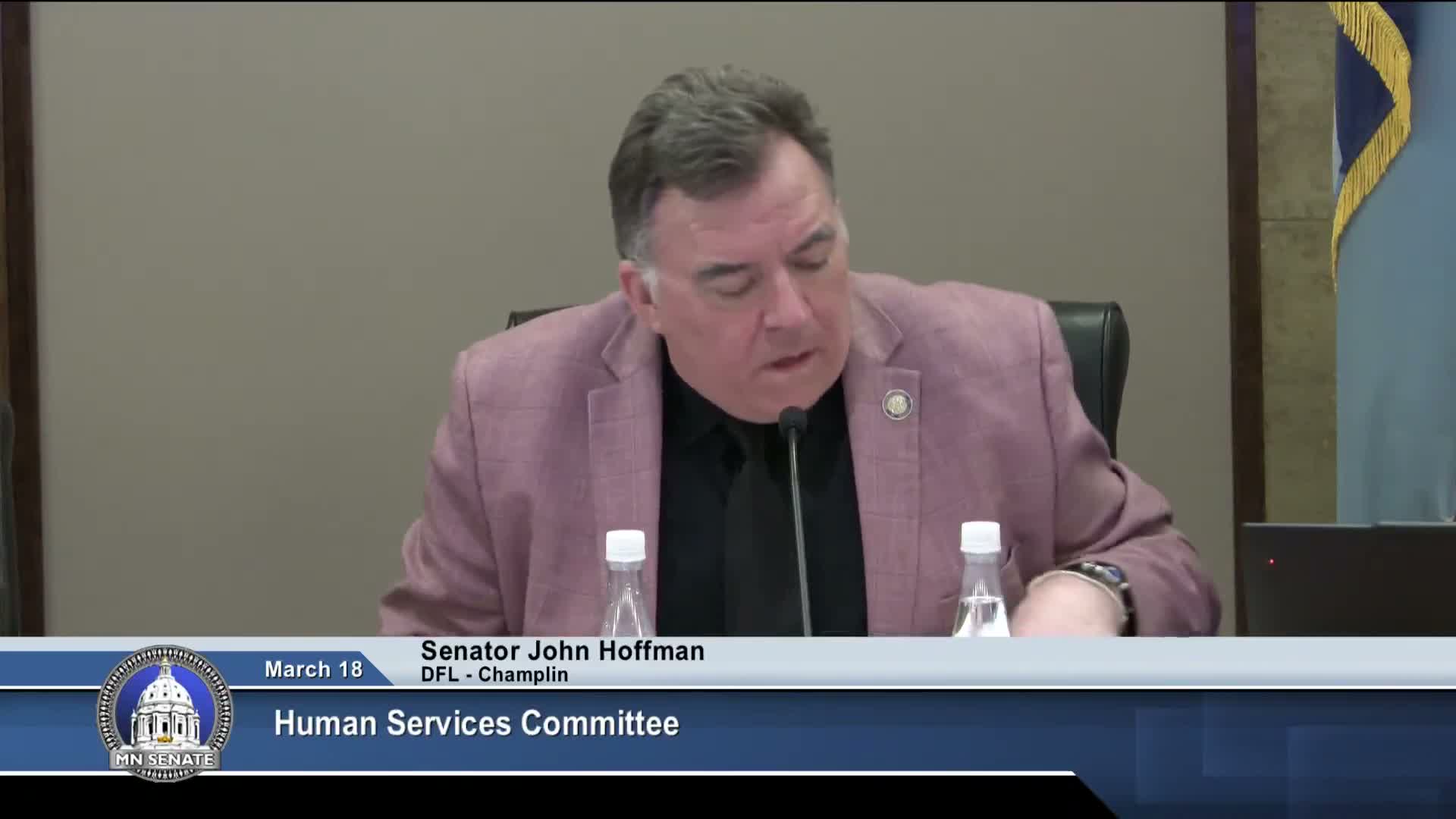
The Minnesota Senate Human Services Committee on March 18 advanced a bill aimed at addressing concentrated clusters of licensed congregate care homes across the Twin Cities metro, voting to pass Senate File 42-79 without recommendation and re-refer the measure to the Judiciary and Public Safety Committee.
The bill’s author told the committee the measure focuses on four areas: improving the Minnesota Adult Abuse Reporting Center (MARC) response and follow-up; establishing a consistent statewide distancing standard to avoid dense clusters of small licensed homes; requiring notification to local governments when new licenses are issued; and creating an optional state-local partnership so local building inspections can supplement state licensing—while preserving state licensing authority. The author framed the approach as a stakeholder-driven compromise developed in the interim.
Supporters from the North Metro urged action. Nicole Klonowski, a Brooklyn Park council member, said local experience shows large-scale for-profit ownership and clustering are eroding quality and choice. "In Brooklyn Park, less than 3% of our congregate care homes are nonprofit. 97% are operated by corporations or LLCs," she told the committee, arguing concentration often produces staffing shortages and outsized emergency-service burdens.
Hollis Winston, mayor of Brooklyn Park, speaking for a 10-city coalition, said the concentration "is not integration" and urged the committee to back the bill so services are distributed more thoughtfully and residents receive better supports and community integration.
Advocates and providers disputed some policy tools in the bill. Sarah Grafstrom of ARM warned that imposing statewide proximity restrictions can conflict with federal civil-rights law: "This proposed policy is in conflict with the Fair Housing Act of 1988," she said, noting Department of Justice and HUD positions and case law that generally find density restrictions problematic. Provider and municipal witnesses urged attention to root causes such as housing affordability, transportation and workforce shortages rather than relying solely on siting rules.
Senators debated the bill’s distancing language—several described concerns that a 600–650 foot rule could limit where Minnesotans with disabilities may live. Senator Rasmussen and others said they were open to strengthening MARC coordination and the municipal-notification pieces but questioned whether a statewide distancing mandate is the right tool, or whether it would trigger litigation under federal housing civil-rights law. The author and multiple senators said the bill can be revised during subsequent markup and that cross‑chamber conversations would continue.
After extended discussion and the adoption of author amendments, the committee voice‑voted to pass SF 42-79 without recommendation and re-refer it to the Judiciary and Public Safety Committee for further review and possible legal cleanup. The chair said that sending the bill forward without recommendation preserves opportunities for future amendment and continued negotiation.
Next steps: The bill will be considered by Judiciary and Public Safety for the MARC-related legal changes and then could return to human services for additional markup before floor action.
The bill’s author told the committee the measure focuses on four areas: improving the Minnesota Adult Abuse Reporting Center (MARC) response and follow-up; establishing a consistent statewide distancing standard to avoid dense clusters of small licensed homes; requiring notification to local governments when new licenses are issued; and creating an optional state-local partnership so local building inspections can supplement state licensing—while preserving state licensing authority. The author framed the approach as a stakeholder-driven compromise developed in the interim.
Supporters from the North Metro urged action. Nicole Klonowski, a Brooklyn Park council member, said local experience shows large-scale for-profit ownership and clustering are eroding quality and choice. "In Brooklyn Park, less than 3% of our congregate care homes are nonprofit. 97% are operated by corporations or LLCs," she told the committee, arguing concentration often produces staffing shortages and outsized emergency-service burdens.
Hollis Winston, mayor of Brooklyn Park, speaking for a 10-city coalition, said the concentration "is not integration" and urged the committee to back the bill so services are distributed more thoughtfully and residents receive better supports and community integration.
Advocates and providers disputed some policy tools in the bill. Sarah Grafstrom of ARM warned that imposing statewide proximity restrictions can conflict with federal civil-rights law: "This proposed policy is in conflict with the Fair Housing Act of 1988," she said, noting Department of Justice and HUD positions and case law that generally find density restrictions problematic. Provider and municipal witnesses urged attention to root causes such as housing affordability, transportation and workforce shortages rather than relying solely on siting rules.
Senators debated the bill’s distancing language—several described concerns that a 600–650 foot rule could limit where Minnesotans with disabilities may live. Senator Rasmussen and others said they were open to strengthening MARC coordination and the municipal-notification pieces but questioned whether a statewide distancing mandate is the right tool, or whether it would trigger litigation under federal housing civil-rights law. The author and multiple senators said the bill can be revised during subsequent markup and that cross‑chamber conversations would continue.
After extended discussion and the adoption of author amendments, the committee voice‑voted to pass SF 42-79 without recommendation and re-refer it to the Judiciary and Public Safety Committee for further review and possible legal cleanup. The chair said that sending the bill forward without recommendation preserves opportunities for future amendment and continued negotiation.
Next steps: The bill will be considered by Judiciary and Public Safety for the MARC-related legal changes and then could return to human services for additional markup before floor action.
Don't Miss a Word: See the Full Meeting!
Go beyond summaries. Unlock every video, transcript, and key insight with a Founder Membership.
✓
Get instant access to full meeting videos
✓
Search and clip any phrase from complete transcripts
✓
Receive AI-powered summaries & custom alerts
✓
Enjoy lifetime, unrestricted access to government data
30-day money-back guarantee
