Senate committee advances bill to let pharmacists prescribe after certain tests, prompting pushback from physicians
March 18, 2026 | 2026 Legislature TN, Tennessee
This article was created by AI summarizing key points discussed. AI makes mistakes, so for full details and context, please refer to the video of the full meeting. Please report any errors so we can fix them. Report an error »
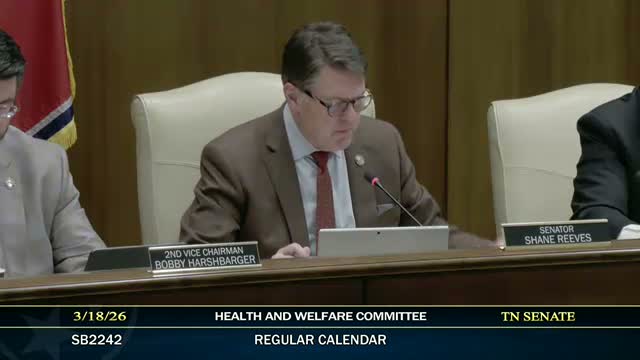
Senator Steven Reeves said the committee approved an amendment that makes Senate Bill 2242, a measure to clarify when pharmacists may issue prescriptions or medical orders. Reeves said the bill limits pharmacists’ new authority to specific situations: when treating a previously diagnosed condition, for minor self‑limited ailments, or on the basis of CLIA‑waived test results performed and interpreted by the pharmacist.
"This legislation removes unnecessary barriers and helps ensure Tennesseans can access care where they live," Reeves said as he described examples — poison ivy, strep testing and follow‑up for stable chronic conditions — where pharmacists could safely intervene. He said pharmacists would be held to the same standard of care as other providers and that prescriptions issued at a pharmacy would not be required to be filled at that pharmacy.
The bill drew caution from the Tennessee Medical Association. Julie Griffin of the TMA told the committee physicians worry the measure, as written, opens the door to pharmacists treating conditions that often require a physical exam and diagnostic data unavailable in the pharmacy setting. "There are over 1,400 CLIA‑waived tests," Griffin said, and not all are appropriate to treat without a clinician’s exam.
Dr. Trey Bates, a family physician representing the Tennessee Academy of Family Physicians, said some diagnostic decisions — for example, choosing the correct antibiotic for a urinary tract infection while accounting for kidney function — depend on clinical context and laboratory resources that are typically not available in a retail pharmacy. "Treating based on a single rapid test without access to the patient's clinical data could lead to harm," he said.
Reeves acknowledged the concerns but said the bill is narrowly tailored and part of a broader rural health transformation strategy that relies on pharmacists as an accessible front line of care. Michael Hendricks, Governor Lee’s policy director, told senators pharmacists are central to the rural plan and that the legislation holds pharmacists to the same standard of care as physicians.
After discussion and two recorded votes — the committee adopted an amendment that makes the bill and then approved the bill as amended — the committee sent Senate Bill 2242 to the calendar. Committee records show the amendment passed on a roll call and the final committee vote was recorded as an affirmative vote sending the bill to calendar.
The bill as amended would permit pharmacists to provide limited tests, interpret CLIA‑waived results and, in some circumstances and under defined standards, issue prescriptions. Opponents urged tighter limits or technical fixes to ensure high‑risk diagnoses remain under physician oversight; proponents said the change is intended to expand timely access to care, particularly in rural communities.
The measure now moves to the next stage of the Senate calendar; committee members said interested parties will continue technical conversations on precise test lists and reporting requirements.
"This legislation removes unnecessary barriers and helps ensure Tennesseans can access care where they live," Reeves said as he described examples — poison ivy, strep testing and follow‑up for stable chronic conditions — where pharmacists could safely intervene. He said pharmacists would be held to the same standard of care as other providers and that prescriptions issued at a pharmacy would not be required to be filled at that pharmacy.
The bill drew caution from the Tennessee Medical Association. Julie Griffin of the TMA told the committee physicians worry the measure, as written, opens the door to pharmacists treating conditions that often require a physical exam and diagnostic data unavailable in the pharmacy setting. "There are over 1,400 CLIA‑waived tests," Griffin said, and not all are appropriate to treat without a clinician’s exam.
Dr. Trey Bates, a family physician representing the Tennessee Academy of Family Physicians, said some diagnostic decisions — for example, choosing the correct antibiotic for a urinary tract infection while accounting for kidney function — depend on clinical context and laboratory resources that are typically not available in a retail pharmacy. "Treating based on a single rapid test without access to the patient's clinical data could lead to harm," he said.
Reeves acknowledged the concerns but said the bill is narrowly tailored and part of a broader rural health transformation strategy that relies on pharmacists as an accessible front line of care. Michael Hendricks, Governor Lee’s policy director, told senators pharmacists are central to the rural plan and that the legislation holds pharmacists to the same standard of care as physicians.
After discussion and two recorded votes — the committee adopted an amendment that makes the bill and then approved the bill as amended — the committee sent Senate Bill 2242 to the calendar. Committee records show the amendment passed on a roll call and the final committee vote was recorded as an affirmative vote sending the bill to calendar.
The bill as amended would permit pharmacists to provide limited tests, interpret CLIA‑waived results and, in some circumstances and under defined standards, issue prescriptions. Opponents urged tighter limits or technical fixes to ensure high‑risk diagnoses remain under physician oversight; proponents said the change is intended to expand timely access to care, particularly in rural communities.
The measure now moves to the next stage of the Senate calendar; committee members said interested parties will continue technical conversations on precise test lists and reporting requirements.
View the Full Meeting & All Its Details
This article offers just a summary. Unlock complete video, transcripts, and insights as a Founder Member.
✓
Watch full, unedited meeting videos
✓
Search every word spoken in unlimited transcripts
✓
AI summaries & real-time alerts (all government levels)
✓
Permanent access to expanding government content
30-day money-back guarantee
