Panel approves one‑time advance payments from opioid‑abatement grants for small nonprofits, with oversight conditions
March 18, 2026 | 2026 Legislature TN, Tennessee
This article was created by AI summarizing key points discussed. AI makes mistakes, so for full details and context, please refer to the video of the full meeting. Please report any errors so we can fix them. Report an error »
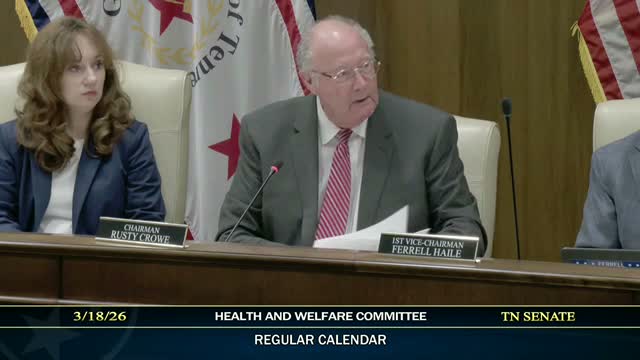
Senator Yeager told the Health and Welfare Committee that Senate Bill 2179 would permit the Opioid Abatement Council to make a one‑time advance payment to a qualifying nonprofit grantee to cover employee salaries, benefits and taxes for up to four months. He said the measure responds to smaller or newer nonprofits that lack cash flow to start programs and would still require nonprofits to be 501(c)(3) entities and to provide written documentation before receiving funds.
"Some nonprofits can't get up and running without front‑end cash," Yeager said, describing the amendment as a safety valve to help grassroots providers deliver opioid‑related services. He said the council's current policy is reimbursement and the bill would allow a limited, document‑backed exception.
Several senators pressed for safeguards. Senator Massey asked whether contracts could include clawback provisions and whether the council had helped draft the amendment; Yeager said clawbacks could be included in agreements and that the house sponsor had negotiated language. Senator Watson said he would vote against the amendment, calling it a dangerous precedent that could invite political pressure and inundate the council with requests for salary advances.
The committee debated whether the advance would be capped and how the council would police misuse; proponents said documentation and council discretion would limit risk. After discussion, the committee considered and voted on the amendment and later on the bill. Committee records show the amendment was recorded in roll calls and that the bill was advanced to the next committee (finance) for further review.
Action on the bill included a request to move it to finance; the motion was seconded and carried. The committee recorded the bill as going to finance where fiscal questions and oversight language will be examined.
"Some nonprofits can't get up and running without front‑end cash," Yeager said, describing the amendment as a safety valve to help grassroots providers deliver opioid‑related services. He said the council's current policy is reimbursement and the bill would allow a limited, document‑backed exception.
Several senators pressed for safeguards. Senator Massey asked whether contracts could include clawback provisions and whether the council had helped draft the amendment; Yeager said clawbacks could be included in agreements and that the house sponsor had negotiated language. Senator Watson said he would vote against the amendment, calling it a dangerous precedent that could invite political pressure and inundate the council with requests for salary advances.
The committee debated whether the advance would be capped and how the council would police misuse; proponents said documentation and council discretion would limit risk. After discussion, the committee considered and voted on the amendment and later on the bill. Committee records show the amendment was recorded in roll calls and that the bill was advanced to the next committee (finance) for further review.
Action on the bill included a request to move it to finance; the motion was seconded and carried. The committee recorded the bill as going to finance where fiscal questions and oversight language will be examined.
Don't Miss a Word: See the Full Meeting!
Go beyond summaries. Unlock every video, transcript, and key insight with a Founder Membership.
✓
Get instant access to full meeting videos
✓
Search and clip any phrase from complete transcripts
✓
Receive AI-powered summaries & custom alerts
✓
Enjoy lifetime, unrestricted access to government data
30-day money-back guarantee
