Senate passes bill to post founding documents and the Ten Commandments in schools after heated debate
March 19, 2026 | 2026 Legislature TN, Tennessee
This article was created by AI summarizing key points discussed. AI makes mistakes, so for full details and context, please refer to the video of the full meeting. Please report any errors so we can fix them. Report an error »
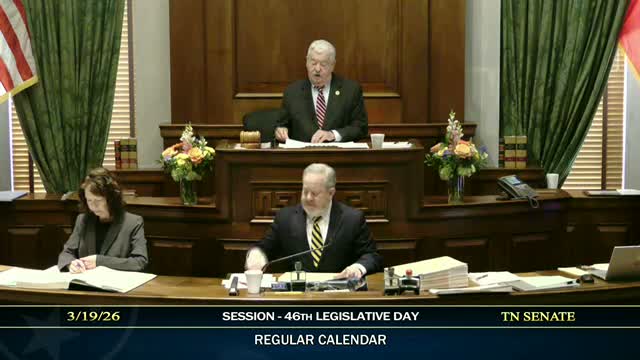
The Tennessee Senate approved House Bill 47 on third and final consideration after floor debate over an education‑committee amendment that would require local education agencies and charter schools to post three documents — a passage of the Declaration of Independence, the Preamble to the U.S. Constitution, and the Ten Commandments — in a prominent location.
Sponsor Senator Pote described the materials as “founding documents” and said the intent is historical and not prescriptive. During debate he corrected an initial reference to Genesis, noting "It is in Exodus," when asked which biblical version contained the Ten Commandments. He emphasized that the posting would be paid for by private groups and that students would not be compelled to read or adopt the content.
Opponents, including Senator Yarbrough and Senator Lamar, raised separation‑of‑church‑and‑state concerns and asked which version of the Ten Commandments would be used. Senator Lamar called the bill “religious indoctrination” if used to push specific beliefs, and noted that public schools should focus on core academic subjects.
Chairman White explained the amendment’s language and said the measure frames the documents in a historical context. After extended floor discussion, the Senate voted to adopt the bill; the recorded tally shows Ayes 27, Nays 6.
What the bill does: The adopted amendment requires posting specified historical documents (including the Ten Commandments) in a prominent location in LEAs and public charter schools. The amendment states nonprofits or other groups may provide and fund the posting; the text does not require students to read or otherwise participate.
Votes and formal action: The Senate recorded 27 Aye votes and 6 Nays on third and final consideration. The motion to reconsider was tabled.
Why it matters: The bill touches a recurring legal and constitutional question about how public institutions present religiously sourced historical materials. Legislators debated both historical context and civil‑rights implications for students of non‑Christian faiths.
Sponsor Senator Pote described the materials as “founding documents” and said the intent is historical and not prescriptive. During debate he corrected an initial reference to Genesis, noting "It is in Exodus," when asked which biblical version contained the Ten Commandments. He emphasized that the posting would be paid for by private groups and that students would not be compelled to read or adopt the content.
Opponents, including Senator Yarbrough and Senator Lamar, raised separation‑of‑church‑and‑state concerns and asked which version of the Ten Commandments would be used. Senator Lamar called the bill “religious indoctrination” if used to push specific beliefs, and noted that public schools should focus on core academic subjects.
Chairman White explained the amendment’s language and said the measure frames the documents in a historical context. After extended floor discussion, the Senate voted to adopt the bill; the recorded tally shows Ayes 27, Nays 6.
What the bill does: The adopted amendment requires posting specified historical documents (including the Ten Commandments) in a prominent location in LEAs and public charter schools. The amendment states nonprofits or other groups may provide and fund the posting; the text does not require students to read or otherwise participate.
Votes and formal action: The Senate recorded 27 Aye votes and 6 Nays on third and final consideration. The motion to reconsider was tabled.
Why it matters: The bill touches a recurring legal and constitutional question about how public institutions present religiously sourced historical materials. Legislators debated both historical context and civil‑rights implications for students of non‑Christian faiths.
Don't Miss a Word: See the Full Meeting!
Go beyond summaries. Unlock every video, transcript, and key insight with a Founder Membership.
✓
Get instant access to full meeting videos
✓
Search and clip any phrase from complete transcripts
✓
Receive AI-powered summaries & custom alerts
✓
Enjoy lifetime, unrestricted access to government data
30-day money-back guarantee
