Senate amends human‑trafficking measure, adopts section expanding mandatory hold for some obstructing arrests
March 19, 2026 | 2026 Legislature TN, Tennessee
This article was created by AI summarizing key points discussed. AI makes mistakes, so for full details and context, please refer to the video of the full meeting. Please report any errors so we can fix them. Report an error »
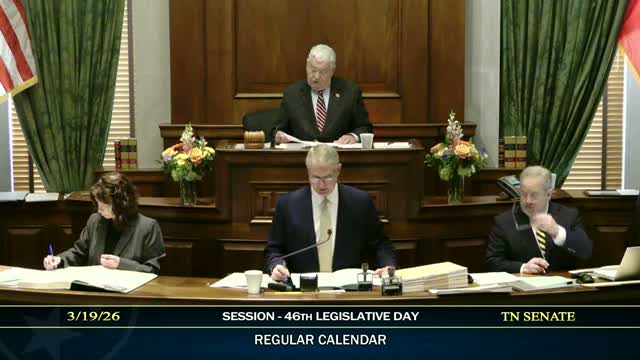
The Senate adopted an amendment to Senate Bill 12‑25 and then passed the bill as amended. The amendment contains multiple sections: several sections strengthen protections for victims of human trafficking (including a presumption that victims who use force against traffickers acted out of reasonable fear), while one section (section 4) creates a mandatory 12‑hour hold following arrest for obstructing a passageway in some circumstances.
Senator Gardner (chair of the judiciary committee) described the amendment as divisible and procedurally appropriate; the body voted on the different divisions separately. Senator Yarbrough asked to divide the question to treat section 4—the mandatory 12‑hour hold—separately because it raised distinct concerns about criminal procedure.
In floor debate, Senator Yarbrough warned the mandatory‑hold language could be abused and likened the change to a chilling effect on protests: "...you can mandate that people be held for 12 hours, and then you don't care whether you can prove it or not. That is a huge problem... a massive chilling effect on free speech." Supporters, including Senator Rose, said the provision targets people who block entrances and harm businesses and cited prior experience with similar laws.
The Senate adopted the divided section 4 by roll call (vote recorded 27–6 in favor of the division) and then passed the bill as amended on third and final consideration.
What the amendment does: It creates a legal presumption for victims of human trafficking in certain circumstances, clarifies post‑arrest processing timelines for obstruction offenses, and specifies venue/timing provisions for related changes in criminal procedure.
Votes and formal action: Division 2 (section 4) was adopted by roll call (27–6 recorded in the transcript), and the bill passed on third and final consideration after the panel votes on other sections.
Why it matters: The trafficking‑victim provisions expand affirmative defenses and procedural protections for victims; the mandatory‑hold provision affects arrest processing rules and prompted constitutional and free‑speech concerns during debate.
Senator Gardner (chair of the judiciary committee) described the amendment as divisible and procedurally appropriate; the body voted on the different divisions separately. Senator Yarbrough asked to divide the question to treat section 4—the mandatory 12‑hour hold—separately because it raised distinct concerns about criminal procedure.
In floor debate, Senator Yarbrough warned the mandatory‑hold language could be abused and likened the change to a chilling effect on protests: "...you can mandate that people be held for 12 hours, and then you don't care whether you can prove it or not. That is a huge problem... a massive chilling effect on free speech." Supporters, including Senator Rose, said the provision targets people who block entrances and harm businesses and cited prior experience with similar laws.
The Senate adopted the divided section 4 by roll call (vote recorded 27–6 in favor of the division) and then passed the bill as amended on third and final consideration.
What the amendment does: It creates a legal presumption for victims of human trafficking in certain circumstances, clarifies post‑arrest processing timelines for obstruction offenses, and specifies venue/timing provisions for related changes in criminal procedure.
Votes and formal action: Division 2 (section 4) was adopted by roll call (27–6 recorded in the transcript), and the bill passed on third and final consideration after the panel votes on other sections.
Why it matters: The trafficking‑victim provisions expand affirmative defenses and procedural protections for victims; the mandatory‑hold provision affects arrest processing rules and prompted constitutional and free‑speech concerns during debate.
View the Full Meeting & All Its Details
This article offers just a summary. Unlock complete video, transcripts, and insights as a Founder Member.
✓
Watch full, unedited meeting videos
✓
Search every word spoken in unlimited transcripts
✓
AI summaries & real-time alerts (all government levels)
✓
Permanent access to expanding government content
30-day money-back guarantee
