Director McReynolds tells council Thrive Indianapolis met targets, details universal-curbside plan and program pivots after state law
March 16, 2026 | Indianapolis City, Marion County, Indiana
This article was created by AI summarizing key points discussed. AI makes mistakes, so for full details and context, please refer to the video of the full meeting. Please report any errors so we can fix them. Report an error »
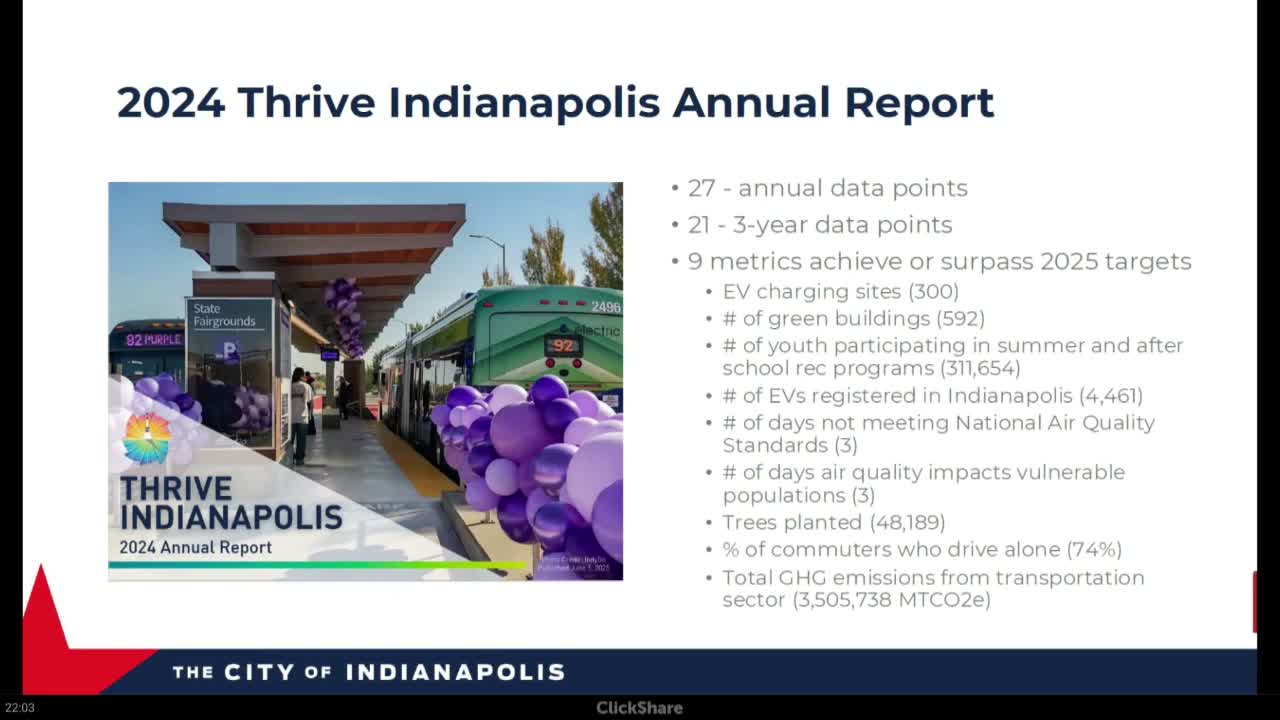
Director McReynolds of the Office of Sustainability told the committee the office completed 59 Thrive Indianapolis action items and that nine metrics exceeded their 2025 targets. The office will move to an updated, data-driven greenhouse-gas inventory and scientific target-setting process to chart progress toward the city's 2050 net-zero commitment.
McReynolds highlighted built-environment work, including a reported fivefold increase in compliance with the thriving buildings program in 2025. But he told the committee that House Bill 1150 (as spoken) removed the city's authority to make energy benchmarking mandatory, making the program voluntary. "We have a number of pivot strategies that we still think can achieve a lot of the success," McReynolds said, describing outreach, broader enrollment beyond the 50,000-square-foot threshold and new resources and incentives as planned approaches.
On waste and recycling, McReynolds said a rebid of residential solid-waste contracts will bring a new processor and hauler mix and that Waste Management has invested about $60,000,000 in a materials-recovery facility (MRF) to process recycling for the community. He said the city plans to transition all 279,000 households to universal curbside recycling by 2028 and that outreach will be a cross-department and partner effort involving the Department of Public Works, Policy and Planning, the hauler and the processor.
Councilors asked how outreach will be executed and who will lead communications. McReynolds said multiple partners will share communications duties and that national recycling advocates and local funding will be used to penetrate the market. On extreme-weather preparedness, McReynolds said city staff are coordinating internal and external partners and that climate adaptation will require continuous investment.
Members of the committee praised the office's work but flagged operational issues, including prior problems with contractor transitions and contaminated community drop-off sites. McReynolds said moving households to curbside bins reduces reliance on drop-off sites, and that contract enforcement and education are priorities for the transition.
What happens next: the Office of Sustainability will continue to develop its updated GHG inventory and pivot strategies for the thriving buildings program, coordinate outreach and partner funding for the universal curbside rollout, and work with other departments on contract enforcement and operational details.
McReynolds highlighted built-environment work, including a reported fivefold increase in compliance with the thriving buildings program in 2025. But he told the committee that House Bill 1150 (as spoken) removed the city's authority to make energy benchmarking mandatory, making the program voluntary. "We have a number of pivot strategies that we still think can achieve a lot of the success," McReynolds said, describing outreach, broader enrollment beyond the 50,000-square-foot threshold and new resources and incentives as planned approaches.
On waste and recycling, McReynolds said a rebid of residential solid-waste contracts will bring a new processor and hauler mix and that Waste Management has invested about $60,000,000 in a materials-recovery facility (MRF) to process recycling for the community. He said the city plans to transition all 279,000 households to universal curbside recycling by 2028 and that outreach will be a cross-department and partner effort involving the Department of Public Works, Policy and Planning, the hauler and the processor.
Councilors asked how outreach will be executed and who will lead communications. McReynolds said multiple partners will share communications duties and that national recycling advocates and local funding will be used to penetrate the market. On extreme-weather preparedness, McReynolds said city staff are coordinating internal and external partners and that climate adaptation will require continuous investment.
Members of the committee praised the office's work but flagged operational issues, including prior problems with contractor transitions and contaminated community drop-off sites. McReynolds said moving households to curbside bins reduces reliance on drop-off sites, and that contract enforcement and education are priorities for the transition.
What happens next: the Office of Sustainability will continue to develop its updated GHG inventory and pivot strategies for the thriving buildings program, coordinate outreach and partner funding for the universal curbside rollout, and work with other departments on contract enforcement and operational details.
Don't Miss a Word: See the Full Meeting!
Go beyond summaries. Unlock every video, transcript, and key insight with a Founder Membership.
✓
Get instant access to full meeting videos
✓
Search and clip any phrase from complete transcripts
✓
Receive AI-powered summaries & custom alerts
✓
Enjoy lifetime, unrestricted access to government data
30-day money-back guarantee
