Committee lays over bill to set $0 floor for family contribution in state grant formula
March 17, 2026 | 2026 Legislature MN, Minnesota
This article was created by AI summarizing key points discussed. AI makes mistakes, so for full details and context, please refer to the video of the full meeting. Please report any errors so we can fix them. Report an error »
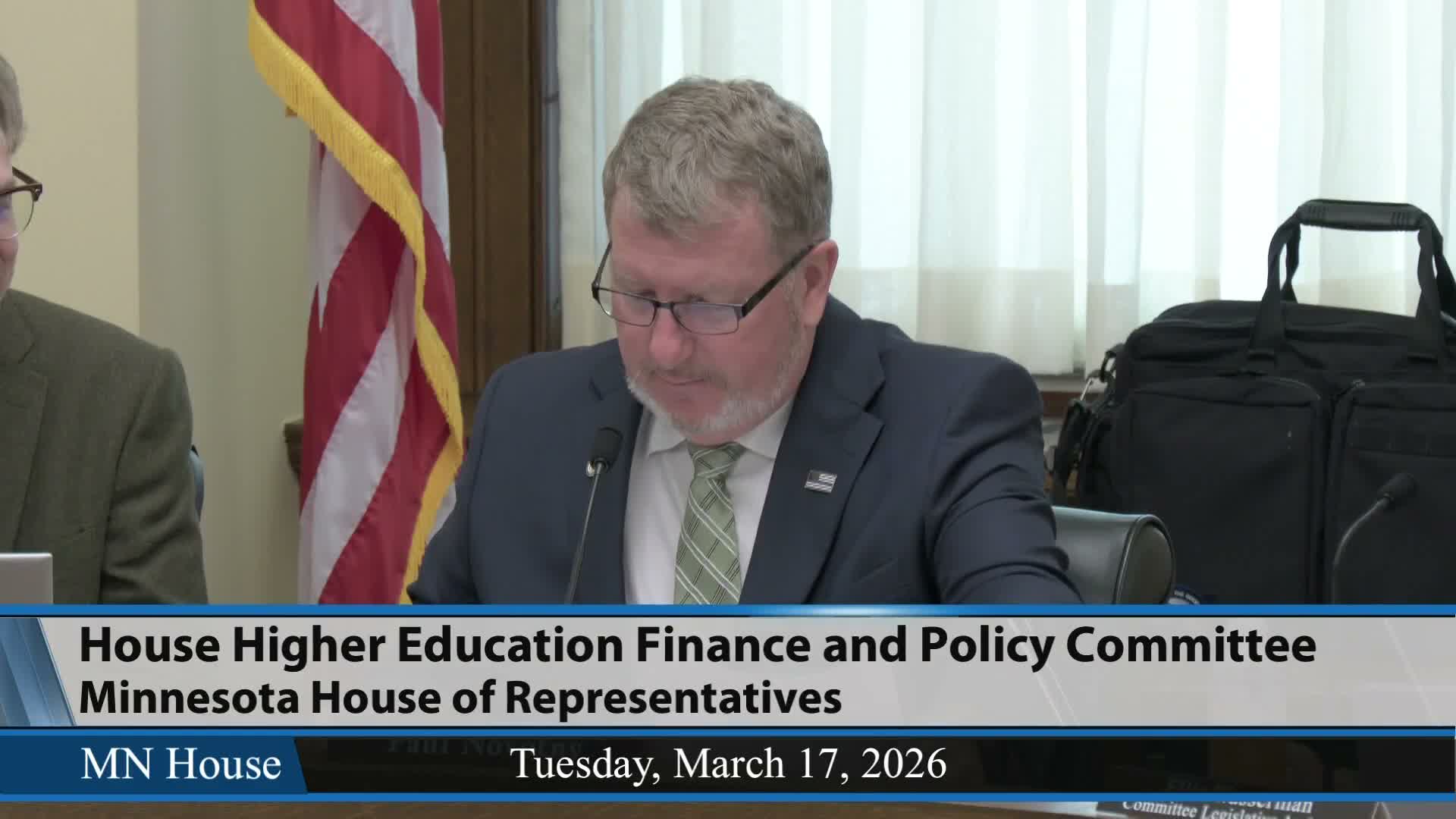
The House Committee on Higher Education Finance and Policy heard testimony on a bill that would change how Minnesota calculates family contributions in its state grant program, setting a $0 floor where the formula now allows negative values.
Representative Keith Allen, the bill’s author, told the committee the legislation “establishes a $0 floor for assigned family responsibility in the state grant formula,” explaining the change prevents the formula from treating certain calculated family contributions as negative amounts and is intended to protect the long-term stability of the state grant program. Allen said the measure does not increase the program’s appropriation but modifies how the formula treats family contributions so surplus funds can be used more flexibly when available.
Nicole Whelan, identified as “the state grant research manager with the Office of Higher Education,” said the fiscal note has been submitted and offered to answer questions about numbers in that document. Whelan told members that, “as the bill is written, the biennial reduction would be roughly $41 million, and about $36.7 million of that is in fiscal year 2027,” based on the submitted fiscal note.
Several members raised concerns about the bill’s distributional impact. Representative Noor warned the committee that “this bill goes backwards because we're not allowing [students] to be able to afford college,” arguing that the change could shift costs onto the neediest students. Representative Knorr asked directly what savings the bill aims to achieve given a reported state grant shortfall.
Other members described the structural challenge the program faces: witnesses and members cited a projected deficit in the state grant program in the low hundreds of millions (a figure of about $102 million was referenced in committee discussion). Supporters of the bill framed it as a tool to keep the grant program solvent and noted the governor’s supplemental budget included a similar recommendation.
After questions and member comment, Representative Allen closed his presentation and the chair laid House File 4266 over for further consideration; no final committee vote on the bill occurred. The committee encouraged further review of the fiscal note, consideration of alternatives to reduce student impact, and continued discussion with the Office of Higher Education and the governor’s office.
Next steps: the bill remains under committee consideration pending further analysis; the committee did not adopt the bill today and expects more fiscal and policy discussion before any vote.
Representative Keith Allen, the bill’s author, told the committee the legislation “establishes a $0 floor for assigned family responsibility in the state grant formula,” explaining the change prevents the formula from treating certain calculated family contributions as negative amounts and is intended to protect the long-term stability of the state grant program. Allen said the measure does not increase the program’s appropriation but modifies how the formula treats family contributions so surplus funds can be used more flexibly when available.
Nicole Whelan, identified as “the state grant research manager with the Office of Higher Education,” said the fiscal note has been submitted and offered to answer questions about numbers in that document. Whelan told members that, “as the bill is written, the biennial reduction would be roughly $41 million, and about $36.7 million of that is in fiscal year 2027,” based on the submitted fiscal note.
Several members raised concerns about the bill’s distributional impact. Representative Noor warned the committee that “this bill goes backwards because we're not allowing [students] to be able to afford college,” arguing that the change could shift costs onto the neediest students. Representative Knorr asked directly what savings the bill aims to achieve given a reported state grant shortfall.
Other members described the structural challenge the program faces: witnesses and members cited a projected deficit in the state grant program in the low hundreds of millions (a figure of about $102 million was referenced in committee discussion). Supporters of the bill framed it as a tool to keep the grant program solvent and noted the governor’s supplemental budget included a similar recommendation.
After questions and member comment, Representative Allen closed his presentation and the chair laid House File 4266 over for further consideration; no final committee vote on the bill occurred. The committee encouraged further review of the fiscal note, consideration of alternatives to reduce student impact, and continued discussion with the Office of Higher Education and the governor’s office.
Next steps: the bill remains under committee consideration pending further analysis; the committee did not adopt the bill today and expects more fiscal and policy discussion before any vote.
Don't Miss a Word: See the Full Meeting!
Go beyond summaries. Unlock every video, transcript, and key insight with a Founder Membership.
✓
Get instant access to full meeting videos
✓
Search and clip any phrase from complete transcripts
✓
Receive AI-powered summaries & custom alerts
✓
Enjoy lifetime, unrestricted access to government data
30-day money-back guarantee
