Sen. Mohammed’s bill to expand access to 4% low-income housing tax credits advances out of committee
March 18, 2026 | 2026 Legislature MN, Minnesota
This article was created by AI summarizing key points discussed. AI makes mistakes, so for full details and context, please refer to the video of the full meeting. Please report any errors so we can fix them. Report an error »
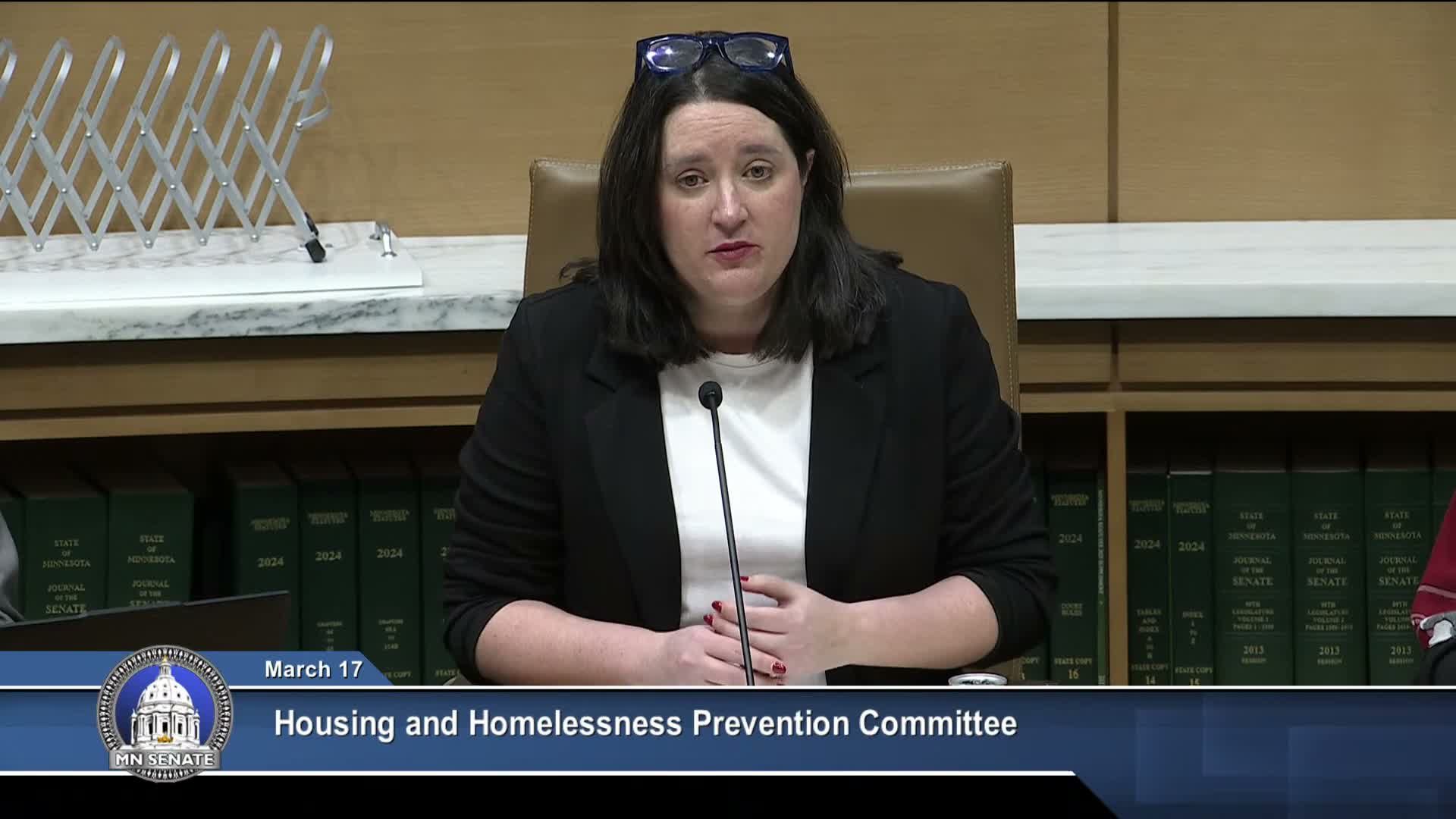
Senator Mohammed on behalf of the author presented Senate File 4400 to the Senate Committee on Homelessness Prevention and Housing, saying the proposal would “leverage public and private investments that will expand affordable housing in Minnesota.” The bill would alter the state’s aggregate bond limitation so more projects can qualify for the 4% low-income housing tax credit, a federal tax incentive tied to tax-exempt private activity bonds.
Andrea Brennan, president and CEO of the Greater Minnesota Housing Fund, testified in support and described the LIHTC as the nation’s primary tool for affordable housing production. "Over the first 40 years of the low income housing tax credit program, almost 4,000,000 units of affordable housing have been produced or preserved," she said, and she explained how federal changes in HR 1 increased 9% credits and lowered the financed-by test for 4% credits, putting pressure on state bond caps.
Mary Tingenthal, identified as a former commissioner and testifying with the Greater Minnesota Housing Fund and the Housing Stability Coalition, walked lawmakers through a $40 million example to show how 4% credits translate to equity. Using the example numbers presented, she said a project could receive about $16 million in credits over 10 years and, at a market pricing assumption of 82¢, attract roughly $13 million in investor equity; adjusting state bond rules, she said, could raise Minnesota’s annual project count from 16 to about 25 and bring more private capital into the state.
Committee members focused questions on who captures financial returns and whether institutional investors would profit from the change. Senator Gruenhagen and others asked whether banks, Fannie Mae, Freddie Mac or insurance firms typically purchase credits; Brennan answered that investors tend to be institutional and that the exchange requires rent limits. On concerns that investors would retain appreciation or large profits, testifiers and the bill author noted that tax credit investors typically exit the ownership partnership after the 15-year recapture period and that affordability restrictions generally limit long-term appreciation-driven gains.
Several senators, including Senator Lucero and Senator Abeler, raised broader policy concerns: whether shifting the allocation would prioritize institutional investors over small local builders, whether long-term maintenance funding could be compromised, and whether expected project cash flows would be sufficient to sustain upkeep. Senator Mohammed and witnesses said the bill’s goal is to make the financing tool more efficient and that tenant protections and other oversight remain separate policy levers.
After discussion, Senator Mohammed moved that SF 4400 be recommended to pass and referred to the committee on finance; the committee voice-voted approval and the bill advanced to finance.
What happens next: SF 4400 goes to the Senate Finance Committee for its fiscal review and further consideration.
Andrea Brennan, president and CEO of the Greater Minnesota Housing Fund, testified in support and described the LIHTC as the nation’s primary tool for affordable housing production. "Over the first 40 years of the low income housing tax credit program, almost 4,000,000 units of affordable housing have been produced or preserved," she said, and she explained how federal changes in HR 1 increased 9% credits and lowered the financed-by test for 4% credits, putting pressure on state bond caps.
Mary Tingenthal, identified as a former commissioner and testifying with the Greater Minnesota Housing Fund and the Housing Stability Coalition, walked lawmakers through a $40 million example to show how 4% credits translate to equity. Using the example numbers presented, she said a project could receive about $16 million in credits over 10 years and, at a market pricing assumption of 82¢, attract roughly $13 million in investor equity; adjusting state bond rules, she said, could raise Minnesota’s annual project count from 16 to about 25 and bring more private capital into the state.
Committee members focused questions on who captures financial returns and whether institutional investors would profit from the change. Senator Gruenhagen and others asked whether banks, Fannie Mae, Freddie Mac or insurance firms typically purchase credits; Brennan answered that investors tend to be institutional and that the exchange requires rent limits. On concerns that investors would retain appreciation or large profits, testifiers and the bill author noted that tax credit investors typically exit the ownership partnership after the 15-year recapture period and that affordability restrictions generally limit long-term appreciation-driven gains.
Several senators, including Senator Lucero and Senator Abeler, raised broader policy concerns: whether shifting the allocation would prioritize institutional investors over small local builders, whether long-term maintenance funding could be compromised, and whether expected project cash flows would be sufficient to sustain upkeep. Senator Mohammed and witnesses said the bill’s goal is to make the financing tool more efficient and that tenant protections and other oversight remain separate policy levers.
After discussion, Senator Mohammed moved that SF 4400 be recommended to pass and referred to the committee on finance; the committee voice-voted approval and the bill advanced to finance.
What happens next: SF 4400 goes to the Senate Finance Committee for its fiscal review and further consideration.
View the Full Meeting & All Its Details
This article offers just a summary. Unlock complete video, transcripts, and insights as a Founder Member.
✓
Watch full, unedited meeting videos
✓
Search every word spoken in unlimited transcripts
✓
AI summaries & real-time alerts (all government levels)
✓
Permanent access to expanding government content
30-day money-back guarantee
