Committee advances constitutional amendment to change Permanent School Fund distribution to 4.5% market‑value formula
March 17, 2026 | 2026 Legislature MN, Minnesota
This article was created by AI summarizing key points discussed. AI makes mistakes, so for full details and context, please refer to the video of the full meeting. Please report any errors so we can fix them. Report an error »
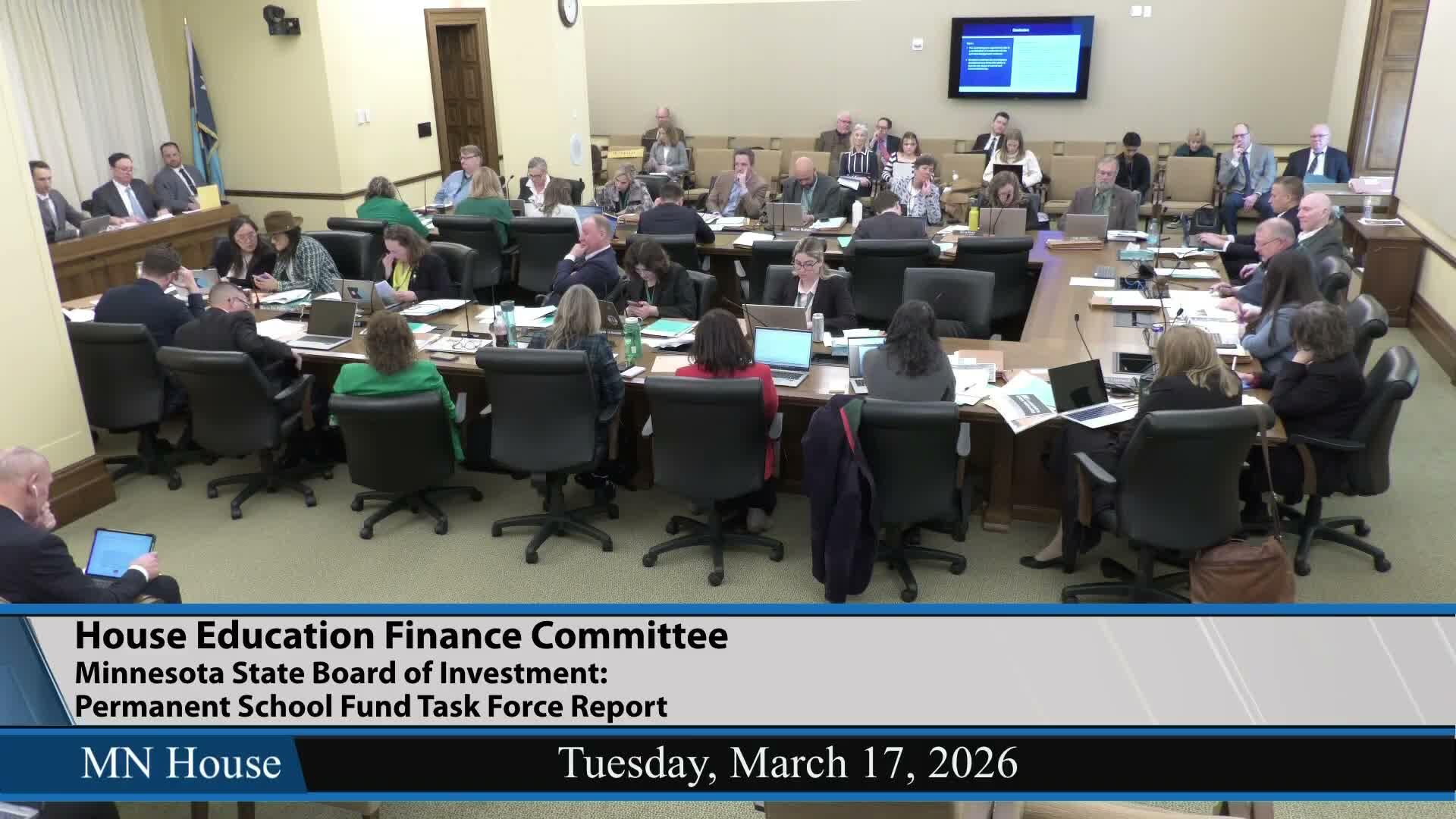
The Minnesota House Education Finance Committee advanced House File 3900 on Tuesday after hearing expert testimony recommending a shift in how the Permanent School Fund’s earnings are calculated and distributed to school districts.
Representative Igoe, the bill’s author, offered an authors’ amendment (D/E 3) that the committee adopted before the roll call. The bill would place a constitutional amendment on the 2026 general election ballot asking voters to change the state constitution so the permanent school fund would use a percent‑of‑market‑value (POMV) distribution instead of the current interest‑and‑dividends‑only rule, with distributions set at 4.5% of a three‑year rolling average of the fund’s market value and an effective date of July 1, 2027. "Shall the Minnesota constitution be amended to increase the funding going to all school districts from the permanent school fund, which is a fund that supports school districts without raising individual income or property taxes effective 07/01/2027," Representative Igoe read for the record.
State Board of Investment officials and the Permanent School Fund task force told the committee they unanimously endorse the change. Nate Blumenshine, vice president of fixed income at the SBI, summarized the task force’s modeling and said a POMV approach would more closely align the fund with common practice among large educational endowments and provide smoother, more predictable distributions. "A 4.5% distribution rate calculated using a 3‑year rolling average of fund value" was the task force’s recommendation, Blumenshine said, and SBI modeling showed that this approach can nearly double near‑term distributions while being designed to preserve long‑term purchasing power by reducing payout amounts when market values decline.
Office of School Trust Lands Director Aaron Vanderlinde provided context on the trust’s assets and revenues. He described roughly 3.5 million acres of surface holdings, about 1 million acres of severed mineral rights, and a fund value the presentation listed at about $2.3 billion. Vanderlinde said land management revenues vary year to year — last year DNR generated about $28 million in gross revenue — and that distributions to school districts have exceeded $300 million over the past decade; the presentation noted about $58 million was distributed most recently. Vanderlinde also described roughly 180,000 acres of trust lands located inside reservation boundaries and said the office is working with tribes and the Department of Natural Resources on transfers and land swaps.
Supporters from the Minnesota School Boards Association told the committee the change would provide predictable, flexible funding for districts. "Moving the interest and dividends only model to a modern POMV framework is responsible endowment management," Kirk Schneider, appearing for MSBA in the transcript, said, adding that predictability matters because districts must adopt budgets and make long‑term commitments.
Several members asked detailed questions about downside risk and the averaging period. Representative Lee raised concerns about what would happen to principal if the fund underperforms; Blumenshine responded that the POMV formula automatically reduces distributions as the fund’s market value declines and that SBI stress scenarios — including sustained negative returns — showed distributions adjust to protect long‑term value. Members also discussed why the task force selected a three‑year rolling average rather than a five‑year average; task force members and the author said three years is common in Minnesota revenue averaging and is more conservative in protecting principal because it reduces distributions sooner following a market downturn.
Members of the committee also pressed the author and testifiers on tribal consultation. Representative Lee and Representative Perez Vega emphasized the importance of government‑to‑government outreach given that some trust lands lie within reservation boundaries; Director Vanderlinde said task force records showed tribal representatives were consulted during the task force meetings and that the office plans additional work, including land transfers and a condemnation/transfer parcel referenced for Mille Lacs. Representative Igoe committed to follow up with tribal nations before the bill leaves the Rules Committee.
After testimony and discussion, Representative Hudson requested a roll call. The committee recorded 21 ayes and 3 nays on the motion to re‑refer House File 3900, as amended, to the Rules Committee. The chair closed the meeting and set the committee’s next meeting for March 24, 2026.
What’s next: Because the bill was re‑referred to the Rules Committee, the proposed constitutional amendment would need to clear further procedural steps and, if approved for the ballot, attract voter approval in November 2026 before the change would take effect on July 1, 2027.
Representative Igoe, the bill’s author, offered an authors’ amendment (D/E 3) that the committee adopted before the roll call. The bill would place a constitutional amendment on the 2026 general election ballot asking voters to change the state constitution so the permanent school fund would use a percent‑of‑market‑value (POMV) distribution instead of the current interest‑and‑dividends‑only rule, with distributions set at 4.5% of a three‑year rolling average of the fund’s market value and an effective date of July 1, 2027. "Shall the Minnesota constitution be amended to increase the funding going to all school districts from the permanent school fund, which is a fund that supports school districts without raising individual income or property taxes effective 07/01/2027," Representative Igoe read for the record.
State Board of Investment officials and the Permanent School Fund task force told the committee they unanimously endorse the change. Nate Blumenshine, vice president of fixed income at the SBI, summarized the task force’s modeling and said a POMV approach would more closely align the fund with common practice among large educational endowments and provide smoother, more predictable distributions. "A 4.5% distribution rate calculated using a 3‑year rolling average of fund value" was the task force’s recommendation, Blumenshine said, and SBI modeling showed that this approach can nearly double near‑term distributions while being designed to preserve long‑term purchasing power by reducing payout amounts when market values decline.
Office of School Trust Lands Director Aaron Vanderlinde provided context on the trust’s assets and revenues. He described roughly 3.5 million acres of surface holdings, about 1 million acres of severed mineral rights, and a fund value the presentation listed at about $2.3 billion. Vanderlinde said land management revenues vary year to year — last year DNR generated about $28 million in gross revenue — and that distributions to school districts have exceeded $300 million over the past decade; the presentation noted about $58 million was distributed most recently. Vanderlinde also described roughly 180,000 acres of trust lands located inside reservation boundaries and said the office is working with tribes and the Department of Natural Resources on transfers and land swaps.
Supporters from the Minnesota School Boards Association told the committee the change would provide predictable, flexible funding for districts. "Moving the interest and dividends only model to a modern POMV framework is responsible endowment management," Kirk Schneider, appearing for MSBA in the transcript, said, adding that predictability matters because districts must adopt budgets and make long‑term commitments.
Several members asked detailed questions about downside risk and the averaging period. Representative Lee raised concerns about what would happen to principal if the fund underperforms; Blumenshine responded that the POMV formula automatically reduces distributions as the fund’s market value declines and that SBI stress scenarios — including sustained negative returns — showed distributions adjust to protect long‑term value. Members also discussed why the task force selected a three‑year rolling average rather than a five‑year average; task force members and the author said three years is common in Minnesota revenue averaging and is more conservative in protecting principal because it reduces distributions sooner following a market downturn.
Members of the committee also pressed the author and testifiers on tribal consultation. Representative Lee and Representative Perez Vega emphasized the importance of government‑to‑government outreach given that some trust lands lie within reservation boundaries; Director Vanderlinde said task force records showed tribal representatives were consulted during the task force meetings and that the office plans additional work, including land transfers and a condemnation/transfer parcel referenced for Mille Lacs. Representative Igoe committed to follow up with tribal nations before the bill leaves the Rules Committee.
After testimony and discussion, Representative Hudson requested a roll call. The committee recorded 21 ayes and 3 nays on the motion to re‑refer House File 3900, as amended, to the Rules Committee. The chair closed the meeting and set the committee’s next meeting for March 24, 2026.
What’s next: Because the bill was re‑referred to the Rules Committee, the proposed constitutional amendment would need to clear further procedural steps and, if approved for the ballot, attract voter approval in November 2026 before the change would take effect on July 1, 2027.
View the Full Meeting & All Its Details
This article offers just a summary. Unlock complete video, transcripts, and insights as a Founder Member.
✓
Watch full, unedited meeting videos
✓
Search every word spoken in unlimited transcripts
✓
AI summaries & real-time alerts (all government levels)
✓
Permanent access to expanding government content
30-day money-back guarantee
