Lawmakers hear urgent appeals to shore up Hennepin Healthcare and North Memorial as uncompensated care rises
March 18, 2026 | 2026 Legislature MN, Minnesota
This article was created by AI summarizing key points discussed. AI makes mistakes, so for full details and context, please refer to the video of the full meeting. Please report any errors so we can fix them. Report an error »
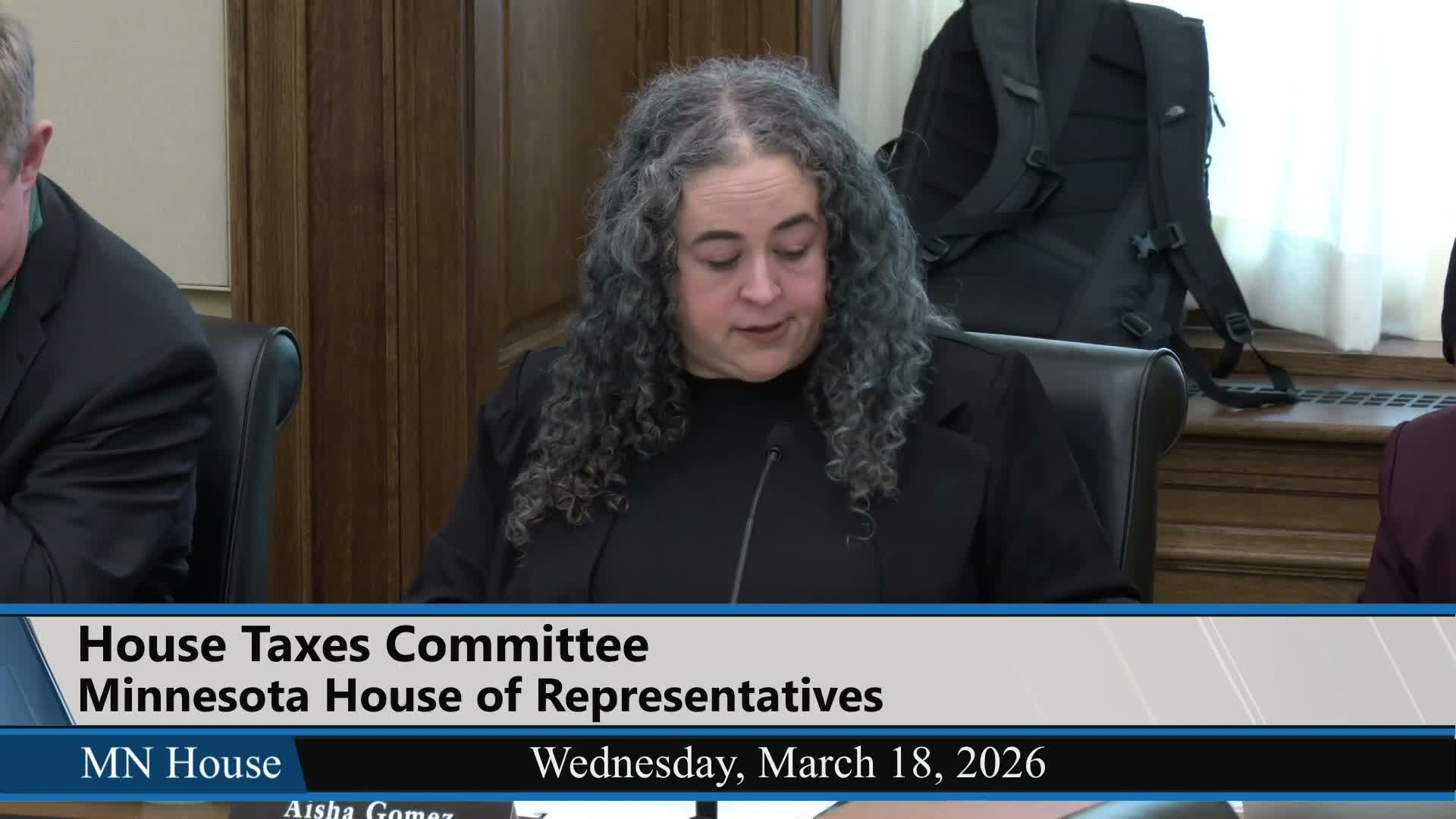
Members of the Minnesota House Tax Committee heard urgent testimony March 18 about mounting financial strain at Hennepin Healthcare (HCMC) and North Memorial, a pair of metro level‑1 trauma centers whose leaders and state data show sharply rising uncompensated care and precarious cash reserves.
The hearing opened with a presentation from the Minnesota Department of Health’s state health economist, Stefan Gildomasa, who said hospitals statewide reported about $444,000,000 in uncompensated care for 2024 and that Hennepin Healthcare’s cost‑based uncompensated care rose to roughly $90,400,000 in 2024 — about a 40% increase from 2023. "Uncompensated care has been rising, and it amounts to a substantial volume of spending," Gildomasa told the committee, noting data lags and cross‑hospital variation.
Those statewide figures framed testimony from the Minnesota Hospital Association and Hennepin County officials. Michelle Benson, speaking for the Minnesota Hospital Association, described Hennepin as a statewide resource that operates the busiest emergency department in Minnesota with more than 100,000 visits a year and a patient mix she said is roughly 75% publicly insured or uninsured. "Preserving the strength and stability of Hennepin Healthcare is not simply a local concern. It is a matter of statewide health security," Benson said.
Hennepin County Commissioner Angela Conley outlined the system’s finances and short‑term actions. She told lawmakers the system has seen uncompensated care grow from about $40,000,000 in 2020 to $104,000,000 in 2024 and that the county currently levies about $38,000,000 a year in property taxes to mitigate those costs. Conley said the system needs to identify roughly $50,000,000 in savings this quarter and faces a projected $1,700,000,000 loss over the next decade tied primarily to lost directed payments and higher uncompensated care under recent federal policy changes referenced in testimony as "HR 1." "The county will not be able to make up those gaps through property taxes," Conley warned.
Clinicians and administrators detailed operational impacts. Dr. Nate Scott, vice president for hospital and acute care at Hennepin Healthcare, said the system has paused some transfers and temporarily reduced about 100 beds to stabilize staffing: "As I had mentioned before, we have stopped accepting some transfers around the state in parallel with that bed reduction," he said. Abdulman Abdi, Hennepin Healthcare’s chief financial officer, said the system has frozen wage increases, cut programs, halted capital projects and is projecting a $40–$50,000,000 operating loss for 2026.
North Memorial leaders described parallel pressures. North reported roughly $70,000,000 of charity care and bad debt in 2024 (IRS 990 view) and said when underpayment by public programs is included the shortfall approaches $250,000,000. The system said Robbinsdale Hospital lost $50,000,000 in 2025 and the broader system lost about $30,000,000. North’s CEO said the system has begun seeking a strategic partner because it lacks the scale to sustain ongoing losses.
Committee members pressed for more granular data. MDH said it can provide hospital‑level and time‑series data and agreed to follow up; members also asked Hennepin County for a formal resolution laying out its financial perspective. Lawmakers questioned the roles of UCare’s dissolution and changes in Medicaid and subsidy rules (referred to in testimony as HR 1) in the recent cash‑flow shocks; hospital witnesses said UCare’s collapse removed a major payer and left the hospitals temporarily short of tens of millions of dollars in receivables.
No formal legislative action was taken at the hearing. Several members framed next steps as a package of possible measures to stabilize the metro safety‑net — from state revenue measures and directed payments to county and system‑level supports — and asked staff and witnesses for additional analyses. The committee adjourned after requesting a county resolution and hospital‑level follow‑up data.
What happens next: the committee did not vote on any bills at the March 18 session; members asked staff to return hospital‑level MDH data and requested Hennepin County produce a formal resolution laying out its perspective and needs.
The hearing opened with a presentation from the Minnesota Department of Health’s state health economist, Stefan Gildomasa, who said hospitals statewide reported about $444,000,000 in uncompensated care for 2024 and that Hennepin Healthcare’s cost‑based uncompensated care rose to roughly $90,400,000 in 2024 — about a 40% increase from 2023. "Uncompensated care has been rising, and it amounts to a substantial volume of spending," Gildomasa told the committee, noting data lags and cross‑hospital variation.
Those statewide figures framed testimony from the Minnesota Hospital Association and Hennepin County officials. Michelle Benson, speaking for the Minnesota Hospital Association, described Hennepin as a statewide resource that operates the busiest emergency department in Minnesota with more than 100,000 visits a year and a patient mix she said is roughly 75% publicly insured or uninsured. "Preserving the strength and stability of Hennepin Healthcare is not simply a local concern. It is a matter of statewide health security," Benson said.
Hennepin County Commissioner Angela Conley outlined the system’s finances and short‑term actions. She told lawmakers the system has seen uncompensated care grow from about $40,000,000 in 2020 to $104,000,000 in 2024 and that the county currently levies about $38,000,000 a year in property taxes to mitigate those costs. Conley said the system needs to identify roughly $50,000,000 in savings this quarter and faces a projected $1,700,000,000 loss over the next decade tied primarily to lost directed payments and higher uncompensated care under recent federal policy changes referenced in testimony as "HR 1." "The county will not be able to make up those gaps through property taxes," Conley warned.
Clinicians and administrators detailed operational impacts. Dr. Nate Scott, vice president for hospital and acute care at Hennepin Healthcare, said the system has paused some transfers and temporarily reduced about 100 beds to stabilize staffing: "As I had mentioned before, we have stopped accepting some transfers around the state in parallel with that bed reduction," he said. Abdulman Abdi, Hennepin Healthcare’s chief financial officer, said the system has frozen wage increases, cut programs, halted capital projects and is projecting a $40–$50,000,000 operating loss for 2026.
North Memorial leaders described parallel pressures. North reported roughly $70,000,000 of charity care and bad debt in 2024 (IRS 990 view) and said when underpayment by public programs is included the shortfall approaches $250,000,000. The system said Robbinsdale Hospital lost $50,000,000 in 2025 and the broader system lost about $30,000,000. North’s CEO said the system has begun seeking a strategic partner because it lacks the scale to sustain ongoing losses.
Committee members pressed for more granular data. MDH said it can provide hospital‑level and time‑series data and agreed to follow up; members also asked Hennepin County for a formal resolution laying out its financial perspective. Lawmakers questioned the roles of UCare’s dissolution and changes in Medicaid and subsidy rules (referred to in testimony as HR 1) in the recent cash‑flow shocks; hospital witnesses said UCare’s collapse removed a major payer and left the hospitals temporarily short of tens of millions of dollars in receivables.
No formal legislative action was taken at the hearing. Several members framed next steps as a package of possible measures to stabilize the metro safety‑net — from state revenue measures and directed payments to county and system‑level supports — and asked staff and witnesses for additional analyses. The committee adjourned after requesting a county resolution and hospital‑level follow‑up data.
What happens next: the committee did not vote on any bills at the March 18 session; members asked staff to return hospital‑level MDH data and requested Hennepin County produce a formal resolution laying out its perspective and needs.
View the Full Meeting & All Its Details
This article offers just a summary. Unlock complete video, transcripts, and insights as a Founder Member.
✓
Watch full, unedited meeting videos
✓
Search every word spoken in unlimited transcripts
✓
AI summaries & real-time alerts (all government levels)
✓
Permanent access to expanding government content
30-day money-back guarantee
