Billings council scraps duplex allowance in work‑session vote, declines one housing incentive
March 17, 2026 | Billings, Yellowstone, Montana
This article was created by AI summarizing key points discussed. AI makes mistakes, so for full details and context, please refer to the video of the full meeting. Please report any errors so we can fix them. Report an error »
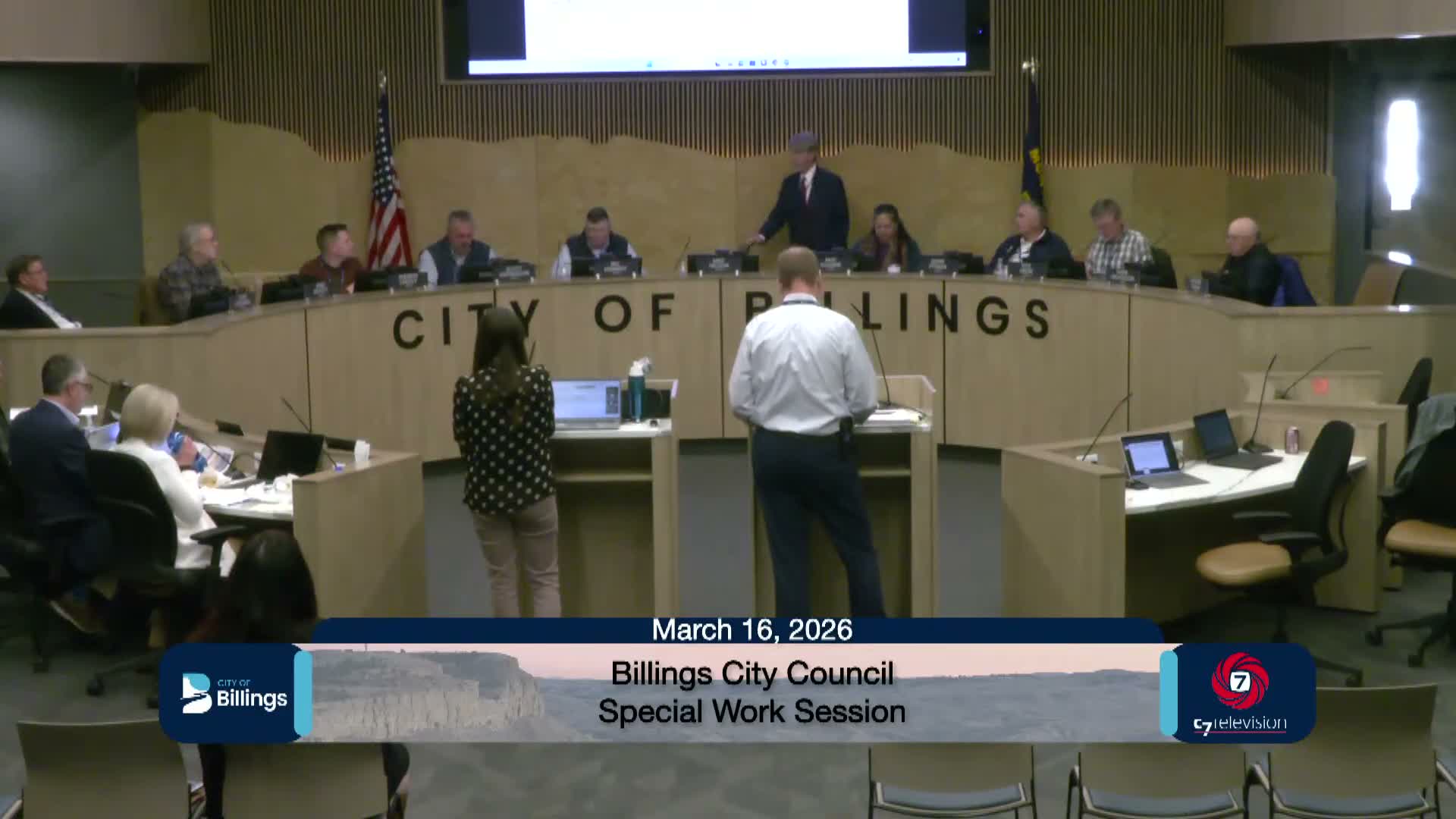
The Billings City Council held a special work session to review proposed zoning incentives and the draft Billings2045 land‑use map, then voted in a work‑session voice vote to remove a previously discussed allowance that would have permitted duplexes on lots now restricted to single‑family houses.
Staff had presented a packet of housing incentives and zoning options — labeled A through N — that the council had discussed at prior meetings. Item N would have permitted higher‑density multiunit dwellings in places where only single‑unit dwellings are currently allowed, effectively skipping the duplex→triplex→fourplex progression on some lots. Several council members objected, saying the change would eliminate predictable transitions in neighborhood density and risk conflict with adjacent properties.
The council took a motion from Council member Pippen to reconsider the prior recommendation and not adopt the duplex allowance. The mayor announced the result of the advisory work‑session vote as passing, recorded verbally as six in favor and four opposed. Following the vote, staff said they will remove that allowance from the published checklist and incorporate the direction into the draft materials that will return to council.
Why this matters: the decision narrows one proposed tool intended to increase housing types on existing parcels; staff repeatedly told the council some of the incentives are already implemented in parts of the city while others would require policy changes or further refinement in the infill policy work. City staff stressed they will consult legal counsel before declaring compliance with related state law items when the city submits its May compliance package.
Council members stressed the importance of predictability for both neighbors and developers in residential areas and asked staff to focus on other infill incentives and design options that would not remove incremental density steps. The council also directed staff to return with clarified map categories and to reflect the vote in the next draft of the Billings2045 materials.
The work session is advisory; any formal code changes will require future public hearings and formal votes.
Staff had presented a packet of housing incentives and zoning options — labeled A through N — that the council had discussed at prior meetings. Item N would have permitted higher‑density multiunit dwellings in places where only single‑unit dwellings are currently allowed, effectively skipping the duplex→triplex→fourplex progression on some lots. Several council members objected, saying the change would eliminate predictable transitions in neighborhood density and risk conflict with adjacent properties.
The council took a motion from Council member Pippen to reconsider the prior recommendation and not adopt the duplex allowance. The mayor announced the result of the advisory work‑session vote as passing, recorded verbally as six in favor and four opposed. Following the vote, staff said they will remove that allowance from the published checklist and incorporate the direction into the draft materials that will return to council.
Why this matters: the decision narrows one proposed tool intended to increase housing types on existing parcels; staff repeatedly told the council some of the incentives are already implemented in parts of the city while others would require policy changes or further refinement in the infill policy work. City staff stressed they will consult legal counsel before declaring compliance with related state law items when the city submits its May compliance package.
Council members stressed the importance of predictability for both neighbors and developers in residential areas and asked staff to focus on other infill incentives and design options that would not remove incremental density steps. The council also directed staff to return with clarified map categories and to reflect the vote in the next draft of the Billings2045 materials.
The work session is advisory; any formal code changes will require future public hearings and formal votes.
Don't Miss a Word: See the Full Meeting!
Go beyond summaries. Unlock every video, transcript, and key insight with a Founder Membership.
✓
Get instant access to full meeting videos
✓
Search and clip any phrase from complete transcripts
✓
Receive AI-powered summaries & custom alerts
✓
Enjoy lifetime, unrestricted access to government data
30-day money-back guarantee
