Mayor Farrell unveils $87 million FY27 budget, warns of big long‑term liabilities and leans on grants for water projects
March 07, 2026 | Huntington, Cabell County, West Virginia
This article was created by AI summarizing key points discussed. AI makes mistakes, so for full details and context, please refer to the video of the full meeting. Please report any errors so we can fix them. Report an error »
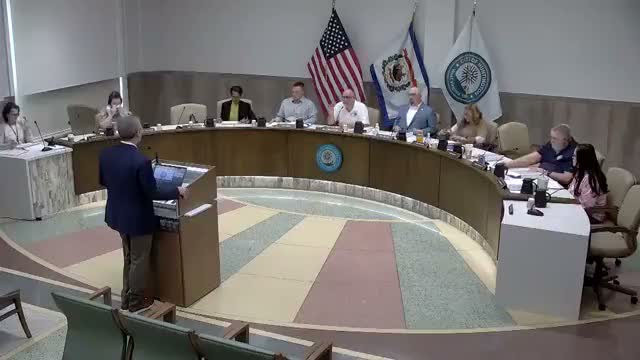
Mayor Farrell presented the Huntington City Council with a proposed FY27 budget he called "a balance and disciplined budget about $87,000,000 with conservative revenue estimates," saying the plan focuses on three priorities: public safety, building infrastructure and growing the economy.
The mayor told the council the increase from last year’s $78 million budget is driven mainly by grant pass‑throughs, including funds routed through the Water Quality Board and EPA SRF programs, and he emphasized a conservative approach to forecasting. "A budget is simply our best idea of what might happen next year as far as collections of tax revenues," Farrell said.
Why it matters: the plan preserves services while trying to build financial resiliency, but the administration faces large, existing obligations that constrain flexibility. Farrell outlined nearly $200 million in combined long‑term liabilities for a closed pension plan (~$100,000,000) and other post‑employment benefits (~$92,000,000), plus an estimated $30,000,000 environmental liability to cap the Deetz (Deeds/Deetz) Hollow landfill. Separately, the Water Quality Board’s wastewater program represents roughly $260,000,000 in bonded work that is outside the general fund but remains a citywide obligation.
The mayor highlighted the administration’s efforts on three program areas:
• Public safety: continued support for the Huntington Homeless Services Hub (now a 501(c)(3)) and investments in HPD and fire, including requests for vehicles, training funds, a polygraph examiner and equipment. "We’re gonna add a polygraph examiner, for some and some training funds for the HPD. They also need vehicles. They need drones," Farrell said.
• Infrastructure and flood mitigation: the budget accounts for state‑funded bridge work (Enslow Park, Fort Polk Creek), ongoing sewer‑separation work in Highline, and major wastewater construction. Farrell noted a roughly $52,000,000 contract to address two pump stations (13th Street West and 4th Street) that he said is moving through the procurement process.
• Housing and economic development: the Live Huntington initiative aims to return vacant and boarded properties to productive use, coordinate with HADCO, and support projects tied to Marshall University’s planned medical school. Farrell said the city cannot force private businesses to locate in redevelopments but must create conditions for investment.
Council questions and clarifications
Council members pressed the mayor on several specifics during a detailed Q&A. On the Deetz Hollow landfill, Farrell said some money is set aside but not the full $30 million; acceptance into the state’s Landfill Closure Assistance Program will require repaying past tipping fees and could take years for closure work to begin. "It may take up to 10 years," he told the council.
On the sanitation enterprise fund, Farrell confirmed the general fund will contribute $400,000 annually to cover the shortfall between collection costs and user fees rather than raising resident rates immediately. On the council’s repeated request for clearer, outcome‑focused reporting, he said the administration will publish a public‑safety dashboard and offered the unassigned fund balance as a resiliency metric (he estimates an unassigned fund balance of about $10,000,000 against a GFOA two‑month benchmark of $11,500,000).
Points of note and council priorities
• Insurance and benefits: Farrell said the city moved health insurance from a single central bucket into department budgets and that actual health costs may exceed $13,000,000 this year, prompting a healthcare task force to seek cost‑control steps.
• Flood mitigation scale: the mayor tallied roughly $300,000,000 or more in combined water‑infrastructure investments when including bonds, federal appropriations and pump‑station work directed at flooding and stormwater.
• Community contributions and microgrants: council members urged more direct support for nonprofits and microgrants to build trust in neighborhoods. The mayor reiterated a higher bar for taxpayer dollars to private charities but said contribution requests can be submitted and considered as revenues allow.
What’s next
No final votes on the FY27 budget were recorded in this session. Council members continued detailed questioning and requested printed slides and additional data; the meeting transitioned to a recess and then to a subsequent public hearing/work session. Farrell said he would work with council on any budget revisions that materialize if actual revenues come in higher than the conservative estimates in the proposed plan.
(Reporting from the Huntington City Council budget presentation. Quotes and attributions are drawn from the council transcript.)
The mayor told the council the increase from last year’s $78 million budget is driven mainly by grant pass‑throughs, including funds routed through the Water Quality Board and EPA SRF programs, and he emphasized a conservative approach to forecasting. "A budget is simply our best idea of what might happen next year as far as collections of tax revenues," Farrell said.
Why it matters: the plan preserves services while trying to build financial resiliency, but the administration faces large, existing obligations that constrain flexibility. Farrell outlined nearly $200 million in combined long‑term liabilities for a closed pension plan (~$100,000,000) and other post‑employment benefits (~$92,000,000), plus an estimated $30,000,000 environmental liability to cap the Deetz (Deeds/Deetz) Hollow landfill. Separately, the Water Quality Board’s wastewater program represents roughly $260,000,000 in bonded work that is outside the general fund but remains a citywide obligation.
The mayor highlighted the administration’s efforts on three program areas:
• Public safety: continued support for the Huntington Homeless Services Hub (now a 501(c)(3)) and investments in HPD and fire, including requests for vehicles, training funds, a polygraph examiner and equipment. "We’re gonna add a polygraph examiner, for some and some training funds for the HPD. They also need vehicles. They need drones," Farrell said.
• Infrastructure and flood mitigation: the budget accounts for state‑funded bridge work (Enslow Park, Fort Polk Creek), ongoing sewer‑separation work in Highline, and major wastewater construction. Farrell noted a roughly $52,000,000 contract to address two pump stations (13th Street West and 4th Street) that he said is moving through the procurement process.
• Housing and economic development: the Live Huntington initiative aims to return vacant and boarded properties to productive use, coordinate with HADCO, and support projects tied to Marshall University’s planned medical school. Farrell said the city cannot force private businesses to locate in redevelopments but must create conditions for investment.
Council questions and clarifications
Council members pressed the mayor on several specifics during a detailed Q&A. On the Deetz Hollow landfill, Farrell said some money is set aside but not the full $30 million; acceptance into the state’s Landfill Closure Assistance Program will require repaying past tipping fees and could take years for closure work to begin. "It may take up to 10 years," he told the council.
On the sanitation enterprise fund, Farrell confirmed the general fund will contribute $400,000 annually to cover the shortfall between collection costs and user fees rather than raising resident rates immediately. On the council’s repeated request for clearer, outcome‑focused reporting, he said the administration will publish a public‑safety dashboard and offered the unassigned fund balance as a resiliency metric (he estimates an unassigned fund balance of about $10,000,000 against a GFOA two‑month benchmark of $11,500,000).
Points of note and council priorities
• Insurance and benefits: Farrell said the city moved health insurance from a single central bucket into department budgets and that actual health costs may exceed $13,000,000 this year, prompting a healthcare task force to seek cost‑control steps.
• Flood mitigation scale: the mayor tallied roughly $300,000,000 or more in combined water‑infrastructure investments when including bonds, federal appropriations and pump‑station work directed at flooding and stormwater.
• Community contributions and microgrants: council members urged more direct support for nonprofits and microgrants to build trust in neighborhoods. The mayor reiterated a higher bar for taxpayer dollars to private charities but said contribution requests can be submitted and considered as revenues allow.
What’s next
No final votes on the FY27 budget were recorded in this session. Council members continued detailed questioning and requested printed slides and additional data; the meeting transitioned to a recess and then to a subsequent public hearing/work session. Farrell said he would work with council on any budget revisions that materialize if actual revenues come in higher than the conservative estimates in the proposed plan.
(Reporting from the Huntington City Council budget presentation. Quotes and attributions are drawn from the council transcript.)
Don't Miss a Word: See the Full Meeting!
Go beyond summaries. Unlock every video, transcript, and key insight with a Founder Membership.
✓
Get instant access to full meeting videos
✓
Search and clip any phrase from complete transcripts
✓
Receive AI-powered summaries & custom alerts
✓
Enjoy lifetime, unrestricted access to government data
30-day money-back guarantee
