Early childhood committee hears DESE update on childcare access, funding and market‑rate study
March 19, 2026 | 2026 Legislature AR, Arkansas
This article was created by AI summarizing key points discussed. AI makes mistakes, so for full details and context, please refer to the video of the full meeting. Please report any errors so we can fix them. Report an error »
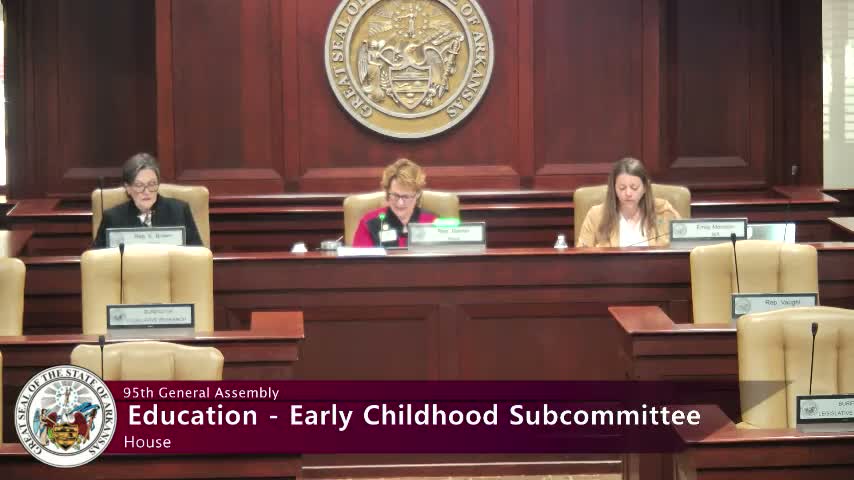
The House early childhood committee met for a briefing from Department of Education officials about childcare access, program funding and an upcoming market‑rate study aimed at informing reimbursement levels.
The committee chair opened the session by citing recent reports that, the chair said, describe a statewide childcare crisis and significant economic losses tied to lack of care; the chair urged the panel to stay informed about access, affordability and workforce issues.
Ashlyn Abney, education division director in the Office of Early Childhood, summarized her office’s responsibilities under the LEARNDS Act to improve kindergarten readiness, expand affordable seats and support families and providers. "We pulled down $127,000,000 from that grant," Abney said, referring to federal CCDF funds the state has drawn to support School Readiness Assistance (SRA).
Abney and Stacy Smith (DESE) gave program-level counts: SRA serves roughly 14,600 children and the office is tracking about 3,000 children on the SRA wait list; the state-funded Arkansas Better Chance (ABC) program serves about 21,000 children (roughly 19,800 in center‑based ABC and about 3,000 through related home‑visiting supports). Staff told the committee they obtained State Board approval to increase ABC capacity to 24,000 slots to preserve continuity of care after operational shifts.
On how reimbursements are set, staff explained SRA rates are tied to a federal market‑rate survey and currently are set at about 75% of that market estimate. "For preschool it's around $32," Abney said, adding that market prices vary by region and that an example rate in northwest Arkansas is roughly $46.35 for comparable care.
Members pressed DESE about the difference between a market‑rate survey and a cost analysis. Abney said the market‑rate survey uses provider‑reported tuition data, while a cost analysis models the true expense of running high‑quality programs. DESE said it is issuing an RFP to procure both studies, expects the work to start by August and hopes to have substantive findings by December.
Committee members raised concerns about rural access and provider deserts. DESE said its network of roughly 26 local leads conducts child counts and needs assessments across catchment areas and will provide county‑level information to the committee. "We will look at the allocation of ABC seats and prioritize counties with lower participation," Abney said.
Members also asked about communication with families and providers. Abney said DESE holds monthly provider calls (first Tuesday at noon), posts materials on its website and relies on local leads for outreach; staff said they will prepare a one‑page contact sheet for legislators to share locally.
On program changes and eligibility, DESE staff said the department revised work‑requirement policy and that the office can attempt to quantify effects on families and workforce, including which centers closed or opened. The department said it will try to provide spreadsheets showing centers that have closed and data on renewals and family exits where available.
Staff discussed workforce pressures and pay disparities: ABC requires certified teachers and carries program requirements that can increase operating costs, but per‑child ABC allocations are often lower than SRA reimbursement levels; private‑sector centers often pay lower wages than school‑district programs, contributing to staffing shortages.
The committee approved the Feb. 17 minutes by voice vote early in the session. No legislative motions or votes on policy or appropriations were held; DESE staff said the meeting's immediate priorities are completing the market‑rate and cost analyses and returning with county‑level counts and program‑impact data.
The committee closed after members and staff agreed to continue these monthly briefings and to supply additional data requested by the members.
The committee chair opened the session by citing recent reports that, the chair said, describe a statewide childcare crisis and significant economic losses tied to lack of care; the chair urged the panel to stay informed about access, affordability and workforce issues.
Ashlyn Abney, education division director in the Office of Early Childhood, summarized her office’s responsibilities under the LEARNDS Act to improve kindergarten readiness, expand affordable seats and support families and providers. "We pulled down $127,000,000 from that grant," Abney said, referring to federal CCDF funds the state has drawn to support School Readiness Assistance (SRA).
Abney and Stacy Smith (DESE) gave program-level counts: SRA serves roughly 14,600 children and the office is tracking about 3,000 children on the SRA wait list; the state-funded Arkansas Better Chance (ABC) program serves about 21,000 children (roughly 19,800 in center‑based ABC and about 3,000 through related home‑visiting supports). Staff told the committee they obtained State Board approval to increase ABC capacity to 24,000 slots to preserve continuity of care after operational shifts.
On how reimbursements are set, staff explained SRA rates are tied to a federal market‑rate survey and currently are set at about 75% of that market estimate. "For preschool it's around $32," Abney said, adding that market prices vary by region and that an example rate in northwest Arkansas is roughly $46.35 for comparable care.
Members pressed DESE about the difference between a market‑rate survey and a cost analysis. Abney said the market‑rate survey uses provider‑reported tuition data, while a cost analysis models the true expense of running high‑quality programs. DESE said it is issuing an RFP to procure both studies, expects the work to start by August and hopes to have substantive findings by December.
Committee members raised concerns about rural access and provider deserts. DESE said its network of roughly 26 local leads conducts child counts and needs assessments across catchment areas and will provide county‑level information to the committee. "We will look at the allocation of ABC seats and prioritize counties with lower participation," Abney said.
Members also asked about communication with families and providers. Abney said DESE holds monthly provider calls (first Tuesday at noon), posts materials on its website and relies on local leads for outreach; staff said they will prepare a one‑page contact sheet for legislators to share locally.
On program changes and eligibility, DESE staff said the department revised work‑requirement policy and that the office can attempt to quantify effects on families and workforce, including which centers closed or opened. The department said it will try to provide spreadsheets showing centers that have closed and data on renewals and family exits where available.
Staff discussed workforce pressures and pay disparities: ABC requires certified teachers and carries program requirements that can increase operating costs, but per‑child ABC allocations are often lower than SRA reimbursement levels; private‑sector centers often pay lower wages than school‑district programs, contributing to staffing shortages.
The committee approved the Feb. 17 minutes by voice vote early in the session. No legislative motions or votes on policy or appropriations were held; DESE staff said the meeting's immediate priorities are completing the market‑rate and cost analyses and returning with county‑level counts and program‑impact data.
The committee closed after members and staff agreed to continue these monthly briefings and to supply additional data requested by the members.
Don't Miss a Word: See the Full Meeting!
Go beyond summaries. Unlock every video, transcript, and key insight with a Founder Membership.
✓
Get instant access to full meeting videos
✓
Search and clip any phrase from complete transcripts
✓
Receive AI-powered summaries & custom alerts
✓
Enjoy lifetime, unrestricted access to government data
30-day money-back guarantee
