Housing agency urges Legislature to maintain housing incentive fund as demand far exceeds awards
March 18, 2026 | 2026 Legislature ND, North Dakota
This article was created by AI summarizing key points discussed. AI makes mistakes, so for full details and context, please refer to the video of the full meeting. Please report any errors so we can fix them. Report an error »
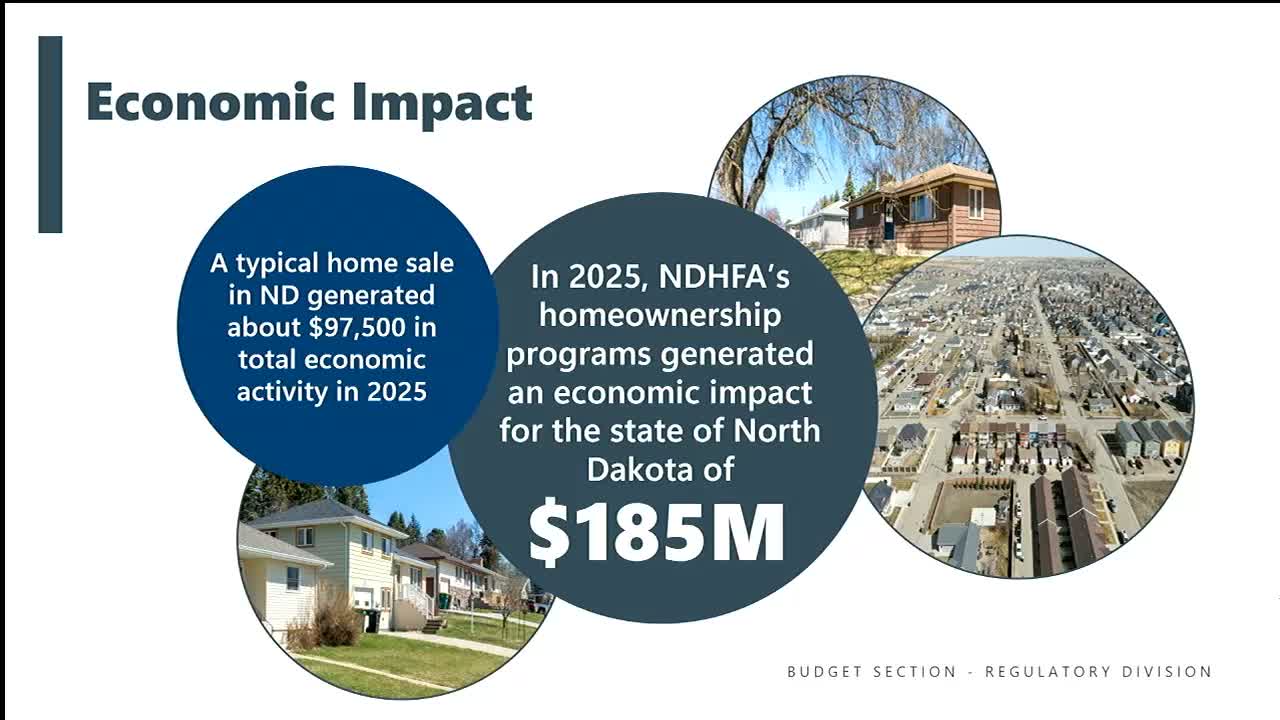
Brandon Delof, Executive Director of the North Dakota Housing Finance Agency, told the Budget Section (Regulatory Division) that the agency is putting state housing dollars to work but faces far more demand than available funding.
“We received requests for over $73,000,000 and we were able to award $25,000,000 total,” said Jennifer Henderson, director of community housing and grants management, describing the September 2025 multifamily application round. The agency combined federal programs and state Housing Incentive Fund (HIF) dollars in a single round and conditionally committed awards that must close and break ground by September 2026 or forfeit the funds.
Why it matters: Lawmakers must decide whether to sustain or grow the HIF, which the agency uses as gap financing alongside federal awards and tax credits. The program leverages other capital—Henderson said multifamily projects leverage roughly $6.17 in total development costs for every HIF dollar and single-family investments generate nearly $4 in development per HIF dollar—so changes to HIF appropriations would affect how many projects can move forward.
Details: The 2025 HIF allocation consisted of a $25,000,000 Strategic Investment Fund transfer split into $20,000,000 for multifamily projects and $5,000,000 for single-family development. The agency reports 16 qualified multifamily projects did not receive awards in the round. For single-family development, projects in communities under 20,000 population may receive up to $120,000 as a construction line of credit; community land trusts in Fargo, Grand Forks and Minot have used revolving lines to acquire and resell homes. Henderson said the single-family program has averaged repayments of about $56,000 per home and that $2,100,000 in awards will support construction of 19 homes equaling roughly $8,000,000 in development costs across small towns.
Homeless funding: The agency also manages a $9,850,000 allocation for homeless programs. In the first application round the agency received roughly $7,500,000 in requests and awarded about $4,600,000. Awarded funds were divided among emergency shelter operations (around 41%), homeless prevention and rapid rehousing services (around 42%), and HMIS or administrative costs. Henderson said the agency is prioritizing renewal of existing, performing providers and awarded preference points to organizations able to serve statewide so under-resourced regions now have access to services.
Accountability and next steps: Committee members pressed for outcome tracking and metrics; Henderson described scoring criteria that include spending performance (projects that have expended up to 80% of prior funds receive points), exits to positive destinations and reduction in returns to homelessness. Representative members asked for the number of individuals served once the program year closes; Henderson pledged to provide those figures after year-end reporting is complete. The agency recommended that the Legislature consider funding HIF, single-family development and homeless programs at current levels or higher to continue leveraging private capital and to expand housing stock and services.
The committee heard the agency say awards are conditional and that unused or returned funds are reallocated to future rounds. The session concluded with members indicating they will consider the agencies’ recommendations during upcoming budget deliberations.
“We received requests for over $73,000,000 and we were able to award $25,000,000 total,” said Jennifer Henderson, director of community housing and grants management, describing the September 2025 multifamily application round. The agency combined federal programs and state Housing Incentive Fund (HIF) dollars in a single round and conditionally committed awards that must close and break ground by September 2026 or forfeit the funds.
Why it matters: Lawmakers must decide whether to sustain or grow the HIF, which the agency uses as gap financing alongside federal awards and tax credits. The program leverages other capital—Henderson said multifamily projects leverage roughly $6.17 in total development costs for every HIF dollar and single-family investments generate nearly $4 in development per HIF dollar—so changes to HIF appropriations would affect how many projects can move forward.
Details: The 2025 HIF allocation consisted of a $25,000,000 Strategic Investment Fund transfer split into $20,000,000 for multifamily projects and $5,000,000 for single-family development. The agency reports 16 qualified multifamily projects did not receive awards in the round. For single-family development, projects in communities under 20,000 population may receive up to $120,000 as a construction line of credit; community land trusts in Fargo, Grand Forks and Minot have used revolving lines to acquire and resell homes. Henderson said the single-family program has averaged repayments of about $56,000 per home and that $2,100,000 in awards will support construction of 19 homes equaling roughly $8,000,000 in development costs across small towns.
Homeless funding: The agency also manages a $9,850,000 allocation for homeless programs. In the first application round the agency received roughly $7,500,000 in requests and awarded about $4,600,000. Awarded funds were divided among emergency shelter operations (around 41%), homeless prevention and rapid rehousing services (around 42%), and HMIS or administrative costs. Henderson said the agency is prioritizing renewal of existing, performing providers and awarded preference points to organizations able to serve statewide so under-resourced regions now have access to services.
Accountability and next steps: Committee members pressed for outcome tracking and metrics; Henderson described scoring criteria that include spending performance (projects that have expended up to 80% of prior funds receive points), exits to positive destinations and reduction in returns to homelessness. Representative members asked for the number of individuals served once the program year closes; Henderson pledged to provide those figures after year-end reporting is complete. The agency recommended that the Legislature consider funding HIF, single-family development and homeless programs at current levels or higher to continue leveraging private capital and to expand housing stock and services.
The committee heard the agency say awards are conditional and that unused or returned funds are reallocated to future rounds. The session concluded with members indicating they will consider the agencies’ recommendations during upcoming budget deliberations.
View the Full Meeting & All Its Details
This article offers just a summary. Unlock complete video, transcripts, and insights as a Founder Member.
✓
Watch full, unedited meeting videos
✓
Search every word spoken in unlimited transcripts
✓
AI summaries & real-time alerts (all government levels)
✓
Permanent access to expanding government content
30-day money-back guarantee
