Bismarck transit to extend hours; executive director cites sales-tax revenue and federal grants to cover fleet and service needs
March 19, 2026 | 2026 Legislature ND, North Dakota
This article was created by AI summarizing key points discussed. AI makes mistakes, so for full details and context, please refer to the video of the full meeting. Please report any errors so we can fix them. Report an error »
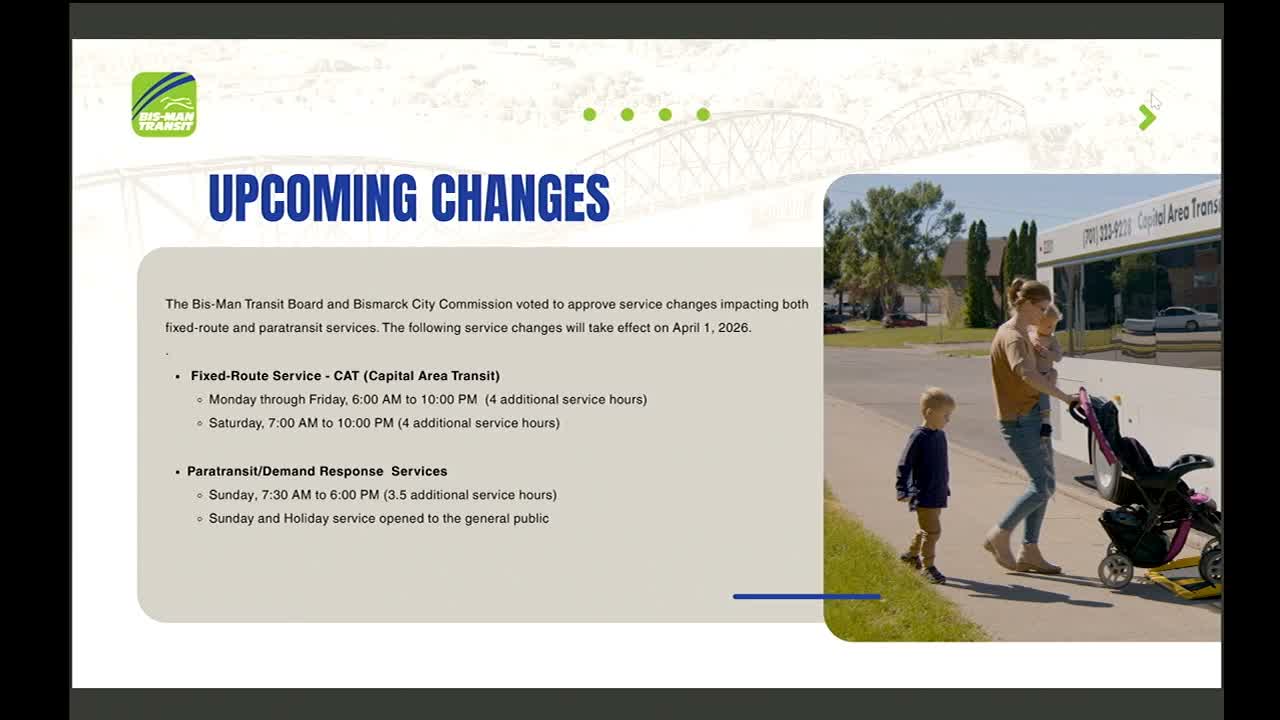
Bismarck transit outlined a service expansion and the funding choices that will support it during testimony before the Government Finance subcommittee.
Deidre Hughes, executive director of Biz Man Transit, said the CAP bus will operate additional hours starting April 1: weekday service will run from 6 a.m. to 10 p.m., Saturday service will be extended to 7 a.m. to 10 p.m., and demand-response service will be available Sundays and holidays with hours extended to 6 p.m. Hughes said the changes aim to serve shift workers and residents needing later-evening access to employment and community activities.
Hughes provided a projected incremental cost of roughly $665,000 for the remainder of 2026 and about $954,000 for 2027, and outlined funding sources: local mill levies (Bismarck 3 mills; Mandan 2 mills), fare revenue, advertising and facility leases, and federal grants. She said Bismarck’s portion of the Section 5307 urbanized area formula grant was $2,176,599 in 2025 and that federal grants remain the primary capital source for fleet replacement (typically 85% federal, 15% local match).
Local sales-tax measures passed in 2024 in Mandan and Bismarck dedicate two-tenths of a cent to public transportation; Hughes said the cities retain those funds in a dedicated account and agencies must apply to access them. She noted Biz Man Transit requested approximately $650,000 from Bismarck and $110,000 from Mandan to offset operating shortfalls, and that the agency holds cash reserves of about $5,000,000.
Hughes warned of long lead times for new buses (18–20 months) and rising unit prices; those constraints have prompted interest in alternatives such as refurbished buses, though she said federal capital grants still cover most replacements when local matches are available.
What’s next: Hughes said agency leaders will ask the four urban transit providers to coordinate on a unified funding request for the full committee to consider; legislative staff will prepare the subcommittee summary for inclusion in the Government Finance Committee’s November report.
Deidre Hughes, executive director of Biz Man Transit, said the CAP bus will operate additional hours starting April 1: weekday service will run from 6 a.m. to 10 p.m., Saturday service will be extended to 7 a.m. to 10 p.m., and demand-response service will be available Sundays and holidays with hours extended to 6 p.m. Hughes said the changes aim to serve shift workers and residents needing later-evening access to employment and community activities.
Hughes provided a projected incremental cost of roughly $665,000 for the remainder of 2026 and about $954,000 for 2027, and outlined funding sources: local mill levies (Bismarck 3 mills; Mandan 2 mills), fare revenue, advertising and facility leases, and federal grants. She said Bismarck’s portion of the Section 5307 urbanized area formula grant was $2,176,599 in 2025 and that federal grants remain the primary capital source for fleet replacement (typically 85% federal, 15% local match).
Local sales-tax measures passed in 2024 in Mandan and Bismarck dedicate two-tenths of a cent to public transportation; Hughes said the cities retain those funds in a dedicated account and agencies must apply to access them. She noted Biz Man Transit requested approximately $650,000 from Bismarck and $110,000 from Mandan to offset operating shortfalls, and that the agency holds cash reserves of about $5,000,000.
Hughes warned of long lead times for new buses (18–20 months) and rising unit prices; those constraints have prompted interest in alternatives such as refurbished buses, though she said federal capital grants still cover most replacements when local matches are available.
What’s next: Hughes said agency leaders will ask the four urban transit providers to coordinate on a unified funding request for the full committee to consider; legislative staff will prepare the subcommittee summary for inclusion in the Government Finance Committee’s November report.
View the Full Meeting & All Its Details
This article offers just a summary. Unlock complete video, transcripts, and insights as a Founder Member.
✓
Watch full, unedited meeting videos
✓
Search every word spoken in unlimited transcripts
✓
AI summaries & real-time alerts (all government levels)
✓
Permanent access to expanding government content
30-day money-back guarantee
