House Energy Committee adopts substitute for omnibus energy bill amid debate over utility wildfire‑liability and right‑of‑way powers
March 19, 2026 | 2026 Legislature Alaska, Alaska
This article was created by AI summarizing key points discussed. AI makes mistakes, so for full details and context, please refer to the video of the full meeting. Please report any errors so we can fix them. Report an error »
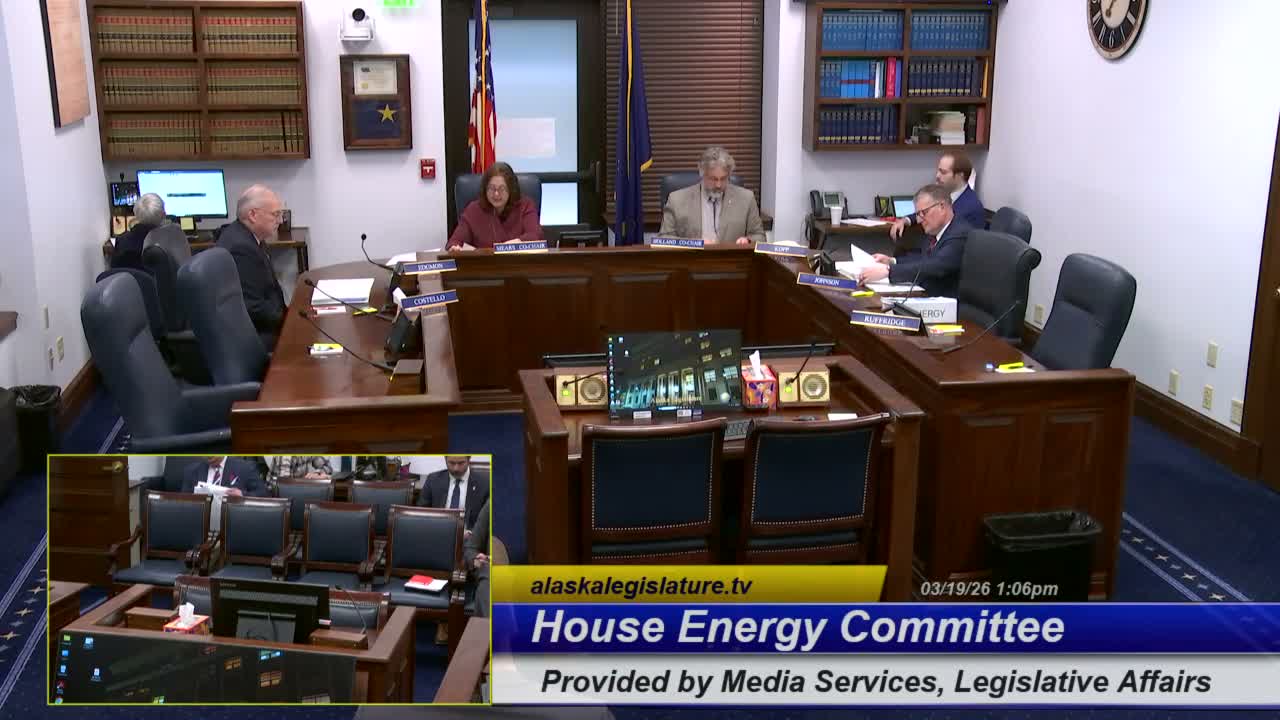
Juneau — The Alaska House Energy Committee on March 19 adopted a committee substitute for House Bill 369, the committee’s omnibus energy bill, and heard extended testimony from utilities and staff on provisions that would limit utility liability for wildfires when a utility adopts a wildland fire mitigation plan.
Co‑Chair Donna Mears opened the meeting and the committee adopted Version G of the CS (work order 34 LS1521G) as a working document after a procedural objection was withdrawn. Sponsor and Co‑Chair Representative Kai Holland and committee staff said Version G reflects stakeholder feedback and incorporates language originally derived from House Bill 252 while removing some earlier, more prescriptive requirements for the Regulatory Commission of Alaska (RCA).
"Version G of the bill resulted from sharing draft language with numerous stakeholders, including utility partners, the Rail Belt Reliability Council and other community members," Holland said, describing drafts that narrowed and reworked prior language.
Tim Truer, staff to Rep. Holland, walked the committee through the changes in Version G. Key edits summarized by Truer included removing a proposed RCA process for pre‑clearing diversified energy projects, lowering a proposed local‑control cap so certain renewable projects would be eligible to proceed without RCA approval only if they are 7 megawatts or smaller (down from earlier, larger thresholds), and simplifying the diversified‑portfolio multiplier to a single 1.5 multiplier for qualifying projects. Version G also shifts some technical certification duties to third‑party reviewers rather than the Department of Environmental Conservation.
The committee focused most sharply on Sections 2 and 3. Section 2 would create a presumption of non‑negligence for utilities that adopt a wildland fire mitigation plan and comply with it, except in cases of gross negligence; the CS clarifies civil liability would otherwise be judged under ordinary negligence and includes caps on liability for unnecessary removal of vegetation. Section 3 would require plans to be in writing, describe the utility and adjacent properties, be updated every three years, be filed with the Department of Natural Resources (DNR) (which may comment but would not have an approval role), and include inspection, de‑energization, vegetation‑management, detection and emergency‑notification procedures. The CS would require publication of a plan 60 days before adoption and a 30‑day public comment window.
Utilities that testified expressed appreciation for the engagement but warned portions of the bill could expand costs, administrative burden and legal exposure if left unchanged.
Julie Esty, chief strategy officer for Matanuska Electric Association (MEA), told the committee MEA appreciates the bill’s long‑term intent and several edits in Version G but said Sections 2 and 3 as currently drafted give rise to several problems. "MEA will be unable to support the bill if these sections remain intact," Esty said, pointing to compliance challenges, potential cost escalations and property‑rights concerns tied to language that would reach beyond utility easements. Esty said MEA currently staffs 12 people for vegetation management and maintains about 4,800 miles of line; MEA reported it spends at least $4.5 million annually on its right‑of‑way program and that expanding obligations outside easement lines would create significant new costs for members.
Rob Montgomery, chief operating officer for Homer Electric, echoed the concern that utility responsibility "really does end at the edge of the right of way." He said Homer Electric spends roughly $1.5 million a year on right‑of‑way clearing and maintenance, patrols lines by ground and air and is moving toward drone inspections; in 2025 Homer reported removing more than 7,100 hazard trees using grant support. Montgomery said the CS’s terms such as "imminent threat," "timely written notice," "reasonably foreseeable cause" and the tests for "substantial compliance" are currently vague and need clearer definition so utilities and courts can apply them consistently.
Committee members asked detailed implementation questions: whether the bill creates an implicit timeline that converts notice into liability, how to define the limited adjacent area the utility may consider when assessing vegetation, and whether the CS would create duties that undermine common‑law doctrines such as necessity. Sponsor Holland said some earlier proposals (including a 300‑foot adjacent‑vegetation line) are being pulled back and that staff will work with legal counsel and utilities to refine the language, seeking a balance between enabling utilities to share hazard information and avoiding unintended liability transfers to utilities and ratepayers.
On generation policy, witnesses generally supported the 7‑megawatt local‑control threshold (instead of a larger cap) but asked the committee to add an aggregate limit to prevent gaming and to preserve RCA transparency where appropriate. Utilities also asked the committee to consider moving milestones such as diversified‑portfolio deadlines later (some suggested 2040 rather than 2036) and to include battery energy‑storage systems as qualifying multipliers to help integrate variable renewables.
The committee set HB 369 aside for additional drafting and legal review; Co‑Chair Mears and sponsor Holland said they expect further technical amendments informed by the utilities’ testimony and by a legal assessment of the reach of any authority over adjacent private property. The committee adjourned at 3:00 p.m. with additional items scheduled for next week.
Co‑Chair Donna Mears opened the meeting and the committee adopted Version G of the CS (work order 34 LS1521G) as a working document after a procedural objection was withdrawn. Sponsor and Co‑Chair Representative Kai Holland and committee staff said Version G reflects stakeholder feedback and incorporates language originally derived from House Bill 252 while removing some earlier, more prescriptive requirements for the Regulatory Commission of Alaska (RCA).
"Version G of the bill resulted from sharing draft language with numerous stakeholders, including utility partners, the Rail Belt Reliability Council and other community members," Holland said, describing drafts that narrowed and reworked prior language.
Tim Truer, staff to Rep. Holland, walked the committee through the changes in Version G. Key edits summarized by Truer included removing a proposed RCA process for pre‑clearing diversified energy projects, lowering a proposed local‑control cap so certain renewable projects would be eligible to proceed without RCA approval only if they are 7 megawatts or smaller (down from earlier, larger thresholds), and simplifying the diversified‑portfolio multiplier to a single 1.5 multiplier for qualifying projects. Version G also shifts some technical certification duties to third‑party reviewers rather than the Department of Environmental Conservation.
The committee focused most sharply on Sections 2 and 3. Section 2 would create a presumption of non‑negligence for utilities that adopt a wildland fire mitigation plan and comply with it, except in cases of gross negligence; the CS clarifies civil liability would otherwise be judged under ordinary negligence and includes caps on liability for unnecessary removal of vegetation. Section 3 would require plans to be in writing, describe the utility and adjacent properties, be updated every three years, be filed with the Department of Natural Resources (DNR) (which may comment but would not have an approval role), and include inspection, de‑energization, vegetation‑management, detection and emergency‑notification procedures. The CS would require publication of a plan 60 days before adoption and a 30‑day public comment window.
Utilities that testified expressed appreciation for the engagement but warned portions of the bill could expand costs, administrative burden and legal exposure if left unchanged.
Julie Esty, chief strategy officer for Matanuska Electric Association (MEA), told the committee MEA appreciates the bill’s long‑term intent and several edits in Version G but said Sections 2 and 3 as currently drafted give rise to several problems. "MEA will be unable to support the bill if these sections remain intact," Esty said, pointing to compliance challenges, potential cost escalations and property‑rights concerns tied to language that would reach beyond utility easements. Esty said MEA currently staffs 12 people for vegetation management and maintains about 4,800 miles of line; MEA reported it spends at least $4.5 million annually on its right‑of‑way program and that expanding obligations outside easement lines would create significant new costs for members.
Rob Montgomery, chief operating officer for Homer Electric, echoed the concern that utility responsibility "really does end at the edge of the right of way." He said Homer Electric spends roughly $1.5 million a year on right‑of‑way clearing and maintenance, patrols lines by ground and air and is moving toward drone inspections; in 2025 Homer reported removing more than 7,100 hazard trees using grant support. Montgomery said the CS’s terms such as "imminent threat," "timely written notice," "reasonably foreseeable cause" and the tests for "substantial compliance" are currently vague and need clearer definition so utilities and courts can apply them consistently.
Committee members asked detailed implementation questions: whether the bill creates an implicit timeline that converts notice into liability, how to define the limited adjacent area the utility may consider when assessing vegetation, and whether the CS would create duties that undermine common‑law doctrines such as necessity. Sponsor Holland said some earlier proposals (including a 300‑foot adjacent‑vegetation line) are being pulled back and that staff will work with legal counsel and utilities to refine the language, seeking a balance between enabling utilities to share hazard information and avoiding unintended liability transfers to utilities and ratepayers.
On generation policy, witnesses generally supported the 7‑megawatt local‑control threshold (instead of a larger cap) but asked the committee to add an aggregate limit to prevent gaming and to preserve RCA transparency where appropriate. Utilities also asked the committee to consider moving milestones such as diversified‑portfolio deadlines later (some suggested 2040 rather than 2036) and to include battery energy‑storage systems as qualifying multipliers to help integrate variable renewables.
The committee set HB 369 aside for additional drafting and legal review; Co‑Chair Mears and sponsor Holland said they expect further technical amendments informed by the utilities’ testimony and by a legal assessment of the reach of any authority over adjacent private property. The committee adjourned at 3:00 p.m. with additional items scheduled for next week.
Don't Miss a Word: See the Full Meeting!
Go beyond summaries. Unlock every video, transcript, and key insight with a Founder Membership.
✓
Get instant access to full meeting videos
✓
Search and clip any phrase from complete transcripts
✓
Receive AI-powered summaries & custom alerts
✓
Enjoy lifetime, unrestricted access to government data
30-day money-back guarantee
