Alaska health leaders warn subsidy cliff and federal changes risk pushing people off coverage and raising costs
March 19, 2026 | 2026 Legislature Alaska, Alaska
This article was created by AI summarizing key points discussed. AI makes mistakes, so for full details and context, please refer to the video of the full meeting. Please report any errors so we can fix them. Report an error »
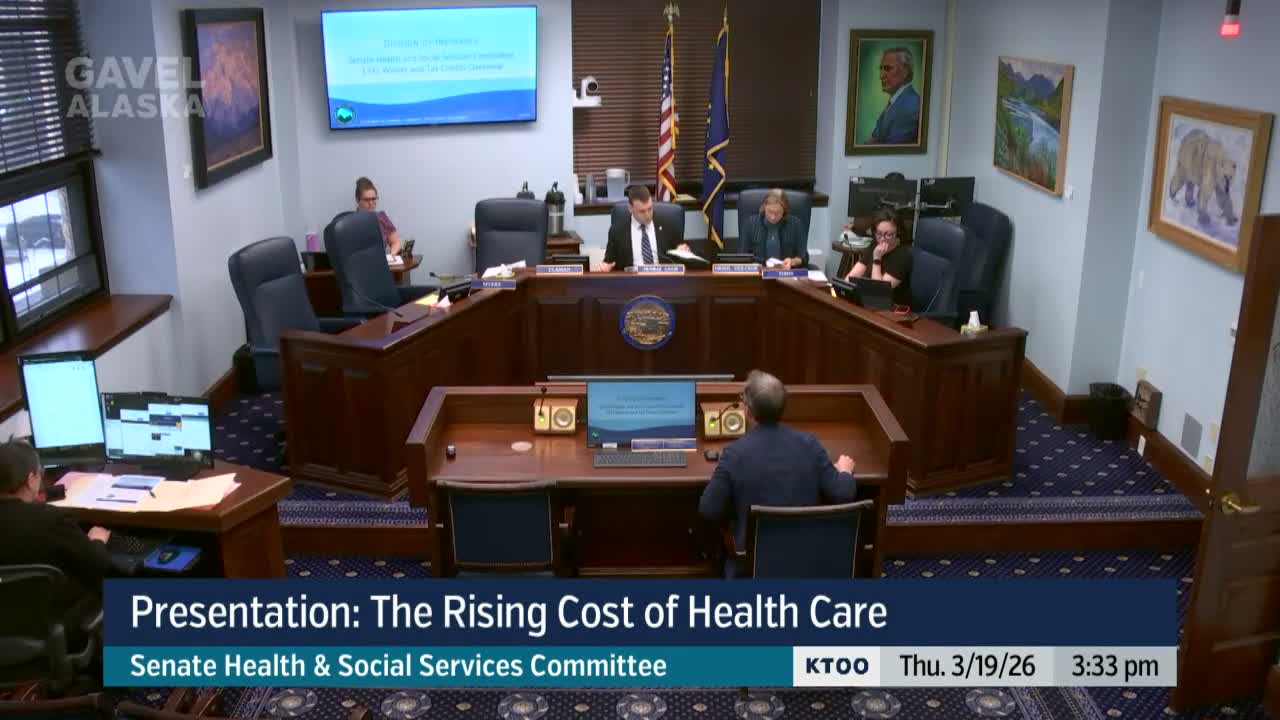
Jared Kosen, president and CEO of the Alaska Hospital and Health Care Association, told the Senate Health and Social Services Committee on March 19 that the expiration of enhanced premium tax credits on Dec. 31, 2025 removed roughly $43 million in federal subsidy support and is contributing to steep premium increases and coverage losses across Alaska.
"When we lost that, we essentially saw doubling and tripling of insurance premiums for the individuals on the ACA," Kosen said, arguing that those shifts are driving people to forgo coverage and raising uncompensated care for providers.
Kosen and other witnesses linked the subsidy lapse to a cascade of pressures on the state’s health system: higher premiums lead to more uninsured patients, which increases uncompensated care that insurers and providers absorb and then shift into higher premiums for other customers. Kosen also warned that federal proposals tied to the recent HR 1 reconciliation package — including work requirements and more frequent Medicaid redeterminations — could further reduce coverage in 2027, citing a Department of Health estimate that on the high end as many as 13,611 Alaskans in the Medicaid expansion population could lose coverage under some scenarios.
Heather Carpenter, director of the Division of Insurance, told the committee the state’s 1332 reinsurance waiver — first implemented in 2017 and extended through 2027 — has reduced rates by about 40 percent and has directed more than $800 million into the program through 2025. But Carpenter said federal pass‑through funding that helped finance the waiver will not be enough going forward and the division expects to draw on the ceded‑premium (seeded premium) account to make up the shortfall.
"Our Alaska reinsurance program continues to lower rates by about 40% and it does bring some much‑needed stability to the market," Carpenter said, adding that the federal calculations were adjusted so states would retain some financial responsibility rather than receive all savings.
Licensed broker Shayla Teague described front‑line experience with ‘‘premium shock’’ during the latest open enrollment: she said many families faced surprise increases and some shoppers disengaged from enrollment when they wrongly concluded all financial assistance was gone. Teague gave a client example of a married couple with about $115,000 in household income who previously paid about $600 per month and now face roughly $3,300 per month for the same plan.
"This year, the same plan costs approximately $3,300 per month," Teague said, adding that preliminary data show at least an 11 percent decline in marketplace enrollment so far and that the trend could worsen as grace periods end.
Committee members asked detailed questions about why pass‑through funds would fall short, why insurers remain in the individual market if they cede high‑cost claims, and whether new pharmaceuticals (such as GLP‑1 class drugs) might reduce some long‑term costs even as they raise near‑term pharmacy spending. Carpenter said the ACA restricts insurers from excluding people for preexisting conditions, which creates an incentive for insurers to remain in the market if reinsurance helps stabilize losses; Teague and Kosen said drug prices, workforce shortages and Alaska’s small risk pool magnify national cost trends locally.
The session underscored two policy tensions for the Legislature: short‑term financial shocks from the end of enhanced federal subsidies, and longer‑term cost drivers (chronic disease, workforce and high pharmacy costs) that would require broader, multi‑year strategies to address. Committee members asked the insurance division for additional market data and for carriers’ practices on longer‑term dispensing for maintenance medications.
The committee did not take formal action on market fixes during the meeting; members indicated the need for follow‑up data and possible legislative options to mitigate coverage losses and market instability.
The committee’s next meeting was scheduled for March 24 to continue related business.
"When we lost that, we essentially saw doubling and tripling of insurance premiums for the individuals on the ACA," Kosen said, arguing that those shifts are driving people to forgo coverage and raising uncompensated care for providers.
Kosen and other witnesses linked the subsidy lapse to a cascade of pressures on the state’s health system: higher premiums lead to more uninsured patients, which increases uncompensated care that insurers and providers absorb and then shift into higher premiums for other customers. Kosen also warned that federal proposals tied to the recent HR 1 reconciliation package — including work requirements and more frequent Medicaid redeterminations — could further reduce coverage in 2027, citing a Department of Health estimate that on the high end as many as 13,611 Alaskans in the Medicaid expansion population could lose coverage under some scenarios.
Heather Carpenter, director of the Division of Insurance, told the committee the state’s 1332 reinsurance waiver — first implemented in 2017 and extended through 2027 — has reduced rates by about 40 percent and has directed more than $800 million into the program through 2025. But Carpenter said federal pass‑through funding that helped finance the waiver will not be enough going forward and the division expects to draw on the ceded‑premium (seeded premium) account to make up the shortfall.
"Our Alaska reinsurance program continues to lower rates by about 40% and it does bring some much‑needed stability to the market," Carpenter said, adding that the federal calculations were adjusted so states would retain some financial responsibility rather than receive all savings.
Licensed broker Shayla Teague described front‑line experience with ‘‘premium shock’’ during the latest open enrollment: she said many families faced surprise increases and some shoppers disengaged from enrollment when they wrongly concluded all financial assistance was gone. Teague gave a client example of a married couple with about $115,000 in household income who previously paid about $600 per month and now face roughly $3,300 per month for the same plan.
"This year, the same plan costs approximately $3,300 per month," Teague said, adding that preliminary data show at least an 11 percent decline in marketplace enrollment so far and that the trend could worsen as grace periods end.
Committee members asked detailed questions about why pass‑through funds would fall short, why insurers remain in the individual market if they cede high‑cost claims, and whether new pharmaceuticals (such as GLP‑1 class drugs) might reduce some long‑term costs even as they raise near‑term pharmacy spending. Carpenter said the ACA restricts insurers from excluding people for preexisting conditions, which creates an incentive for insurers to remain in the market if reinsurance helps stabilize losses; Teague and Kosen said drug prices, workforce shortages and Alaska’s small risk pool magnify national cost trends locally.
The session underscored two policy tensions for the Legislature: short‑term financial shocks from the end of enhanced federal subsidies, and longer‑term cost drivers (chronic disease, workforce and high pharmacy costs) that would require broader, multi‑year strategies to address. Committee members asked the insurance division for additional market data and for carriers’ practices on longer‑term dispensing for maintenance medications.
The committee did not take formal action on market fixes during the meeting; members indicated the need for follow‑up data and possible legislative options to mitigate coverage losses and market instability.
The committee’s next meeting was scheduled for March 24 to continue related business.
Don't Miss a Word: See the Full Meeting!
Go beyond summaries. Unlock every video, transcript, and key insight with a Founder Membership.
✓
Get instant access to full meeting videos
✓
Search and clip any phrase from complete transcripts
✓
Receive AI-powered summaries & custom alerts
✓
Enjoy lifetime, unrestricted access to government data
30-day money-back guarantee
