Senate committee opens SB 276 hearing on 12‑month contraceptive dispensing; clinicians and providers back the bill
March 19, 2026 | 2026 Legislature Alaska, Alaska
This article was created by AI summarizing key points discussed. AI makes mistakes, so for full details and context, please refer to the video of the full meeting. Please report any errors so we can fix them. Report an error »
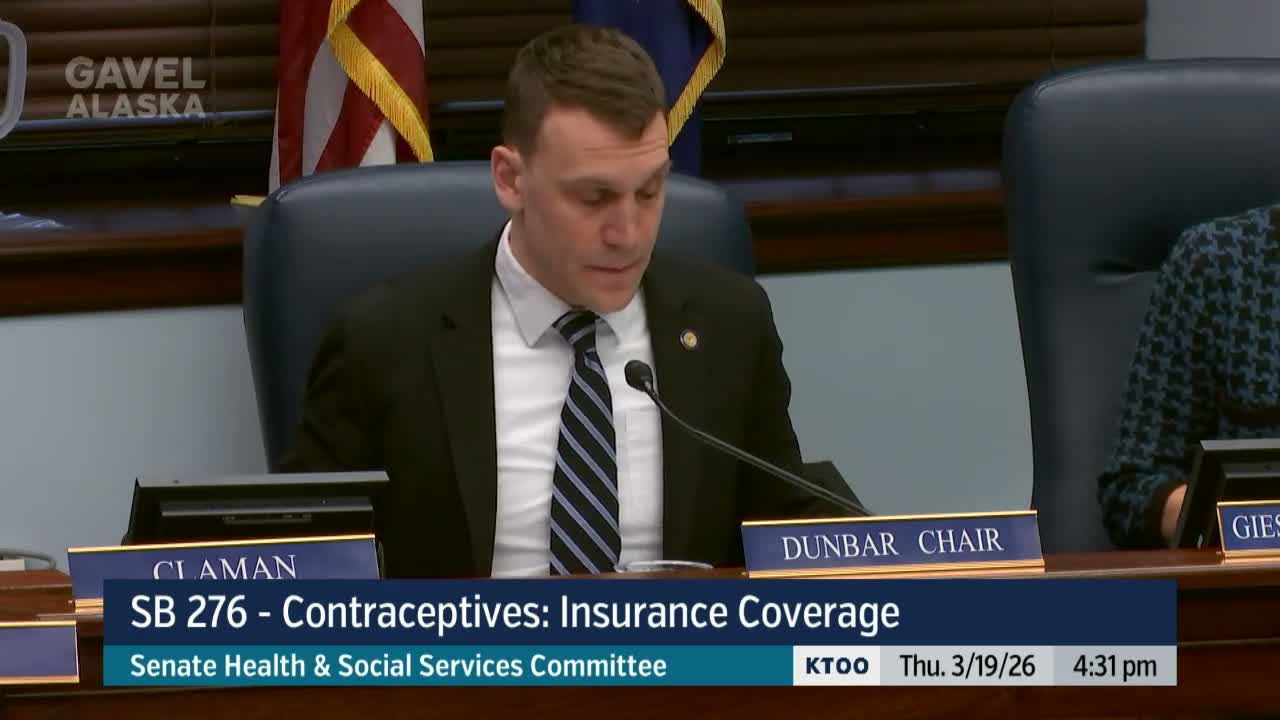
The Senate Health and Social Services Committee held an introductory hearing on SB 276 on March 19, a bill sponsored by the committee that would require insurers to provide coverage for up to a 12‑month supply of prescribed contraceptives and would direct the Department of Health to seek federal approval so Medicaid could pay for a 12‑month supply for eligible recipients.
Ariel Harbison, staff to Chair Dunbar, summarized SB 276’s provisions: insurers must reimburse dispensing prescription contraceptives intended to last a 12‑month period, may not offset the cost of compliance, and cannot restrict or delay contraceptive coverage. The bill includes exemptions for certain religious employers and an uncodified provision making the Medicaid payment section conditional on federal approval of a state plan amendment.
Dr. Ingrid Johnson, an associate professor at the University of Alaska Fairbanks who studies gender‑based violence, testified the policy would be particularly important for people experiencing reproductive coercion and intimate‑partner violence. Johnson cited Alaska victimization survey data showing roughly 1 in 5 women have experienced reproductive control and said uninterrupted access to a preferred contraceptive reduces the risk of unintended pregnancy for those who cannot reliably make repeated pharmacy visits.
"So if they're required to go back to the pharmacy every 1 to 3 months ... that can be made much more difficult when they have a partner who is regularly monitoring and controlling those behaviors," Johnson said.
Claudia Haynes, CEO of Kachemak Bay Family Planning Clinic, described real‑world rural barriers — distance, pharmacy hours and transportation — and said limitations on dispensing force some patients to switch methods or risk gaps that increase unintended‑pregnancy rates. Dr. Sarah Truitt, chair of the Alaska section of the American College of Obstetricians and Gynecologists, said clinicians across the state support the policy and that a full‑year supply would help patients who rely on visiting or mail‑order services.
Harbison told the committee SB 276 carries a zero fiscal note in the staff packet and cited a 2024 Department of Health Fiscal Note for a similar bill that estimated about $1.35 million in annual savings from reduced unplanned pregnancies; the bill includes language directing the Department of Health to prepare a state plan amendment so Medicaid could cover a 12‑month supply for eligible recipients if federal approval is given.
Senators asked practical questions during the hearing: Senator Myers queried whether other maintenance medications are commonly dispensed in 12‑month quantities; Director Heather Carpenter said some maintenance drugs (she cited her own 3‑month fills) vary by carrier practice and that the division would query carriers for more information. Chair Dunbar set an amendment deadline for SB 276 for Monday, March 23 at 5 p.m. and scheduled another committee meeting for March 24 to continue related work.
No vote was taken during the introductory hearing; committee members indicated a desire to move the bill forward in session with additional technical follow‑up from the Division of Insurance.
Ariel Harbison, staff to Chair Dunbar, summarized SB 276’s provisions: insurers must reimburse dispensing prescription contraceptives intended to last a 12‑month period, may not offset the cost of compliance, and cannot restrict or delay contraceptive coverage. The bill includes exemptions for certain religious employers and an uncodified provision making the Medicaid payment section conditional on federal approval of a state plan amendment.
Dr. Ingrid Johnson, an associate professor at the University of Alaska Fairbanks who studies gender‑based violence, testified the policy would be particularly important for people experiencing reproductive coercion and intimate‑partner violence. Johnson cited Alaska victimization survey data showing roughly 1 in 5 women have experienced reproductive control and said uninterrupted access to a preferred contraceptive reduces the risk of unintended pregnancy for those who cannot reliably make repeated pharmacy visits.
"So if they're required to go back to the pharmacy every 1 to 3 months ... that can be made much more difficult when they have a partner who is regularly monitoring and controlling those behaviors," Johnson said.
Claudia Haynes, CEO of Kachemak Bay Family Planning Clinic, described real‑world rural barriers — distance, pharmacy hours and transportation — and said limitations on dispensing force some patients to switch methods or risk gaps that increase unintended‑pregnancy rates. Dr. Sarah Truitt, chair of the Alaska section of the American College of Obstetricians and Gynecologists, said clinicians across the state support the policy and that a full‑year supply would help patients who rely on visiting or mail‑order services.
Harbison told the committee SB 276 carries a zero fiscal note in the staff packet and cited a 2024 Department of Health Fiscal Note for a similar bill that estimated about $1.35 million in annual savings from reduced unplanned pregnancies; the bill includes language directing the Department of Health to prepare a state plan amendment so Medicaid could cover a 12‑month supply for eligible recipients if federal approval is given.
Senators asked practical questions during the hearing: Senator Myers queried whether other maintenance medications are commonly dispensed in 12‑month quantities; Director Heather Carpenter said some maintenance drugs (she cited her own 3‑month fills) vary by carrier practice and that the division would query carriers for more information. Chair Dunbar set an amendment deadline for SB 276 for Monday, March 23 at 5 p.m. and scheduled another committee meeting for March 24 to continue related work.
No vote was taken during the introductory hearing; committee members indicated a desire to move the bill forward in session with additional technical follow‑up from the Division of Insurance.
View the Full Meeting & All Its Details
This article offers just a summary. Unlock complete video, transcripts, and insights as a Founder Member.
✓
Watch full, unedited meeting videos
✓
Search every word spoken in unlimited transcripts
✓
AI summaries & real-time alerts (all government levels)
✓
Permanent access to expanding government content
30-day money-back guarantee
