Senate Resources Committee hears briefing on SB 275 surcharge, tax and CO2‑processing implications
March 20, 2026 | 2026 Legislature Alaska, Alaska
This article was created by AI summarizing key points discussed. AI makes mistakes, so for full details and context, please refer to the video of the full meeting. Please report any errors so we can fix them. Report an error »
ANCHORAGE — The Senate Resources Committee on March 20 continued a Gaffney Klein briefing on Senate Bill 275, which would add a proposed $0.15 per MMBtu processing surcharge applicable to LNG exports, and heard expert analysis of how that levy could affect project economics and state revenue.
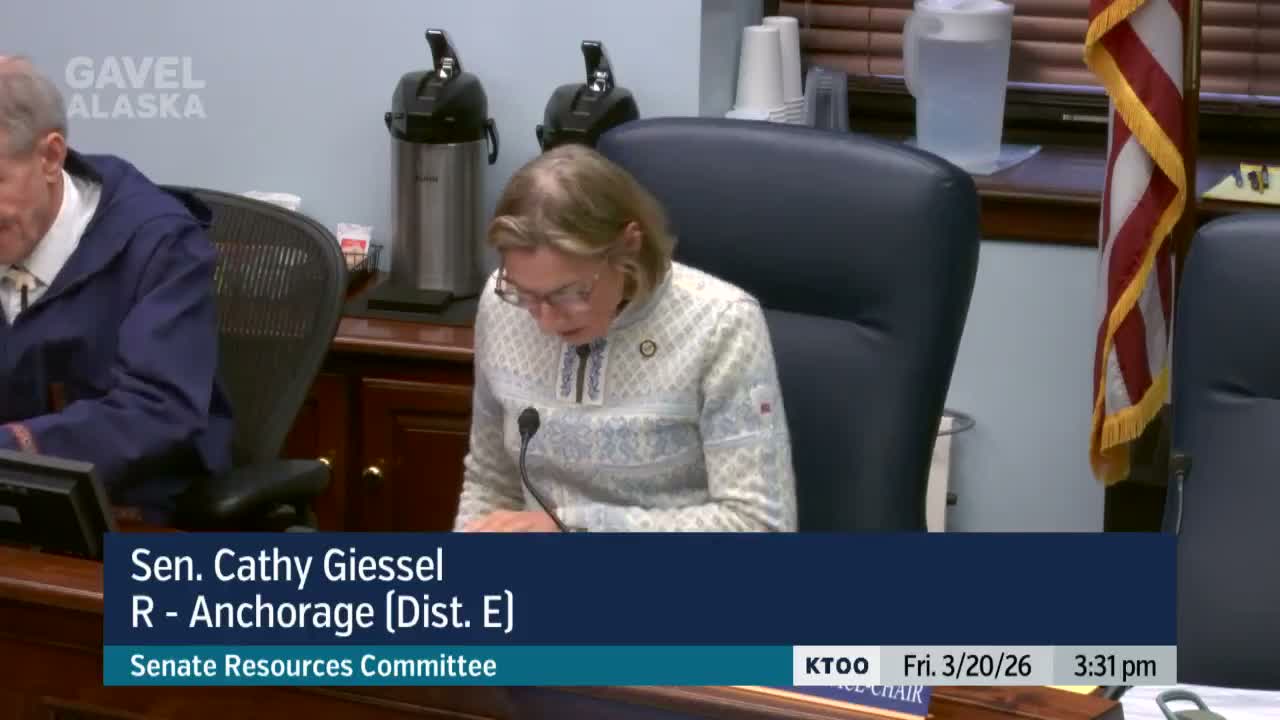
Senator Giesel, chair of the Senate Resources Committee, opened the session and said the panel would continue work on SB 275 with testimony from Gaffney Klein. "We have a quorum to conduct business," she said, and introduced Nicholas Fulford, senior director of gas and LNG at Gaffney Klein, and Fernando Rolo, senior economist at the firm.
Fulford framed two broad scenarios for the surcharge: one in which sufficient economic rent exists across the chain so the surcharge funds state revenue without imperiling returns; and another in which the surcharge reduces project economics enough to delay or derail a final investment decision. "It's useful to consider those two scenarios," he said, adding that which side Alaska sits on depends on many assumptions and confidential commercial terms.
Using the briefing's illustrative numbers, Fulford said a $0.15/MMBtu surcharge would produce government revenues "almost exactly the same as the state corporate income tax on the pipeline, roughly $150,000,000–$160,000,000 per annum." He offered analogous frames — calling it roughly equivalent to a property-tax change of about two mils or about a 1.5% sales‑tax equivalent on a $10 delivered price — and noted the numbers are sensitive to assumptions. Under one illustrative case, a 10% post‑tax internal rate of return could fall to about 9.64% if the surcharge applies.
Committee members pressed on transparency and negotiating practice. Senator Myers asked whether detailed project economics in other countries are typically shared with legislatures or kept at ministerial or state‑company levels; Fulford said governments and national gas companies commonly receive confidential models, while legislatures often receive less detailed briefings. Fulford described the confidentiality around host‑government agreements and commercial sensitivity.
Members debated who would absorb the surcharge. Myers outlined three possible channels: lower wellhead prices and royalties, lower returns to owners, or higher prices to buyers. Fulford said it is "unlikely" the $0.15 would be absorbed by buyers in Asia in the short run and that the more probable outcome is pressure on project economics across producers, pipeline and plant owners.
Lawmakers also discussed tax treatment of lease operating expenses and capital investments needed to convert some fields to gas production. Fulford used a hypothetical $1 billion conversion example (citing a Point Thompson‑like case) and said allowing that spend to be treated as an offset could reduce the gas price on the order of $0.03–$0.05/MMBtu under illustrative assumptions. He cautioned that Alaska's net tax system is complex and results depend heavily on the assumptions plugged into a model.
Fulford described the proposed gas processing plant's role in removing CO2 and other impurities on the North Slope to meet pipeline and liquefaction specifications. He said the CO2 stream could be substantial; some captured CO2 may be sequestered and some could be sold for enhanced oil recovery. On federal incentives, Fulford cited the federal carbon‑capture credit under Section 45Q at roughly "$85 per ton," said the credit is available for about 12 years after operation, and referenced a construction deadline cited in the briefing (01/01/2033). He added that monetizing such credits often involves complex tax‑partnership structures and that ownership of a CO2 removal facility could be structured separately from the LNG project to capture value.
Senator Dunbar raised concerns that allowing expansive capital write‑offs would remove incentives for cost control and could invite disputes over what is a legitimate lease expense. Fulford responded that other jurisdictions use production‑sharing or robust audit and arm's‑length safeguards when cost recovery is allowed.
On timing and government sequencing, Fulford said final investment decisions sometimes follow the finalization of fiscal packages but that FID can occur earlier in cases where the investment case is robust; he referenced LNG Canada as an example where fiscal dialogue preceded FID by several years. He told the committee a combination of clearer CapEx estimates, capital structure, and potential federal support would improve the legislature's ability to assess the government's take.
Chair Senator Giesel closed by emphasizing the committee's fiduciary duty. "We have no financial information. We're working blind here," she said, and announced the committee would set SB 275 aside to seek further modeling and analysis; she also scheduled the next meeting for March 23 at 3:30 p.m.
The committee recorded no formal vote on SB 275 during the session; members asked staff and consultants to develop additional modeling and to involve AGDC and other stakeholders in follow‑up analysis.
Sources: Presentation and Q&A with Nicholas Fulford (Gaffney Klein) and Senate Resources Committee members during the March 20 committee meeting.
Senator Giesel, chair of the Senate Resources Committee, opened the session and said the panel would continue work on SB 275 with testimony from Gaffney Klein. "We have a quorum to conduct business," she said, and introduced Nicholas Fulford, senior director of gas and LNG at Gaffney Klein, and Fernando Rolo, senior economist at the firm.
Fulford framed two broad scenarios for the surcharge: one in which sufficient economic rent exists across the chain so the surcharge funds state revenue without imperiling returns; and another in which the surcharge reduces project economics enough to delay or derail a final investment decision. "It's useful to consider those two scenarios," he said, adding that which side Alaska sits on depends on many assumptions and confidential commercial terms.
Using the briefing's illustrative numbers, Fulford said a $0.15/MMBtu surcharge would produce government revenues "almost exactly the same as the state corporate income tax on the pipeline, roughly $150,000,000–$160,000,000 per annum." He offered analogous frames — calling it roughly equivalent to a property-tax change of about two mils or about a 1.5% sales‑tax equivalent on a $10 delivered price — and noted the numbers are sensitive to assumptions. Under one illustrative case, a 10% post‑tax internal rate of return could fall to about 9.64% if the surcharge applies.
Committee members pressed on transparency and negotiating practice. Senator Myers asked whether detailed project economics in other countries are typically shared with legislatures or kept at ministerial or state‑company levels; Fulford said governments and national gas companies commonly receive confidential models, while legislatures often receive less detailed briefings. Fulford described the confidentiality around host‑government agreements and commercial sensitivity.
Members debated who would absorb the surcharge. Myers outlined three possible channels: lower wellhead prices and royalties, lower returns to owners, or higher prices to buyers. Fulford said it is "unlikely" the $0.15 would be absorbed by buyers in Asia in the short run and that the more probable outcome is pressure on project economics across producers, pipeline and plant owners.
Lawmakers also discussed tax treatment of lease operating expenses and capital investments needed to convert some fields to gas production. Fulford used a hypothetical $1 billion conversion example (citing a Point Thompson‑like case) and said allowing that spend to be treated as an offset could reduce the gas price on the order of $0.03–$0.05/MMBtu under illustrative assumptions. He cautioned that Alaska's net tax system is complex and results depend heavily on the assumptions plugged into a model.
Fulford described the proposed gas processing plant's role in removing CO2 and other impurities on the North Slope to meet pipeline and liquefaction specifications. He said the CO2 stream could be substantial; some captured CO2 may be sequestered and some could be sold for enhanced oil recovery. On federal incentives, Fulford cited the federal carbon‑capture credit under Section 45Q at roughly "$85 per ton," said the credit is available for about 12 years after operation, and referenced a construction deadline cited in the briefing (01/01/2033). He added that monetizing such credits often involves complex tax‑partnership structures and that ownership of a CO2 removal facility could be structured separately from the LNG project to capture value.
Senator Dunbar raised concerns that allowing expansive capital write‑offs would remove incentives for cost control and could invite disputes over what is a legitimate lease expense. Fulford responded that other jurisdictions use production‑sharing or robust audit and arm's‑length safeguards when cost recovery is allowed.
On timing and government sequencing, Fulford said final investment decisions sometimes follow the finalization of fiscal packages but that FID can occur earlier in cases where the investment case is robust; he referenced LNG Canada as an example where fiscal dialogue preceded FID by several years. He told the committee a combination of clearer CapEx estimates, capital structure, and potential federal support would improve the legislature's ability to assess the government's take.
Chair Senator Giesel closed by emphasizing the committee's fiduciary duty. "We have no financial information. We're working blind here," she said, and announced the committee would set SB 275 aside to seek further modeling and analysis; she also scheduled the next meeting for March 23 at 3:30 p.m.
The committee recorded no formal vote on SB 275 during the session; members asked staff and consultants to develop additional modeling and to involve AGDC and other stakeholders in follow‑up analysis.
Sources: Presentation and Q&A with Nicholas Fulford (Gaffney Klein) and Senate Resources Committee members during the March 20 committee meeting.
View the Full Meeting & All Its Details
This article offers just a summary. Unlock complete video, transcripts, and insights as a Founder Member.
✓
Watch full, unedited meeting videos
✓
Search every word spoken in unlimited transcripts
✓
AI summaries & real-time alerts (all government levels)
✓
Permanent access to expanding government content
30-day money-back guarantee
