House Finance advances SB 64 after debate over ballot curing, tracking and PFD registration
March 20, 2026 | 2026 Legislature Alaska, Alaska
This article was created by AI summarizing key points discussed. AI makes mistakes, so for full details and context, please refer to the video of the full meeting. Please report any errors so we can fix them. Report an error »
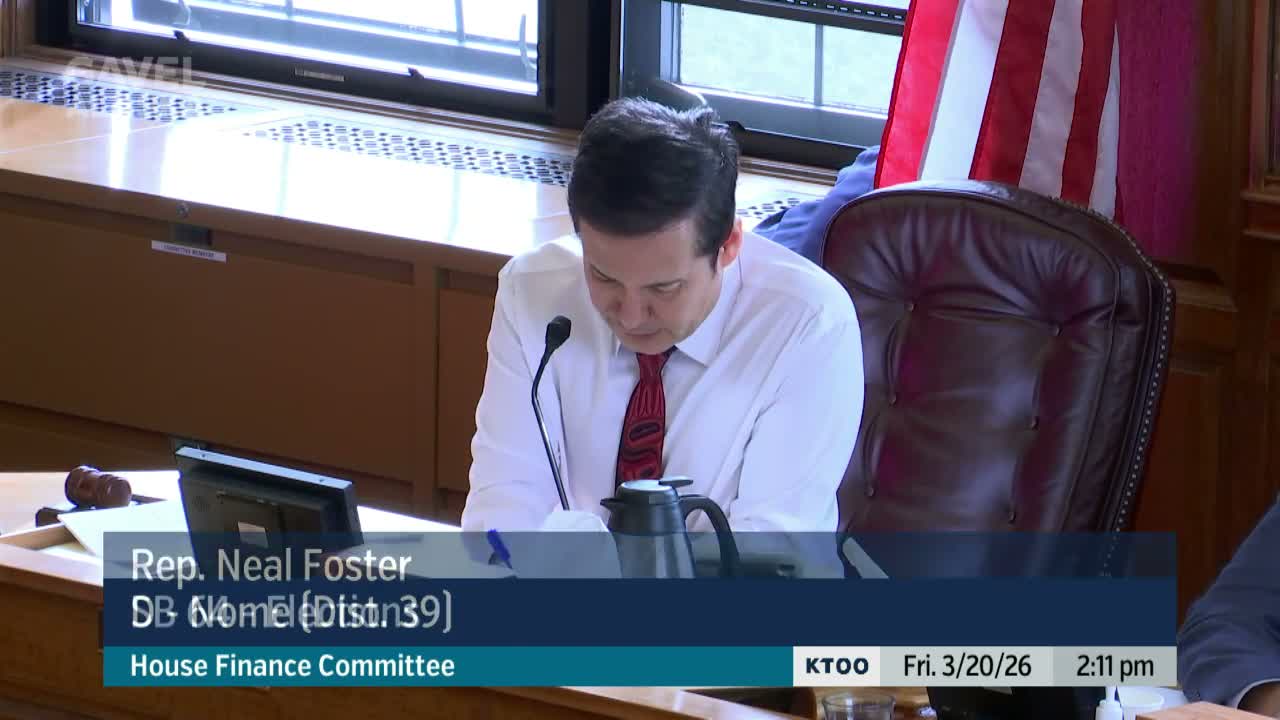
The House Finance Committee spent the bulk of its March 20 meeting considering amendments to Senate Bill 64, an omnibus elections bill covering ballot handling, tracking and registration processes. Committee members debated multiple amendments addressing how ballots returned after election day are treated (curing), when a ballot-tracking system and electronic curing must take effect, how Permanent Fund Dividend (PFD) application data is used for voter registration, and whether witness signatures should remain required on absentee ballots.
Representative Bynum offered and later withdrew Amendment 4 (to narrow the curing window) after senators and members raised constitutional and rural‑access concerns; Sen. Bill Wilikowski argued the narrowed curing window could “create two classes of voters” and might be unconstitutional. Members from rural districts gave concrete examples of postal unreliability and travel obstacles that can delay ballots.
The committee adopted Amendment 5 (restoring language that PFD data shared with the Division of Elections should be filtered to U.S. citizens ages 18 or older or who will be within 90 days) after Division director Carol Beecher explained how the filter affects operational workload. The committee also adopted Amendment 6 as modified by a conceptual amendment to delay the effective date for ballot-tracking and electronic curing provisions to give the Division of Elections additional implementation time (the conceptual amendment moved the effective date to roughly 09/19/2026 and exempted the October REAA elections). Director Beecher cautioned repeatedly that implementing IT systems in an election year would be “a real challenge for the division.” The sponsor and Sen. Wilikowski said vendor commitments and five temporary staff in the fiscal note make implementation feasible; sponsors estimated roughly 500–1,000 ballots would require curing and said five temporary hires in the fiscal note should suffice to handle curing workloads.
Representative Tomaszewski’s Amendment 1 — which would have turned the PFD-based automatic (opt‑out) registration into an opt‑in process — was debated at length and failed on a roll call, 3 yea to 8 nay. Proponents of the opt‑in change argued it would reduce unnecessary work and protect privacy; opponents said it would shrink registration numbers and undermine a voter-approved 2016 ballot measure that established the PFD registration pathway.
Representative Bynum proposed a signature‑verification system (Amendment 3) that would remove the witness requirement for absentee ballots and replace it with state signature‑matching technology; members pressed about fiscal cost and potential disparate impacts on youth and older voters, and Bynum withdrew that amendment as well. Representative Allard also withdrew a lengthy amendment (number 7) after concluding it would take too long to process in committee.
At the end of the session the committee voted to report SB 64 (version B, as amended) out of committee with individual recommendations and attached fiscal notes; the roll call was 9 yea, 2 nay.
Votes at a glance:
- Amendment 5 (restore PFD filter to U.S. citizens 18+/90 days): adopted (no roll call recorded).
- Amendment 6 (effective-date sequencing; delay ballot-tracking/cure provisions to allow implementation, conceptual amendment moved date to 09/19/2026 and exempted REAA election): adopted (no roll call recorded).
- Amendment 1 (Tomaszewski — change PFD auto-registration to opt‑in): failed on roll call 3–8 (Yes: Representative Allard, Representative Stapp, Representative Tomaszewski; No: Representatives Jimmy, Galvin, Moore, Hannon, Bynum, Josephson, Shrage, Foster).
- Amendment 3 (signature verification, remove witness signature): withdrawn by maker.
Senator Bill Wilikowski (bill sponsor) emphasized the bipartisan compromise that produced the bill and urged members not to add major changes late in the process; Division of Elections Director Carol Beecher repeatedly urged caution about timelines and staffing for new IT systems. The committee’s action sends SB 64 to the next step with amendments and fiscal notes attached.
Representative Bynum offered and later withdrew Amendment 4 (to narrow the curing window) after senators and members raised constitutional and rural‑access concerns; Sen. Bill Wilikowski argued the narrowed curing window could “create two classes of voters” and might be unconstitutional. Members from rural districts gave concrete examples of postal unreliability and travel obstacles that can delay ballots.
The committee adopted Amendment 5 (restoring language that PFD data shared with the Division of Elections should be filtered to U.S. citizens ages 18 or older or who will be within 90 days) after Division director Carol Beecher explained how the filter affects operational workload. The committee also adopted Amendment 6 as modified by a conceptual amendment to delay the effective date for ballot-tracking and electronic curing provisions to give the Division of Elections additional implementation time (the conceptual amendment moved the effective date to roughly 09/19/2026 and exempted the October REAA elections). Director Beecher cautioned repeatedly that implementing IT systems in an election year would be “a real challenge for the division.” The sponsor and Sen. Wilikowski said vendor commitments and five temporary staff in the fiscal note make implementation feasible; sponsors estimated roughly 500–1,000 ballots would require curing and said five temporary hires in the fiscal note should suffice to handle curing workloads.
Representative Tomaszewski’s Amendment 1 — which would have turned the PFD-based automatic (opt‑out) registration into an opt‑in process — was debated at length and failed on a roll call, 3 yea to 8 nay. Proponents of the opt‑in change argued it would reduce unnecessary work and protect privacy; opponents said it would shrink registration numbers and undermine a voter-approved 2016 ballot measure that established the PFD registration pathway.
Representative Bynum proposed a signature‑verification system (Amendment 3) that would remove the witness requirement for absentee ballots and replace it with state signature‑matching technology; members pressed about fiscal cost and potential disparate impacts on youth and older voters, and Bynum withdrew that amendment as well. Representative Allard also withdrew a lengthy amendment (number 7) after concluding it would take too long to process in committee.
At the end of the session the committee voted to report SB 64 (version B, as amended) out of committee with individual recommendations and attached fiscal notes; the roll call was 9 yea, 2 nay.
Votes at a glance:
- Amendment 5 (restore PFD filter to U.S. citizens 18+/90 days): adopted (no roll call recorded).
- Amendment 6 (effective-date sequencing; delay ballot-tracking/cure provisions to allow implementation, conceptual amendment moved date to 09/19/2026 and exempted REAA election): adopted (no roll call recorded).
- Amendment 1 (Tomaszewski — change PFD auto-registration to opt‑in): failed on roll call 3–8 (Yes: Representative Allard, Representative Stapp, Representative Tomaszewski; No: Representatives Jimmy, Galvin, Moore, Hannon, Bynum, Josephson, Shrage, Foster).
- Amendment 3 (signature verification, remove witness signature): withdrawn by maker.
Senator Bill Wilikowski (bill sponsor) emphasized the bipartisan compromise that produced the bill and urged members not to add major changes late in the process; Division of Elections Director Carol Beecher repeatedly urged caution about timelines and staffing for new IT systems. The committee’s action sends SB 64 to the next step with amendments and fiscal notes attached.
View the Full Meeting & All Its Details
This article offers just a summary. Unlock complete video, transcripts, and insights as a Founder Member.
✓
Watch full, unedited meeting videos
✓
Search every word spoken in unlimited transcripts
✓
AI summaries & real-time alerts (all government levels)
✓
Permanent access to expanding government content
30-day money-back guarantee
