DOT preconstruction officials outline project steps and common delays before House Transportation Committee
March 19, 2026 | 2026 Legislature Alaska, Alaska
This article was created by AI summarizing key points discussed. AI makes mistakes, so for full details and context, please refer to the video of the full meeting. Please report any errors so we can fix them. Report an error »
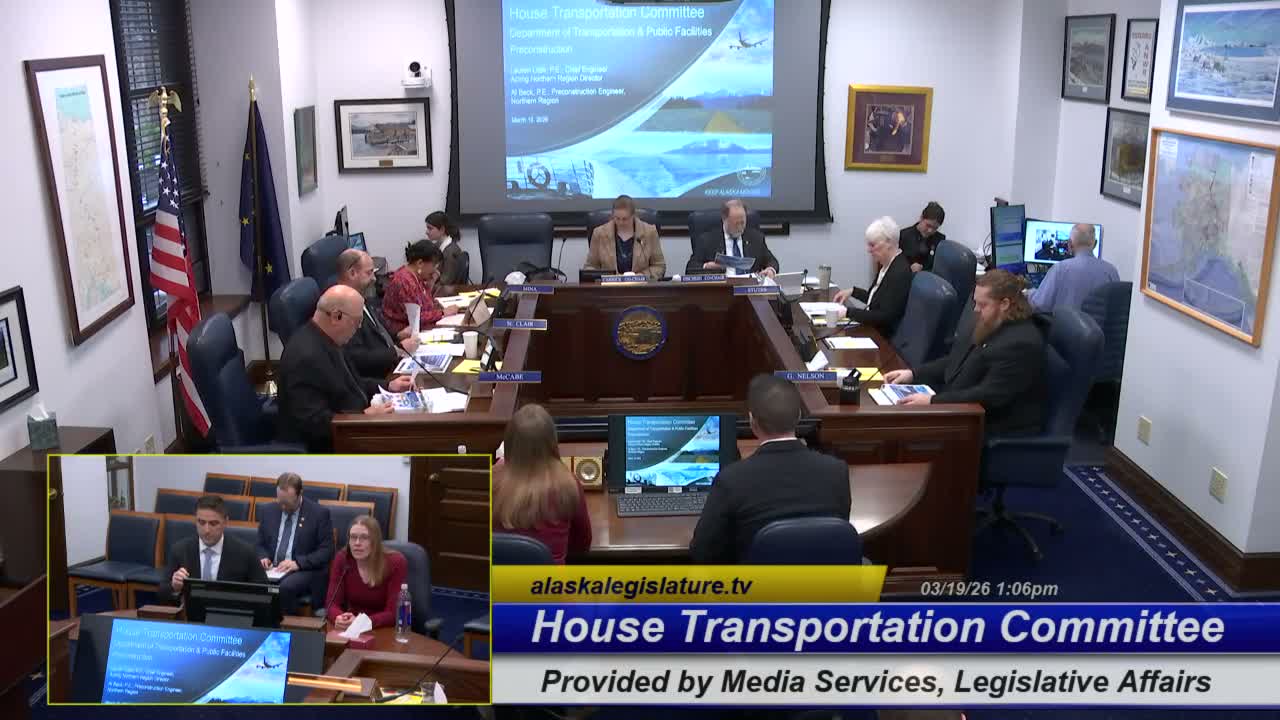
Alaska Department of Transportation and Public Facilities chief engineer and acting northern region director Lauren Little told the House Transportation Committee on March 19 that projects move from planning and needs lists through environmental review to detailed design and then construction, and that the environmental stage often includes roughly 10–30% design work before teams complete plans, specifications and cost estimates.
"Once we're done with that, NEPA stage of the project, we move into detailed design," Little said, explaining the sequence used for federally funded projects. She told lawmakers the state process follows similar categories but that funding source affects which steps can run in parallel.
Little described the right‑of‑way acquisition process: identify the property interest, appraise it, review the appraisal and then make an offer. "Under the Uniform Act, we we don't negotiate with property owners," she said, adding that owners can submit counteroffers but the acquisition process follows statutory procedures rather than bilateral haggling.
Al Beck, northern region preconstruction engineer, described how aviation projects differ: they may be designed early on state dollars, scored through an aviation advisory panel (APEP) for FAA funding, and require FAA concurrence before advertising; FAA grants typically reimburse up to 90% of eligible costs with final reimbursements after project closeout.
Committee members pressed DOT officials on when public involvement occurs. Little said public engagement is "throughout the life of the project," with particularly robust outreach during the environmental stage and additional updates (open houses, newsletters, websites) as projects advance.
Lawmakers and DOT staff discussed common bottlenecks that slow project delivery. Little cited turnover and slower reviews at federal permitting agencies, saying she has "seen a real slowdown" at agency reviewers, and highlighted how post‑Infrastructure Investment and Jobs Act domestic preference rules have complicated sourcing for utility materials. She told the committee that those changes have sometimes delayed utility relocations and held up multimillion‑dollar projects.
Little and Beck illustrated how outcomes vary by project type and funding. They described a Fairbanks highway safety improvement program (HSIP) project that was well defined, delivered on time and under budget and achieved a 37% crash cost reduction, and contrasted it with larger corridor projects — including the Parks Highway milepost 319–325 realignment near Nenana — that demanded extensive survey, environmental and land‑acquisition work and ultimately exceeded early cost and schedule expectations.
On land ownership, Little noted Alaska's patchwork surface and subsurface ownership can require acquiring interests from multiple parties for the same parcel: "you have Toqotili that owns the surface rights out here, and then Doyon owns the subsurface rights," she said, describing how that complexity adds time and cost.
Committee members also asked whether DOT disposes of surplus right‑of‑way. Andy Mills, DOT legislative liaison, said the department's right‑of‑way team evaluates potential disposals but balances them against future transportation needs, so disposal occurs when staff determine parcels are not needed for future projects.
Cochair Carrick closed the presentation by thanking Little and Beck and offered to bring additional DOT divisions to future briefings. The session continued with scheduling announcements and adjourned at 2:24 p.m.
Next steps: lawmakers requested background documentation on a separate Girdwood bill and indicated the committee will revisit that item at a later hearing.
"Once we're done with that, NEPA stage of the project, we move into detailed design," Little said, explaining the sequence used for federally funded projects. She told lawmakers the state process follows similar categories but that funding source affects which steps can run in parallel.
Little described the right‑of‑way acquisition process: identify the property interest, appraise it, review the appraisal and then make an offer. "Under the Uniform Act, we we don't negotiate with property owners," she said, adding that owners can submit counteroffers but the acquisition process follows statutory procedures rather than bilateral haggling.
Al Beck, northern region preconstruction engineer, described how aviation projects differ: they may be designed early on state dollars, scored through an aviation advisory panel (APEP) for FAA funding, and require FAA concurrence before advertising; FAA grants typically reimburse up to 90% of eligible costs with final reimbursements after project closeout.
Committee members pressed DOT officials on when public involvement occurs. Little said public engagement is "throughout the life of the project," with particularly robust outreach during the environmental stage and additional updates (open houses, newsletters, websites) as projects advance.
Lawmakers and DOT staff discussed common bottlenecks that slow project delivery. Little cited turnover and slower reviews at federal permitting agencies, saying she has "seen a real slowdown" at agency reviewers, and highlighted how post‑Infrastructure Investment and Jobs Act domestic preference rules have complicated sourcing for utility materials. She told the committee that those changes have sometimes delayed utility relocations and held up multimillion‑dollar projects.
Little and Beck illustrated how outcomes vary by project type and funding. They described a Fairbanks highway safety improvement program (HSIP) project that was well defined, delivered on time and under budget and achieved a 37% crash cost reduction, and contrasted it with larger corridor projects — including the Parks Highway milepost 319–325 realignment near Nenana — that demanded extensive survey, environmental and land‑acquisition work and ultimately exceeded early cost and schedule expectations.
On land ownership, Little noted Alaska's patchwork surface and subsurface ownership can require acquiring interests from multiple parties for the same parcel: "you have Toqotili that owns the surface rights out here, and then Doyon owns the subsurface rights," she said, describing how that complexity adds time and cost.
Committee members also asked whether DOT disposes of surplus right‑of‑way. Andy Mills, DOT legislative liaison, said the department's right‑of‑way team evaluates potential disposals but balances them against future transportation needs, so disposal occurs when staff determine parcels are not needed for future projects.
Cochair Carrick closed the presentation by thanking Little and Beck and offered to bring additional DOT divisions to future briefings. The session continued with scheduling announcements and adjourned at 2:24 p.m.
Next steps: lawmakers requested background documentation on a separate Girdwood bill and indicated the committee will revisit that item at a later hearing.
Don't Miss a Word: See the Full Meeting!
Go beyond summaries. Unlock every video, transcript, and key insight with a Founder Membership.
✓
Get instant access to full meeting videos
✓
Search and clip any phrase from complete transcripts
✓
Receive AI-powered summaries & custom alerts
✓
Enjoy lifetime, unrestricted access to government data
30-day money-back guarantee
