Alaska agencies warn of spread of Northern pike, green crab and invasive mussels; lawmakers pressed on capacity and funding
March 19, 2026 | 2026 Legislature Alaska, Alaska
This article was created by AI summarizing key points discussed. AI makes mistakes, so for full details and context, please refer to the video of the full meeting. Please report any errors so we can fix them. Report an error »
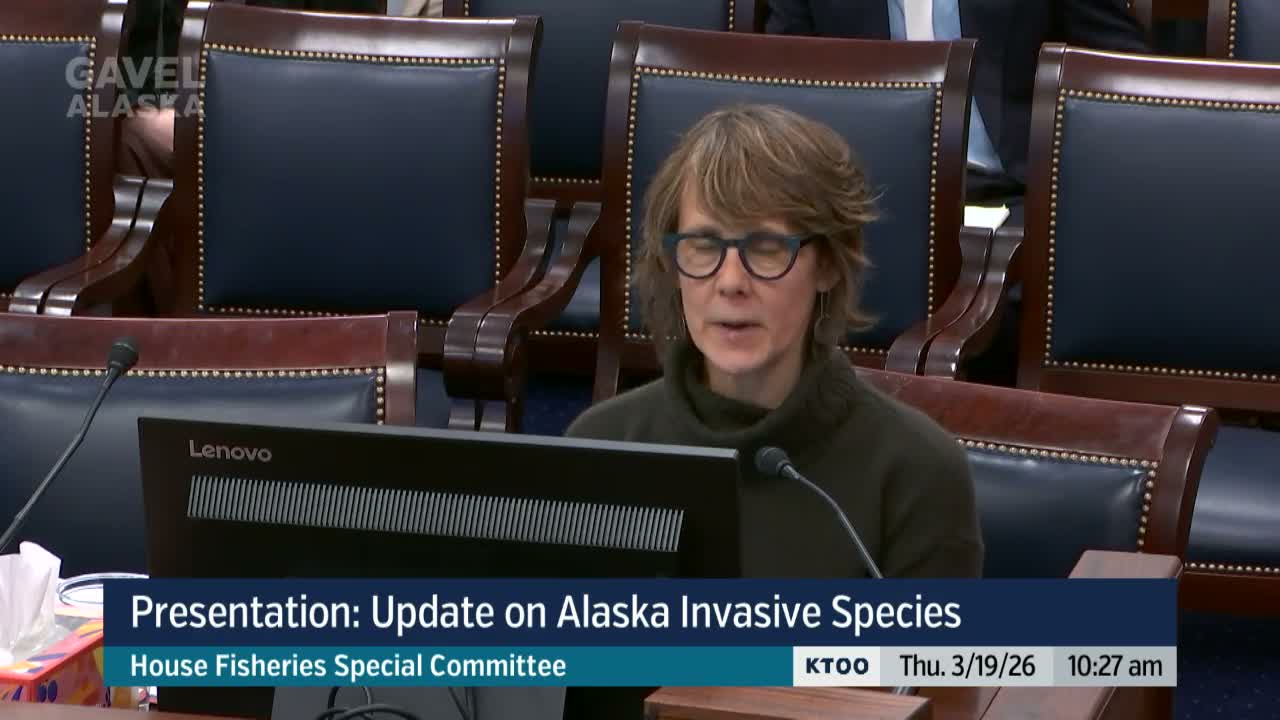
State agency officials told the House Special Committee on Fisheries on March 19 that Alaska faces growing aquatic invasive species threats and that prevention, monitoring and expanded community engagement are urgent priorities.
"It is legal to import live ornamental fish," Tammy Davis, invasive species program coordinator for the Alaska Department of Fish and Game (ADF&G), told the committee. She cited state and federal authorities that guide the program — including AS 16.35.210 (nonindigenous fish prohibition) and regulations such as 5 AAC 41.070 and the banned species list at 5 AAC 41.075 — and described how the department coordinates with federal, tribal and local partners to prevent, detect and respond to invasions.
Davis outlined three priority species: Northern pike, European green crab and dreissenid (zebra and quagga) mussels. She said Northern pike were illegally introduced to South Central Alaska and now are present in more than 150 water bodies; the fish are apex predators that have removed salmon from roughly 27% of some Matanuska‑Susitna lakes. ADF&G described multi‑year eradication and suppression efforts and cited tens of thousands of fish removed from targeted systems. "We have eradicated Northern Pike from 23 water bodies on the Kenai Peninsula", Davis said, and noted large collaborative removal efforts since 2011.
On European green crab, Davis said the species was first detected at Annette Islands Reserve in 2022 and the most recent verified report came from October 2025 at South Etalan Island. She warned the crab can damage eelgrass and nearshore food webs that support juvenile salmon and shellfish. ADF&G and partners have carried out trapping and beach surveys in Southeast communities (Metlakatla, Bostwick Inlet, Gravina Island, Cassan/Prince of Wales) and reported live animals and carapaces; Davis described an assessment that pulled 38 green crab over a five‑day, 100‑trap effort.
Dreissenid mussels have not been found established in Alaska, Davis said, but veligers and shell fragments have been detected on watercraft entering at the Alcan port. ADF&G emphasized prevention through outreach ("Clean, Drain, Dry"), inspection/decontamination partners, passive settlement samplers, plankton tows and training for community monitors. Davis said the state is eligible for some federal funds through adoption of an aquatic nuisance species management plan and that coordinated early detection enables access to federal implementation grants.
Committee members pressed agency staff on what tools Alaska can use and whether community bounty programs could help. Representative Russell McCabe proposed a $10‑per‑fish bounty or pike derbies like those used elsewhere. Joe Feckel, deputy director assisting the commissioner's office at ADF&G, said he would raise the idea with regional sportfish staff and return with a formal response on logistics and feasibility.
Lawmakers asked about statewide coordination and whether Alaska needs a formal council like those in other states. Davis said the Alaska Invasive Species Partnership (ACISP) provides cross‑sector coordination but that a more formal council could offer advisory authority to state agencies and legislators. She acknowledged Alaska currently lacks the personnel and logistical capacity for large‑scale, immediate rapid responses in many places and noted regulatory hurdles (including NEPA) that can complicate some interventions.
On funding, Feckel said ADF&G's statewide invasive species position is permanent and regional pike efforts have dedicated staff and seasonal employees. Much program support comes from federal grants (including US Fish and Wildlife Service grants and Dingell‑Johnson funds), with state general funds providing required matches.
Casey Dinkel, manager of the Alaska Plant Materials Center at the Department of Natural Resources, updated the committee on elodea work. Dinkel reported 2025 herbicide treatments and surveys at Harding Lake, Alexander and Sucker Lakes (a watershed treatment where Alexander was described as roughly 750 acre‑feet), Crescent Lake (Kenai Peninsula) and Six Mile Lake near Joint Base Elmendorf. Dinkel said the Alexander/Sucker watershed treatment is currently funded year‑to‑year and the plan is to secure three years of funding to pursue eradication.
ADF&G and DNR described planned 2026 actions including more field and lab trainings (including a May 2026 session on the Kenai Peninsula), expanded community‑based early detection networks, eDNA sampling plans with partners and development of communication protocols for interpreting eDNA results and directing follow‑up funding and response. Committee members requested written follow‑ups on potential bounty programs, specific eradication tools and more detail on inspection availability for boats arriving from the Lower 48.
The committee adjourned after the two agency briefings; members directed staff to follow up on the outstanding questions.
"It is legal to import live ornamental fish," Tammy Davis, invasive species program coordinator for the Alaska Department of Fish and Game (ADF&G), told the committee. She cited state and federal authorities that guide the program — including AS 16.35.210 (nonindigenous fish prohibition) and regulations such as 5 AAC 41.070 and the banned species list at 5 AAC 41.075 — and described how the department coordinates with federal, tribal and local partners to prevent, detect and respond to invasions.
Davis outlined three priority species: Northern pike, European green crab and dreissenid (zebra and quagga) mussels. She said Northern pike were illegally introduced to South Central Alaska and now are present in more than 150 water bodies; the fish are apex predators that have removed salmon from roughly 27% of some Matanuska‑Susitna lakes. ADF&G described multi‑year eradication and suppression efforts and cited tens of thousands of fish removed from targeted systems. "We have eradicated Northern Pike from 23 water bodies on the Kenai Peninsula", Davis said, and noted large collaborative removal efforts since 2011.
On European green crab, Davis said the species was first detected at Annette Islands Reserve in 2022 and the most recent verified report came from October 2025 at South Etalan Island. She warned the crab can damage eelgrass and nearshore food webs that support juvenile salmon and shellfish. ADF&G and partners have carried out trapping and beach surveys in Southeast communities (Metlakatla, Bostwick Inlet, Gravina Island, Cassan/Prince of Wales) and reported live animals and carapaces; Davis described an assessment that pulled 38 green crab over a five‑day, 100‑trap effort.
Dreissenid mussels have not been found established in Alaska, Davis said, but veligers and shell fragments have been detected on watercraft entering at the Alcan port. ADF&G emphasized prevention through outreach ("Clean, Drain, Dry"), inspection/decontamination partners, passive settlement samplers, plankton tows and training for community monitors. Davis said the state is eligible for some federal funds through adoption of an aquatic nuisance species management plan and that coordinated early detection enables access to federal implementation grants.
Committee members pressed agency staff on what tools Alaska can use and whether community bounty programs could help. Representative Russell McCabe proposed a $10‑per‑fish bounty or pike derbies like those used elsewhere. Joe Feckel, deputy director assisting the commissioner's office at ADF&G, said he would raise the idea with regional sportfish staff and return with a formal response on logistics and feasibility.
Lawmakers asked about statewide coordination and whether Alaska needs a formal council like those in other states. Davis said the Alaska Invasive Species Partnership (ACISP) provides cross‑sector coordination but that a more formal council could offer advisory authority to state agencies and legislators. She acknowledged Alaska currently lacks the personnel and logistical capacity for large‑scale, immediate rapid responses in many places and noted regulatory hurdles (including NEPA) that can complicate some interventions.
On funding, Feckel said ADF&G's statewide invasive species position is permanent and regional pike efforts have dedicated staff and seasonal employees. Much program support comes from federal grants (including US Fish and Wildlife Service grants and Dingell‑Johnson funds), with state general funds providing required matches.
Casey Dinkel, manager of the Alaska Plant Materials Center at the Department of Natural Resources, updated the committee on elodea work. Dinkel reported 2025 herbicide treatments and surveys at Harding Lake, Alexander and Sucker Lakes (a watershed treatment where Alexander was described as roughly 750 acre‑feet), Crescent Lake (Kenai Peninsula) and Six Mile Lake near Joint Base Elmendorf. Dinkel said the Alexander/Sucker watershed treatment is currently funded year‑to‑year and the plan is to secure three years of funding to pursue eradication.
ADF&G and DNR described planned 2026 actions including more field and lab trainings (including a May 2026 session on the Kenai Peninsula), expanded community‑based early detection networks, eDNA sampling plans with partners and development of communication protocols for interpreting eDNA results and directing follow‑up funding and response. Committee members requested written follow‑ups on potential bounty programs, specific eradication tools and more detail on inspection availability for boats arriving from the Lower 48.
The committee adjourned after the two agency briefings; members directed staff to follow up on the outstanding questions.
Don't Miss a Word: See the Full Meeting!
Go beyond summaries. Unlock every video, transcript, and key insight with a Founder Membership.
✓
Get instant access to full meeting videos
✓
Search and clip any phrase from complete transcripts
✓
Receive AI-powered summaries & custom alerts
✓
Enjoy lifetime, unrestricted access to government data
30-day money-back guarantee
