Study: Alaska oil and gas supported about 70,400 jobs and $6.6 billion in wages in 2024
March 19, 2026 | 2026 Legislature Alaska, Alaska
This article was created by AI summarizing key points discussed. AI makes mistakes, so for full details and context, please refer to the video of the full meeting. Please report any errors so we can fix them. Report an error »
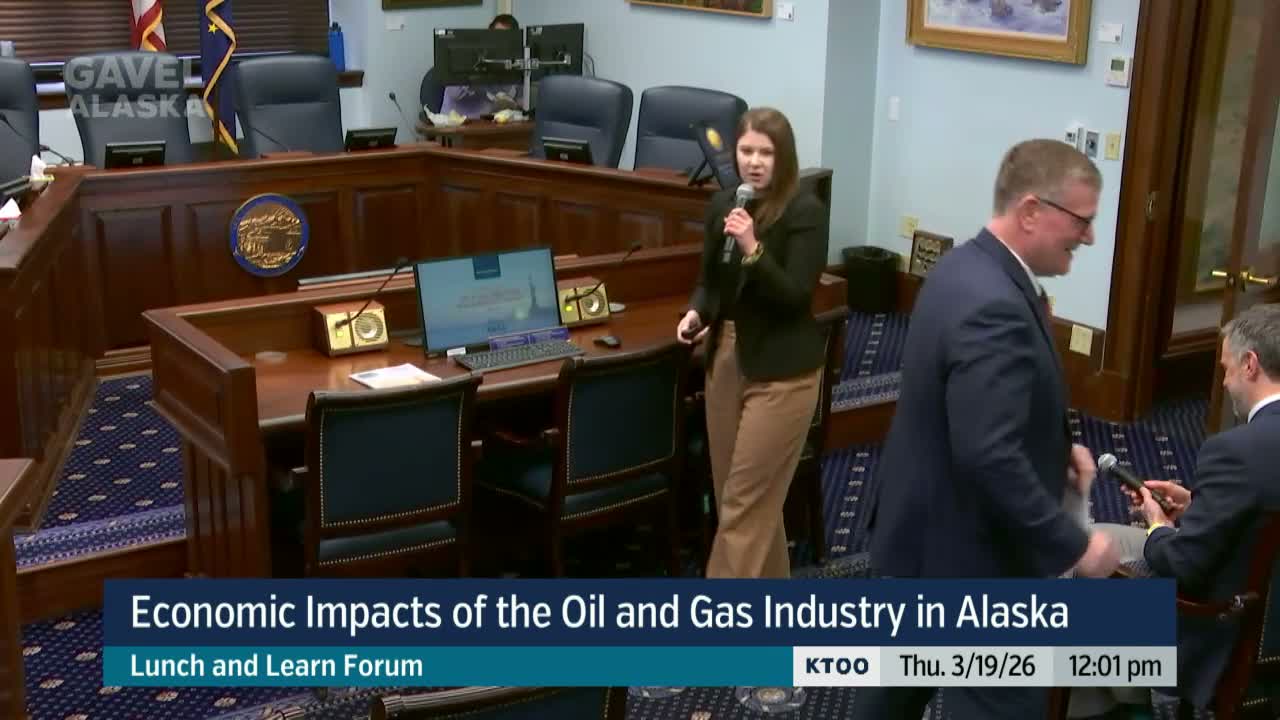
Katy Berry, president of McKinley Research Group, told a legislative lunch-and-learn that Alaska’s oil and gas industry supported roughly 70,400 jobs in 2024 and about $6.6 billion in wages. “In total, in 2024, Alaska's oil and gas industry supported about 70,400 jobs in Alaska, and that was associated with $6,600,000,000 in wages,” Berry said.
Berry said those figures come from an economic-impact update the firm prepared using detailed information from 14 primary companies, special data requests to the Department of Labor and state fiscal data. The study counted about 4,500 workers directly employed by those primary companies in 2024, with about 75% of those jobs filled by Alaska residents, and measured the broader downstream effects of company spending via vendor contracts and state government revenue.
The presentation quantified industry spending and fiscal returns: in 2024 the oil and gas industry spent about $5.8 billion with more than 1,000 Alaska vendors and paid approximately $3.5 billion in taxes, royalties and fees, of which about $3.0 billion went to the state and roughly $510 million to local governments. Berry noted those local receipts are material for jurisdictions such as the North Slope Borough.
Berry described the sector’s multiplier effect: for every one primary-company job the study estimates roughly 14 additional jobs are supported elsewhere in the Alaska economy, a ratio Berry said is currently the highest multiplier of any industry in the state. “That is the highest multiplier of any industry in our state,” she said, adding that the scale reflects a high share of resident employment and extensive vendor spending across many communities.
On production and near-term projects, Berry said North Slope production has been relatively stable despite price volatility and highlighted incoming production tied to two large fields under development. She said Santos expects to start production at Pikka around 2026 and that ConocoPhillips expects Willow to begin producing around 2029–2030, which together help explain projected increases in average barrels per day in coming years.
Looking ahead, Berry said the 14 primary companies collectively expect to spend about $22 billion on investments on the North Slope and in Cook Inlet over the coming years; she emphasized that figure excludes the Alaska LNG project and that a final investment decision on that project would materially change the outlook. For state government revenue, she said oil-and-gas receipts were projected on average at about $2.4 billion per year in forward-looking scenarios and that royalties are expected to increase with new developments, representing roughly 27% of unrestricted general fund revenue in the study’s framing.
During a short question-and-answer period, an attendee asked whether the report includes company-level revenue or per-barrel production breakdowns; Berry replied those company-level details are not in the public report and that interested parties should consult state resources for company-specific totals. When asked whether the 1-to-14 multiplier is permanent, Berry said the goods-and-services spending multiplier has been stable but that the share of the multiplier tied to state government employment has declined as the legislature shifted some dependence from oil-and-gas revenue toward Permanent Fund distributions.
The slides and report are available via the Ayoga website and through the legislative website, Berry said. The session ended after brief closing remarks from the representative who introduced the event.
Berry said those figures come from an economic-impact update the firm prepared using detailed information from 14 primary companies, special data requests to the Department of Labor and state fiscal data. The study counted about 4,500 workers directly employed by those primary companies in 2024, with about 75% of those jobs filled by Alaska residents, and measured the broader downstream effects of company spending via vendor contracts and state government revenue.
The presentation quantified industry spending and fiscal returns: in 2024 the oil and gas industry spent about $5.8 billion with more than 1,000 Alaska vendors and paid approximately $3.5 billion in taxes, royalties and fees, of which about $3.0 billion went to the state and roughly $510 million to local governments. Berry noted those local receipts are material for jurisdictions such as the North Slope Borough.
Berry described the sector’s multiplier effect: for every one primary-company job the study estimates roughly 14 additional jobs are supported elsewhere in the Alaska economy, a ratio Berry said is currently the highest multiplier of any industry in the state. “That is the highest multiplier of any industry in our state,” she said, adding that the scale reflects a high share of resident employment and extensive vendor spending across many communities.
On production and near-term projects, Berry said North Slope production has been relatively stable despite price volatility and highlighted incoming production tied to two large fields under development. She said Santos expects to start production at Pikka around 2026 and that ConocoPhillips expects Willow to begin producing around 2029–2030, which together help explain projected increases in average barrels per day in coming years.
Looking ahead, Berry said the 14 primary companies collectively expect to spend about $22 billion on investments on the North Slope and in Cook Inlet over the coming years; she emphasized that figure excludes the Alaska LNG project and that a final investment decision on that project would materially change the outlook. For state government revenue, she said oil-and-gas receipts were projected on average at about $2.4 billion per year in forward-looking scenarios and that royalties are expected to increase with new developments, representing roughly 27% of unrestricted general fund revenue in the study’s framing.
During a short question-and-answer period, an attendee asked whether the report includes company-level revenue or per-barrel production breakdowns; Berry replied those company-level details are not in the public report and that interested parties should consult state resources for company-specific totals. When asked whether the 1-to-14 multiplier is permanent, Berry said the goods-and-services spending multiplier has been stable but that the share of the multiplier tied to state government employment has declined as the legislature shifted some dependence from oil-and-gas revenue toward Permanent Fund distributions.
The slides and report are available via the Ayoga website and through the legislative website, Berry said. The session ended after brief closing remarks from the representative who introduced the event.
Don't Miss a Word: See the Full Meeting!
Go beyond summaries. Unlock every video, transcript, and key insight with a Founder Membership.
✓
Get instant access to full meeting videos
✓
Search and clip any phrase from complete transcripts
✓
Receive AI-powered summaries & custom alerts
✓
Enjoy lifetime, unrestricted access to government data
30-day money-back guarantee
