Director warns workers' compensation fund shortfall as staffing and services shrink
March 19, 2026 | 2026 Legislature Alaska, Alaska
This article was created by AI summarizing key points discussed. AI makes mistakes, so for full details and context, please refer to the video of the full meeting. Please report any errors so we can fix them. Report an error »
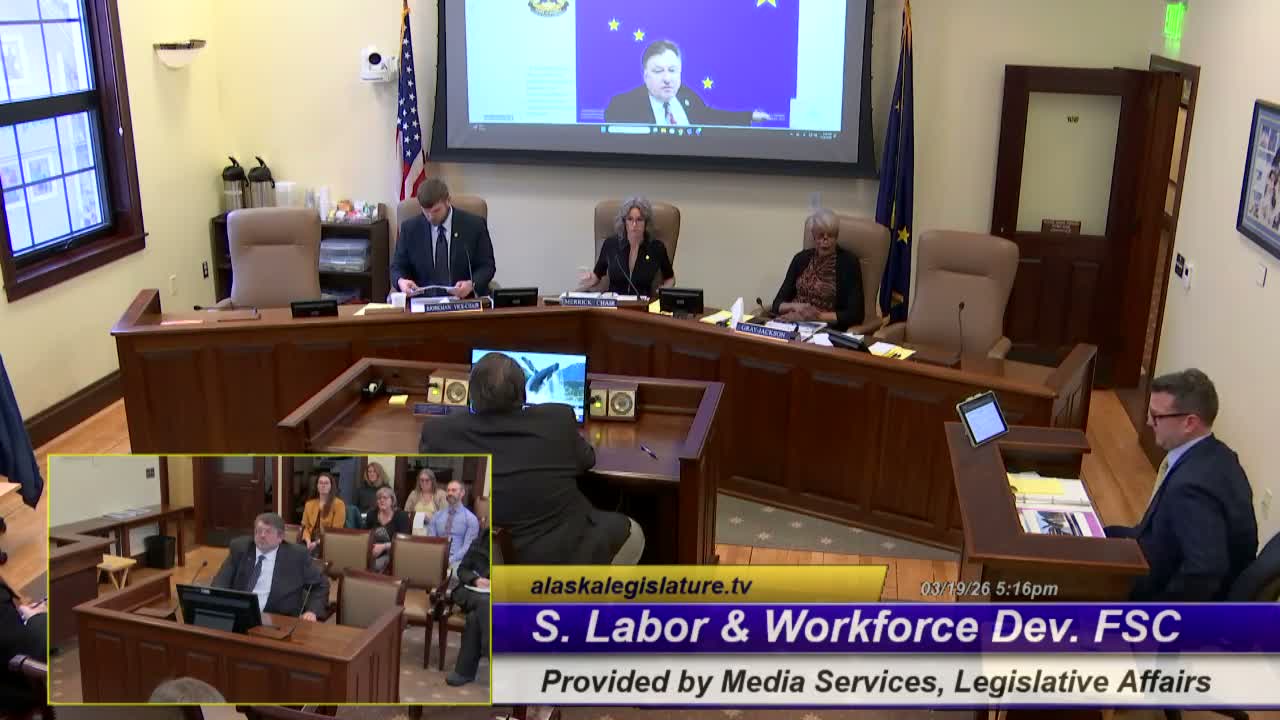
Director Charles Collins told the Department of Labor and Workforce Development Finance Subcommittee on March 19 that long-term declines in premium-based revenue are creating structural funding pressures for the state’s workers' compensation programs.
Collins, who leads the division that administers Alaska's workers' compensation accounts, said the program relies primarily on the Worker Safety and Compensation Administration account (WSCA), plus a Benefits Guarantee Fund and a closed Second Injury Fund. "WSCA ... is made up of fees collected on insurance premiums for workers' compensation and also from the 23 self-insured entities that we have in the state of Alaska," Collins said.
He said the division and its partners have reduced costs and, over the past decade, "we have saved employers 1,100,000,000.0 in costs." At the same time, Collins said premium-driven revenue has fallen: he estimated WSCA receipts around $6.5 million annually and said that shortfall is creating a widening gap between revenue and expenditures.
Collins told the committee the division has cut expenses to manage the gap: 13 positions are vacant, supervisory roles were consolidated, a planned upgrade to the claim database was put on hold, and the Fairbanks office was closed to in-person services. He called the service impacts significant: average hearing readiness times have risen to about 46 days from a statutory 30 days, slowing dispute resolution and in some cases delaying benefits.
Collins also noted $2.75 million in prior transfers out of WSCA at the ends of fiscal years 2022–24. He warned the combination of lower premium collections, rising personal-services costs and unfilled positions means managers will soon face more consequential decisions about services and staffing unless revenue or statutory structures change.
Committee members did not move to a formal action during the meeting; Collins said he was available to answer follow up questions and the committee requested written materials explaining the benefit calculations and program impacts.
The Finance Subcommittee took no votes on the item. The presenters and committee agreed to continue discussion in other forums and next-week legislative hearings.
Collins, who leads the division that administers Alaska's workers' compensation accounts, said the program relies primarily on the Worker Safety and Compensation Administration account (WSCA), plus a Benefits Guarantee Fund and a closed Second Injury Fund. "WSCA ... is made up of fees collected on insurance premiums for workers' compensation and also from the 23 self-insured entities that we have in the state of Alaska," Collins said.
He said the division and its partners have reduced costs and, over the past decade, "we have saved employers 1,100,000,000.0 in costs." At the same time, Collins said premium-driven revenue has fallen: he estimated WSCA receipts around $6.5 million annually and said that shortfall is creating a widening gap between revenue and expenditures.
Collins told the committee the division has cut expenses to manage the gap: 13 positions are vacant, supervisory roles were consolidated, a planned upgrade to the claim database was put on hold, and the Fairbanks office was closed to in-person services. He called the service impacts significant: average hearing readiness times have risen to about 46 days from a statutory 30 days, slowing dispute resolution and in some cases delaying benefits.
Collins also noted $2.75 million in prior transfers out of WSCA at the ends of fiscal years 2022–24. He warned the combination of lower premium collections, rising personal-services costs and unfilled positions means managers will soon face more consequential decisions about services and staffing unless revenue or statutory structures change.
Committee members did not move to a formal action during the meeting; Collins said he was available to answer follow up questions and the committee requested written materials explaining the benefit calculations and program impacts.
The Finance Subcommittee took no votes on the item. The presenters and committee agreed to continue discussion in other forums and next-week legislative hearings.
Don't Miss a Word: See the Full Meeting!
Go beyond summaries. Unlock every video, transcript, and key insight with a Founder Membership.
✓
Get instant access to full meeting videos
✓
Search and clip any phrase from complete transcripts
✓
Receive AI-powered summaries & custom alerts
✓
Enjoy lifetime, unrestricted access to government data
30-day money-back guarantee
