Alaska Marine Highway leaders outline fleet upgrades, workforce plans and a federal grant shortfall to Senate Transportation
March 19, 2026 | 2026 Legislature Alaska, Alaska
This article was created by AI summarizing key points discussed. AI makes mistakes, so for full details and context, please refer to the video of the full meeting. Please report any errors so we can fix them. Report an error »
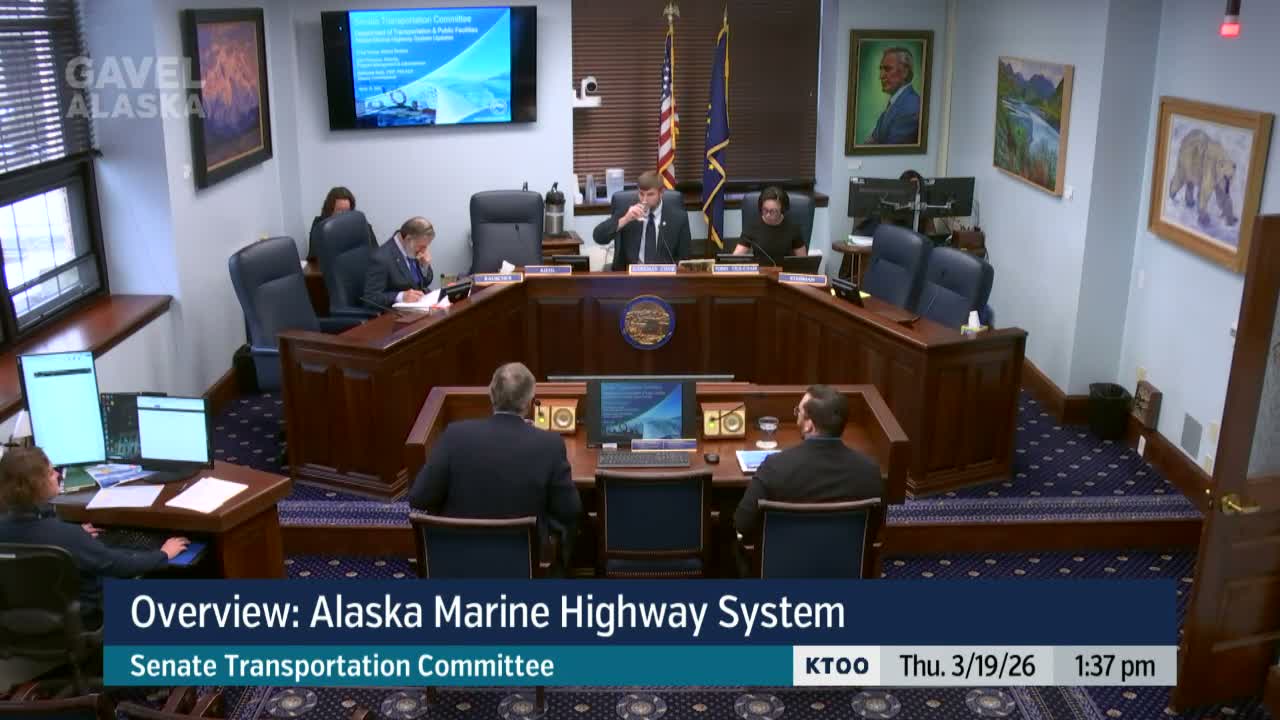
Alaska Marine Highway System (AMHS) leaders told the Senate Transportation Committee on March 19 that a multi‑year effort to modernize vessels and terminals, expand workforce training and improve customer service is under way — but the system faces a potential funding gap because a recurring Federal Transit Administration (FTA) grant the budget assumed was not issued this year.
"Our safety goal is no harm," Craig Torga, Marine Director for the Alaska Marine Highways, told the committee. He reviewed 2025 safety results, saying the system logged nine lost‑time incidents (mostly slips and falls), had no vessel or terminal spills to water, contained several customer vehicle spills at terminals, and responded to a drum leak at the Ketchikan maintenance warehouse that reached a storm drain but was cleaned up.
Torga said AMHS recorded "an uptime of 98.55%" in 2025 and described a fuel‑contamination event that damaged injectors on one vessel. He told senators the department now samples every fuel compartment after a contaminated compartment required repairs: "When the next load, we did that and we found in the third compartment," he said. The department said it has not been compensated because it could not definitively trace the timing to a supplier delivery.
On modernization, Torga outlined an eight‑vessel long‑range fleet plan that emphasizes standardization and interchangeability, highlighted major Kennecott shipyard work (generator replacements, engine rebuilds, hull blasting and cathodic protection) and described upgrades on Columbia intended to keep that vessel operating for another eight to nine years. He said the department is designing a new mainline vessel and has a $9,000,000 design grant for that work; a separate design contract for a small diesel‑electric ferry was awarded to Glosten after a roughly $46,000,000 grant award referenced in the presentation.
Torga described near‑term operational improvements: website fixes, handheld scanners that produce real‑time manifests to satisfy Coast Guard audits, a new vessel scheduling system, upgrades to shipboard Wi‑Fi and a planned mobile reservation/boarding‑pass app.
Workforce development was a major focus. Torga described partnerships with the University of Alaska and apprenticeship pathways that aim to move seafarers from entry‑level roles to licensed positions; he cited tuition and time‑away costs for some advancement courses and said "the tuition itself is... close to $30,000." The department has started programs to promote in‑state hires and provide partial pay for seafarers gaining pilotage under new contract clauses.
Dom Pinone, Director of Program Management and Administration, outlined the department's fiscal picture. He said the FY current budget is $170,700,000 and that budgets had been built assuming a recurring federal grant of roughly $77,900,000 that this year was not issued by the FTA. "With the 90,000,000 we have, that's enough to cash flow the operation without modifying or changing our schedules or or shutting down ships, into July," Pinone said, referring to existing state general funds and Marine Highway Fund revenue. He said the department has high confidence the federal notice of funding opportunity will be issued soon but that confidence cannot be 100% and that contingency planning is ongoing.
Senators pressed officials on specifics: Senator Tobin asked whether the department's in‑state travel request has been included in the budget; Torga said it has been requested through legislative channels but not approved. Senator Rauscher asked about compensation for costs tied to contaminated fuel; Torga said the supplier investigated but the department has not been reimbursed because timing could not be pinned to delivery.
Pinone said the department seeks a multiyear 'waterfall' appropriation for FY27 to allow carryforward flexibility and said the department will pursue available federal program funding (including the remainder of a large program referenced in the presentation). If a federal award is delayed, Pinone said AMHS would use available state funds and work with the legislature on further measures before considering schedule reductions.
The committee did not take votes. Chair Senator Bjorkman closed the meeting at 2:35 p.m. and said the committee will next meet March 24 to hear House Bill 26 (Statewide Public and Community Transit Plan), Senate Bill 239 (Motor Vehicle Registration) and a DOT&PF asset management presentation.
Sources: testimony and answers to senators from Craig Torga (Marine Director, Alaska Marine Highways) and Dom Pinone (Director of Program Management and Administration, DOT&PF) at the March 19, 2026 Senate Transportation Committee hearing.
"Our safety goal is no harm," Craig Torga, Marine Director for the Alaska Marine Highways, told the committee. He reviewed 2025 safety results, saying the system logged nine lost‑time incidents (mostly slips and falls), had no vessel or terminal spills to water, contained several customer vehicle spills at terminals, and responded to a drum leak at the Ketchikan maintenance warehouse that reached a storm drain but was cleaned up.
Torga said AMHS recorded "an uptime of 98.55%" in 2025 and described a fuel‑contamination event that damaged injectors on one vessel. He told senators the department now samples every fuel compartment after a contaminated compartment required repairs: "When the next load, we did that and we found in the third compartment," he said. The department said it has not been compensated because it could not definitively trace the timing to a supplier delivery.
On modernization, Torga outlined an eight‑vessel long‑range fleet plan that emphasizes standardization and interchangeability, highlighted major Kennecott shipyard work (generator replacements, engine rebuilds, hull blasting and cathodic protection) and described upgrades on Columbia intended to keep that vessel operating for another eight to nine years. He said the department is designing a new mainline vessel and has a $9,000,000 design grant for that work; a separate design contract for a small diesel‑electric ferry was awarded to Glosten after a roughly $46,000,000 grant award referenced in the presentation.
Torga described near‑term operational improvements: website fixes, handheld scanners that produce real‑time manifests to satisfy Coast Guard audits, a new vessel scheduling system, upgrades to shipboard Wi‑Fi and a planned mobile reservation/boarding‑pass app.
Workforce development was a major focus. Torga described partnerships with the University of Alaska and apprenticeship pathways that aim to move seafarers from entry‑level roles to licensed positions; he cited tuition and time‑away costs for some advancement courses and said "the tuition itself is... close to $30,000." The department has started programs to promote in‑state hires and provide partial pay for seafarers gaining pilotage under new contract clauses.
Dom Pinone, Director of Program Management and Administration, outlined the department's fiscal picture. He said the FY current budget is $170,700,000 and that budgets had been built assuming a recurring federal grant of roughly $77,900,000 that this year was not issued by the FTA. "With the 90,000,000 we have, that's enough to cash flow the operation without modifying or changing our schedules or or shutting down ships, into July," Pinone said, referring to existing state general funds and Marine Highway Fund revenue. He said the department has high confidence the federal notice of funding opportunity will be issued soon but that confidence cannot be 100% and that contingency planning is ongoing.
Senators pressed officials on specifics: Senator Tobin asked whether the department's in‑state travel request has been included in the budget; Torga said it has been requested through legislative channels but not approved. Senator Rauscher asked about compensation for costs tied to contaminated fuel; Torga said the supplier investigated but the department has not been reimbursed because timing could not be pinned to delivery.
Pinone said the department seeks a multiyear 'waterfall' appropriation for FY27 to allow carryforward flexibility and said the department will pursue available federal program funding (including the remainder of a large program referenced in the presentation). If a federal award is delayed, Pinone said AMHS would use available state funds and work with the legislature on further measures before considering schedule reductions.
The committee did not take votes. Chair Senator Bjorkman closed the meeting at 2:35 p.m. and said the committee will next meet March 24 to hear House Bill 26 (Statewide Public and Community Transit Plan), Senate Bill 239 (Motor Vehicle Registration) and a DOT&PF asset management presentation.
Sources: testimony and answers to senators from Craig Torga (Marine Director, Alaska Marine Highways) and Dom Pinone (Director of Program Management and Administration, DOT&PF) at the March 19, 2026 Senate Transportation Committee hearing.
View the Full Meeting & All Its Details
This article offers just a summary. Unlock complete video, transcripts, and insights as a Founder Member.
✓
Watch full, unedited meeting videos
✓
Search every word spoken in unlimited transcripts
✓
AI summaries & real-time alerts (all government levels)
✓
Permanent access to expanding government content
30-day money-back guarantee
