Officials say Alaska's UI trust fund is overcapitalized; statute limits tax relief
March 19, 2026 | 2026 Legislature Alaska, Alaska
This article was created by AI summarizing key points discussed. AI makes mistakes, so for full details and context, please refer to the video of the full meeting. Please report any errors so we can fix them. Report an error »
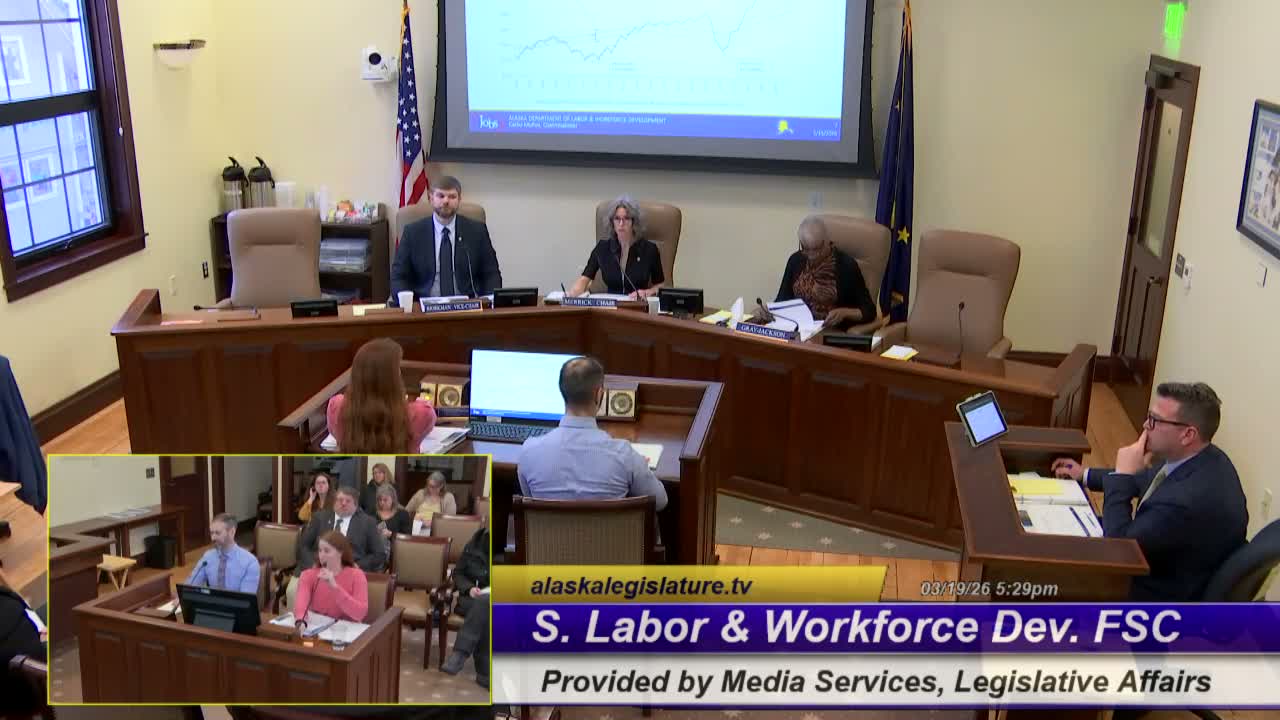
Director Paloma Harbor and economist Lennon Weller told the Finance Subcommittee on March 19 that Alaska’s unemployment insurance trust fund is above statutory solvency targets and statutory minimums are preventing tax rates from falling to actuarially indicated levels.
Weller reported that "In December 2025, the UI trust fund balance was $833,000,000," about $250 million higher than the high end of the statutory target range of $583,000,000 (a reserve ratio target of 3–3.3% of wages). He said low claims (18,790 claimants in 2025) and strong fund performance explain the overcapitalization.
Harbor and Weller explained the statutory mechanics that determine employer and employee rates. "If it is an unemployment tax, it must be deposited into the unemployment trust fund," Harbor said in response to a question about redirecting employer UI taxes. She cited the Federal Unemployment Tax Act (FUTA) as the constraint and said the governor's proposal discussed elsewhere could create a separate employer training tax and lower the UI tax by an equivalent percentage, but that current UI tax receipts cannot be diverted.
Officials described statutory minimums that keep employer tax rates at 1% and employee rates at 0.5% even when actuarial calculations would indicate lower rates; Weller showed how the statutory rate calculation and a multi-class rate system (21 classes) operate to allocate costs by employer experience.
Senator Grama Jackson questioned whether benefit levels keep pace with Alaska's cost of living. Harbor said the minimum weekly benefit is $56, the maximum weekly benefit is $370, and a dependent allowance is $24 per dependent (up to three). Harbor said adjusting the $370 2009 maximum for inflation would yield about $525 per week today; an alternative method aligning benefits to the taxable wage base would result in about $470 per week.
Committee members noted related bills to be considered in Senate Labor and Commerce next week; presenters offered to provide written calculations and supporting data.
No formal action was taken at the subcommittee meeting.
Weller reported that "In December 2025, the UI trust fund balance was $833,000,000," about $250 million higher than the high end of the statutory target range of $583,000,000 (a reserve ratio target of 3–3.3% of wages). He said low claims (18,790 claimants in 2025) and strong fund performance explain the overcapitalization.
Harbor and Weller explained the statutory mechanics that determine employer and employee rates. "If it is an unemployment tax, it must be deposited into the unemployment trust fund," Harbor said in response to a question about redirecting employer UI taxes. She cited the Federal Unemployment Tax Act (FUTA) as the constraint and said the governor's proposal discussed elsewhere could create a separate employer training tax and lower the UI tax by an equivalent percentage, but that current UI tax receipts cannot be diverted.
Officials described statutory minimums that keep employer tax rates at 1% and employee rates at 0.5% even when actuarial calculations would indicate lower rates; Weller showed how the statutory rate calculation and a multi-class rate system (21 classes) operate to allocate costs by employer experience.
Senator Grama Jackson questioned whether benefit levels keep pace with Alaska's cost of living. Harbor said the minimum weekly benefit is $56, the maximum weekly benefit is $370, and a dependent allowance is $24 per dependent (up to three). Harbor said adjusting the $370 2009 maximum for inflation would yield about $525 per week today; an alternative method aligning benefits to the taxable wage base would result in about $470 per week.
Committee members noted related bills to be considered in Senate Labor and Commerce next week; presenters offered to provide written calculations and supporting data.
No formal action was taken at the subcommittee meeting.
Don't Miss a Word: See the Full Meeting!
Go beyond summaries. Unlock every video, transcript, and key insight with a Founder Membership.
✓
Get instant access to full meeting videos
✓
Search and clip any phrase from complete transcripts
✓
Receive AI-powered summaries & custom alerts
✓
Enjoy lifetime, unrestricted access to government data
30-day money-back guarantee
