Commerce presents $242.8 million FY2027 budget; proposes fee shifts, highlights broadband and community aid
March 19, 2026 | 2026 Legislature Alaska, Alaska
This article was created by AI summarizing key points discussed. AI makes mistakes, so for full details and context, please refer to the video of the full meeting. Please report any errors so we can fix them. Report an error »
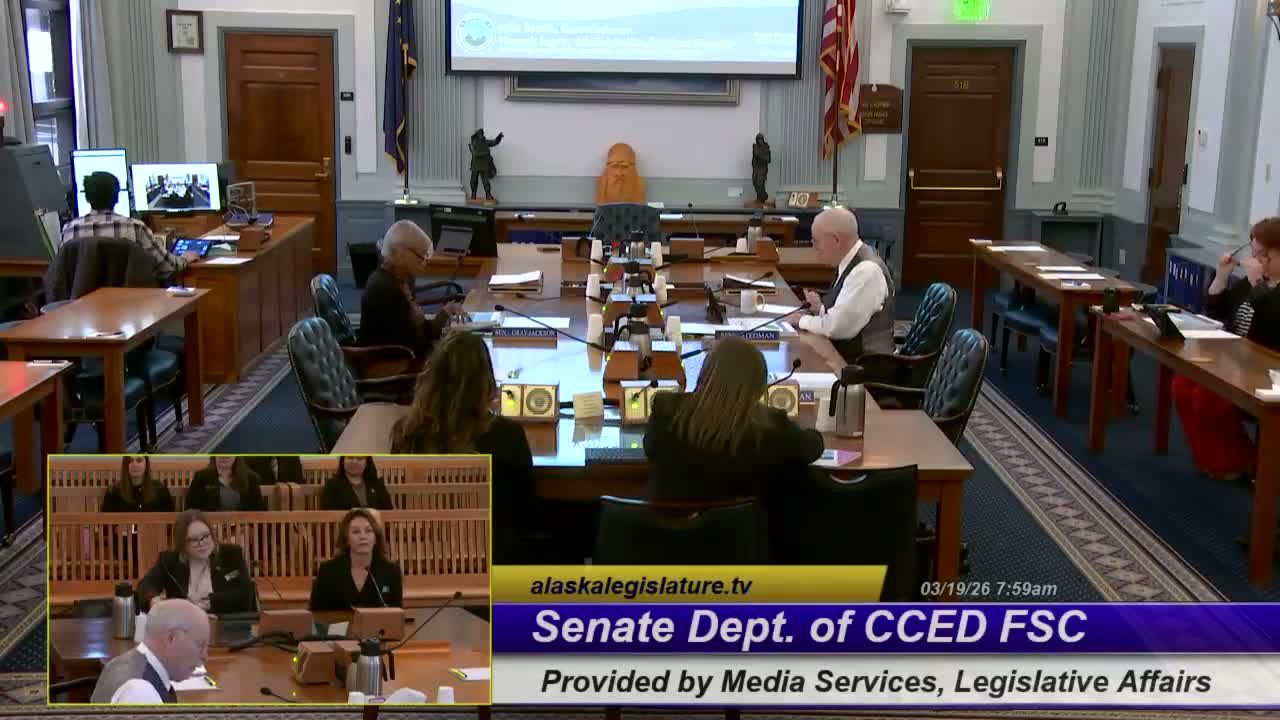
Commissioner Julie Sandy and department budget director Hannah Lager presented the governor's fiscal year 2027 budget for the Department of Commerce, Community and Economic Development to the Alaska Senate Finance Committee on March 19, saying the department's request totals $242,800,000.
Lager, the department's administrative services director, told senators the department consumes a small share of Unrestricted General Fund dollars while relying heavily on designated receipts such as licensing and program fees. "Our fiscal year 20 27 budget request totals 242,800,000.0," Lager said, laying out lines that show a modest general-fund portion and larger designated funds.
The presentation emphasized recent broadband progress. Commissioner Sandy credited the Alaska Broadband Office and singled out staff work behind a recent large award, noting a recent announcement of roughly $600 million tied to broadband initiatives. "We are very excited about that," Lager said.
On community funding, Lager explained how the Community Assistance Fund is computed under statute and recent distributions: the fund pays one-third of its balance each year (balance measured on June 30 and payouts calculated July 1). She said the distribution for fiscal year 2026 was "just over $23,000,000" and noted a $20,000,000 distribution scheduled for July 1, 2026. The governor's proposal includes a $14,000,000 capitalization from the Power Cost Equalization Fund that Lager said could produce roughly an $18,000,000 distribution beginning in fiscal 2028 if enacted.
Senators pressed on policy choices about distribution size and predictability. Lager said setting distribution levels is a policy decision but stressed the department's priority is making funding known in advance so small communities can plan. Committee members indicated they expect to address any shortfalls during the budget process.
Lager also described personnel and operational adjustments: implementing an IT classification study, bringing back positions for travel expense and accounts-payable processing from the Department of Administration while remaining in centralized payroll, and adding grants-management staff to handle large disaster-recovery Community Development Block Grant awards that she described as "30,000,000 plus" per award.
On licensing policy, senators raised concerns that historically held-down fees have left some regulatory boards unable to cover administrative costs. Lager said the administration will propose fee adjustments and described a policy change to remove investigation costs from profession-specific fee-setting; instead, the department proposes paying those costs from business-licensing and corporations receipts so small professions would not absorb the cost of large investigations. "We view that as not the most fair thing to do," she said, adding the change aims to stabilize fees over time.
Senator Bjorkman asked specifically about compact licensing fees. Sylvan Robb, director of the Division of Corporations, Business and Professional Licensing, joined as a lifeline and explained the governor's nurse licensure compact bill would set a multistate compact license at twice the cost of an Alaska-only license but noted that is often still cheaper than holding multiple state licenses. He said other professional compacts are structured differently.
On corporate partners and energy items, Lager described the Railbelt Transmission Organization (RTO) work within the Alaska Energy Authority budget. She said a proposed one-time $1,300,000 draw from the Railbelt Energy Fund would bridge costs until tariff funding approved by the Regulatory Commission of Alaska becomes available. She also characterized the Alaska Gas Line Development Corporation's authority as "hollow" (no current deposit) and said its functional FY27 request is $2,200,000.
Lager flagged several supplemental and amendment requests: extra legal costs tied to the Railbelt Transmission Organization; a fund transfer to the bulk-fuel revolving loan fund to maintain loan eligibility for a community affected by Typhoon Halong; and carry-forward authority for the Alaska Broadband Office to manage a large federal program and related indirect-cost negotiations.
Committee members sought more detail on RTO legal costs and how rights granted in the RTO affect producer costs. Lager said the department had expected a shorter timeline and would follow up with further detail. The committee closed the department presentation and adjourned at 8:37 a.m.
The department said it will provide follow-up materials requested by the committee, including a list of broadband-grant recipients and additional detail on RTO and AGDC fund-authority questions.
Lager, the department's administrative services director, told senators the department consumes a small share of Unrestricted General Fund dollars while relying heavily on designated receipts such as licensing and program fees. "Our fiscal year 20 27 budget request totals 242,800,000.0," Lager said, laying out lines that show a modest general-fund portion and larger designated funds.
The presentation emphasized recent broadband progress. Commissioner Sandy credited the Alaska Broadband Office and singled out staff work behind a recent large award, noting a recent announcement of roughly $600 million tied to broadband initiatives. "We are very excited about that," Lager said.
On community funding, Lager explained how the Community Assistance Fund is computed under statute and recent distributions: the fund pays one-third of its balance each year (balance measured on June 30 and payouts calculated July 1). She said the distribution for fiscal year 2026 was "just over $23,000,000" and noted a $20,000,000 distribution scheduled for July 1, 2026. The governor's proposal includes a $14,000,000 capitalization from the Power Cost Equalization Fund that Lager said could produce roughly an $18,000,000 distribution beginning in fiscal 2028 if enacted.
Senators pressed on policy choices about distribution size and predictability. Lager said setting distribution levels is a policy decision but stressed the department's priority is making funding known in advance so small communities can plan. Committee members indicated they expect to address any shortfalls during the budget process.
Lager also described personnel and operational adjustments: implementing an IT classification study, bringing back positions for travel expense and accounts-payable processing from the Department of Administration while remaining in centralized payroll, and adding grants-management staff to handle large disaster-recovery Community Development Block Grant awards that she described as "30,000,000 plus" per award.
On licensing policy, senators raised concerns that historically held-down fees have left some regulatory boards unable to cover administrative costs. Lager said the administration will propose fee adjustments and described a policy change to remove investigation costs from profession-specific fee-setting; instead, the department proposes paying those costs from business-licensing and corporations receipts so small professions would not absorb the cost of large investigations. "We view that as not the most fair thing to do," she said, adding the change aims to stabilize fees over time.
Senator Bjorkman asked specifically about compact licensing fees. Sylvan Robb, director of the Division of Corporations, Business and Professional Licensing, joined as a lifeline and explained the governor's nurse licensure compact bill would set a multistate compact license at twice the cost of an Alaska-only license but noted that is often still cheaper than holding multiple state licenses. He said other professional compacts are structured differently.
On corporate partners and energy items, Lager described the Railbelt Transmission Organization (RTO) work within the Alaska Energy Authority budget. She said a proposed one-time $1,300,000 draw from the Railbelt Energy Fund would bridge costs until tariff funding approved by the Regulatory Commission of Alaska becomes available. She also characterized the Alaska Gas Line Development Corporation's authority as "hollow" (no current deposit) and said its functional FY27 request is $2,200,000.
Lager flagged several supplemental and amendment requests: extra legal costs tied to the Railbelt Transmission Organization; a fund transfer to the bulk-fuel revolving loan fund to maintain loan eligibility for a community affected by Typhoon Halong; and carry-forward authority for the Alaska Broadband Office to manage a large federal program and related indirect-cost negotiations.
Committee members sought more detail on RTO legal costs and how rights granted in the RTO affect producer costs. Lager said the department had expected a shorter timeline and would follow up with further detail. The committee closed the department presentation and adjourned at 8:37 a.m.
The department said it will provide follow-up materials requested by the committee, including a list of broadband-grant recipients and additional detail on RTO and AGDC fund-authority questions.
View the Full Meeting & All Its Details
This article offers just a summary. Unlock complete video, transcripts, and insights as a Founder Member.
✓
Watch full, unedited meeting videos
✓
Search every word spoken in unlimited transcripts
✓
AI summaries & real-time alerts (all government levels)
✓
Permanent access to expanding government content
30-day money-back guarantee
