State troopers tell committee Anchorage is drug hub; 2025 seizures totaled about 1,139 pounds
March 19, 2026 | 2026 Legislature Alaska, Alaska
This article was created by AI summarizing key points discussed. AI makes mistakes, so for full details and context, please refer to the video of the full meeting. Please report any errors so we can fix them. Report an error »
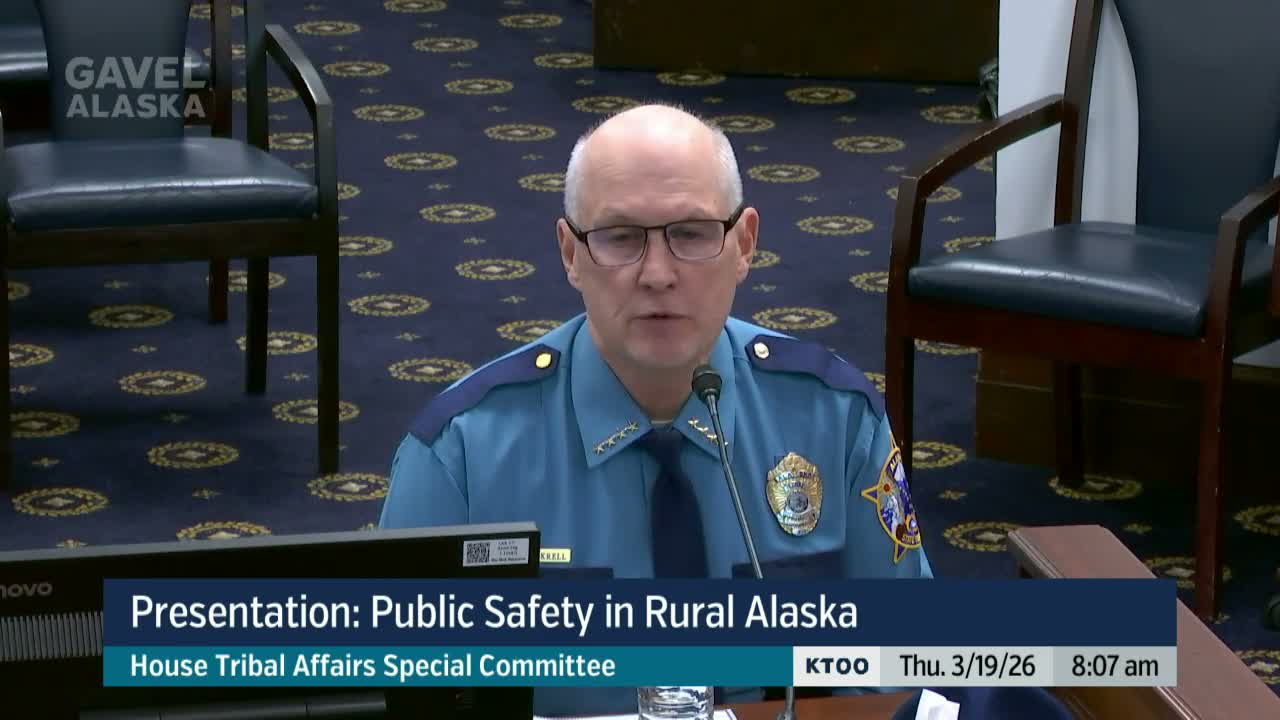
Anchorage remains the primary entry point for illegal drugs into Alaska, state law‑enforcement officials told the House Tribal Affairs Committee on March 19, saying most interdictions begin at the airport or through parcel routes.
"Roughly 82% of all of our drug seizures are occurring in the Anchorage area," said Captain Darren Cooper, commander of the Statewide Drug Enforcement Unit (SDEU). He told the committee the unit recorded about 516,878 grams of illegal controlled substances in 2025 — approximately 1,139 pounds — and that methamphetamine, cocaine and fentanyl were the most commonly seized substances.
The scale of those seizures, Captain Cooper said, is why investigators are based in hubs such as Anchorage, Bethel, Dillingham, Nome, Kodiak and Kotzebue: "If drugs leave Anchorage, they're going to eventually go out to the majority of our communities," he said.
Commissioner James Cockrell, Department of Public Safety, told the committee the department has pushed resources into rural Alaska and that the Village Public Safety Officer (VPSO) program is a priority. "We've got all 90 positions filled," Cockrell said of the VPSO program, while noting the department hopes to expand capacity further so every village that wants a VPSO can have one.
Officials also described staffing pressures that affect operations. Cockrell said the department currently has about 56 vacant state trooper positions, and that retirements and separations are cyclical. Captain Cooper and SDEU staff said the unit currently has 52 assigned SDEU positions (including task‑force officers and 28 Alaska State Troopers), with a handful of local investigator vacancies in Palmer, Fairbanks, Kodiak, Ketchikan and Dillingham.
The presenters emphasized interagency partnerships. Captain Cooper described the High Intensity Drug Trafficking Area (HIDA) program and federal partners including the Drug Enforcement Administration, Federal Bureau of Investigation and the United States Postal Inspection Service that augment state investigations. SDEU members also said the U.S. Postal Inspection Service brought roughly 50 agents into Alaska for parcel interdiction operations in the fall.
Committee members asked about trends and the apparent decline in seizures from 2024 to 2025. SDEU staff told lawmakers they saw a decline in 2025 and attributed it partly to national enforcement patterns and shifts in supply; they noted, for example, that the U.S. Coast Guard made substantially larger cocaine seizures elsewhere that could affect supply routes.
On recruitment, Cockrell said the department is intensifying hiring and outreach, including a dedicated recruiter and media work to attract applicants; he added prior bonus programs had limited sustained effect. The department said it is working with the Alaska Police Standards Council on cultural awareness training and other retention tools to support officers serving in rural postings.
The committee heard that enforcement efforts extend beyond drugs to alcohol interdiction bound for "dry" communities. Captain Cooper described a Western Alaska Alcohol and Narcotics Team (WANT) that seized thousands of bottles and nearly 1,800 liters of alcohol destined for tribal communities in 2025.
No formal vote or policy change was taken at the hearing. Members asked the department to provide follow‑up information on staffing, deployment rationale and seizure trends. The committee adjourned at 9:59 a.m.
"Roughly 82% of all of our drug seizures are occurring in the Anchorage area," said Captain Darren Cooper, commander of the Statewide Drug Enforcement Unit (SDEU). He told the committee the unit recorded about 516,878 grams of illegal controlled substances in 2025 — approximately 1,139 pounds — and that methamphetamine, cocaine and fentanyl were the most commonly seized substances.
The scale of those seizures, Captain Cooper said, is why investigators are based in hubs such as Anchorage, Bethel, Dillingham, Nome, Kodiak and Kotzebue: "If drugs leave Anchorage, they're going to eventually go out to the majority of our communities," he said.
Commissioner James Cockrell, Department of Public Safety, told the committee the department has pushed resources into rural Alaska and that the Village Public Safety Officer (VPSO) program is a priority. "We've got all 90 positions filled," Cockrell said of the VPSO program, while noting the department hopes to expand capacity further so every village that wants a VPSO can have one.
Officials also described staffing pressures that affect operations. Cockrell said the department currently has about 56 vacant state trooper positions, and that retirements and separations are cyclical. Captain Cooper and SDEU staff said the unit currently has 52 assigned SDEU positions (including task‑force officers and 28 Alaska State Troopers), with a handful of local investigator vacancies in Palmer, Fairbanks, Kodiak, Ketchikan and Dillingham.
The presenters emphasized interagency partnerships. Captain Cooper described the High Intensity Drug Trafficking Area (HIDA) program and federal partners including the Drug Enforcement Administration, Federal Bureau of Investigation and the United States Postal Inspection Service that augment state investigations. SDEU members also said the U.S. Postal Inspection Service brought roughly 50 agents into Alaska for parcel interdiction operations in the fall.
Committee members asked about trends and the apparent decline in seizures from 2024 to 2025. SDEU staff told lawmakers they saw a decline in 2025 and attributed it partly to national enforcement patterns and shifts in supply; they noted, for example, that the U.S. Coast Guard made substantially larger cocaine seizures elsewhere that could affect supply routes.
On recruitment, Cockrell said the department is intensifying hiring and outreach, including a dedicated recruiter and media work to attract applicants; he added prior bonus programs had limited sustained effect. The department said it is working with the Alaska Police Standards Council on cultural awareness training and other retention tools to support officers serving in rural postings.
The committee heard that enforcement efforts extend beyond drugs to alcohol interdiction bound for "dry" communities. Captain Cooper described a Western Alaska Alcohol and Narcotics Team (WANT) that seized thousands of bottles and nearly 1,800 liters of alcohol destined for tribal communities in 2025.
No formal vote or policy change was taken at the hearing. Members asked the department to provide follow‑up information on staffing, deployment rationale and seizure trends. The committee adjourned at 9:59 a.m.
Don't Miss a Word: See the Full Meeting!
Go beyond summaries. Unlock every video, transcript, and key insight with a Founder Membership.
✓
Get instant access to full meeting videos
✓
Search and clip any phrase from complete transcripts
✓
Receive AI-powered summaries & custom alerts
✓
Enjoy lifetime, unrestricted access to government data
30-day money-back guarantee
