Committee advances bill to ease physician-assistant collaboration requirements
March 19, 2026 | 2026 Legislature Alaska, Alaska
This article was created by AI summarizing key points discussed. AI makes mistakes, so for full details and context, please refer to the video of the full meeting. Please report any errors so we can fix them. Report an error »
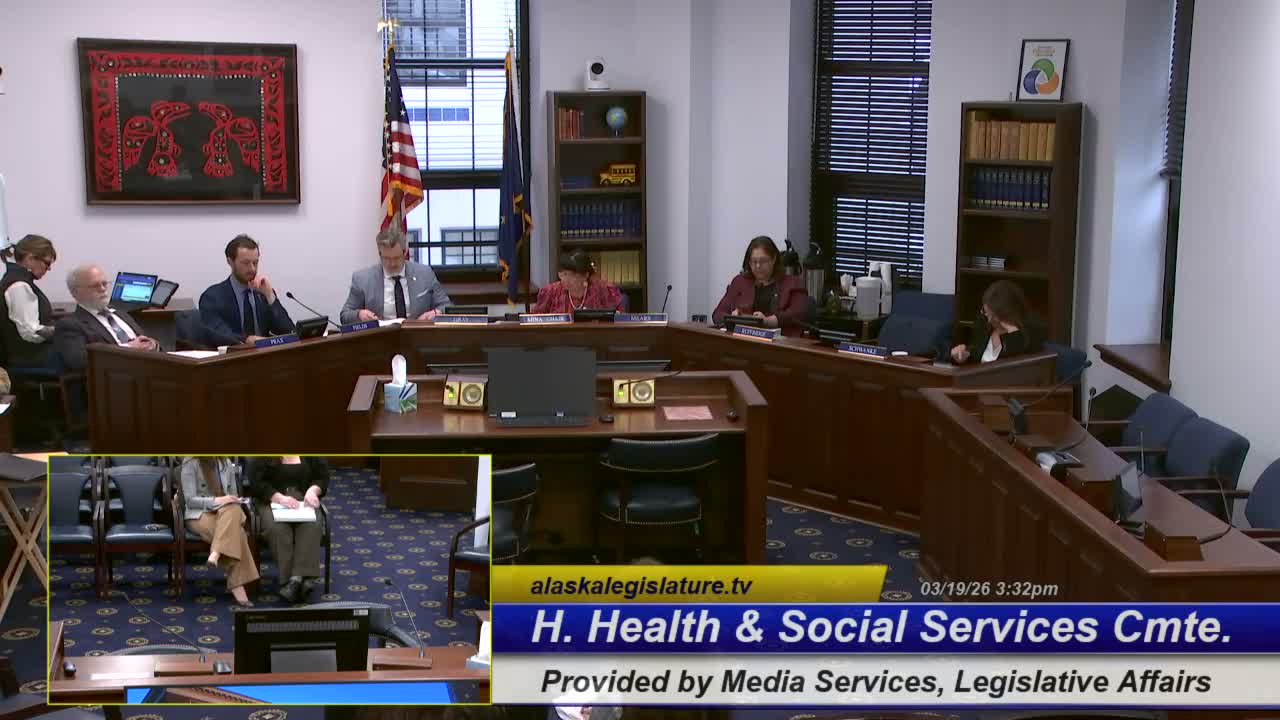
Senate Bill 89, a measure to change physician assistant (PA) scope-of-practice administrative requirements, passed from the House Health and Social Services Committee on March 19 after one conforming amendment.
Ethan McWilliams, president of Wilderness Medical Staffing, testified that PAs are a critical lifeline for care in rural Alaska and said current collaboration requirements add time-consuming, costly paperwork that does little to improve patient safety. “The administrative paperwork necessary is expensive, time consuming, and offers very little in terms of patient safety,” McWilliams said, urging passage to allow more rapid deployment of PAs to communities with shortages.
Catherine Van Atta, a PA based in Wasilla with two decades of experience, told the committee she sees no practical difference in quality between PAs and other advanced clinicians and described unnecessary red tape in required collaborative plans. Mary Swayne, CEO of a Bristol Bay community health center and an FQHC leader, said SB 89 would remove mandated collaborative-plan requirements in settings like FQHCs and reduce annual costs and deployment delays.
Mackenzie Pope, staff to Senator Luki Tobin, described Amendment #1 as a simple conforming change to remove a reference to documented hours from a prior draft; the amendment was adopted. A committee member moved the bill as amended, and Chair Mina announced SB 89 passed from committee by unanimous consent; no roll-call was recorded in the transcript.
Why it matters: Witnesses said reducing administrative burden will help health centers and staffing firms credential and deploy PAs faster into rural and remote communities, supporting continuity of care where recruiting clinicians is difficult.
Next steps: SB 89 passed from committee and will continue through the legislative process. The committee did not record a roll-call vote in this hearing.
Ethan McWilliams, president of Wilderness Medical Staffing, testified that PAs are a critical lifeline for care in rural Alaska and said current collaboration requirements add time-consuming, costly paperwork that does little to improve patient safety. “The administrative paperwork necessary is expensive, time consuming, and offers very little in terms of patient safety,” McWilliams said, urging passage to allow more rapid deployment of PAs to communities with shortages.
Catherine Van Atta, a PA based in Wasilla with two decades of experience, told the committee she sees no practical difference in quality between PAs and other advanced clinicians and described unnecessary red tape in required collaborative plans. Mary Swayne, CEO of a Bristol Bay community health center and an FQHC leader, said SB 89 would remove mandated collaborative-plan requirements in settings like FQHCs and reduce annual costs and deployment delays.
Mackenzie Pope, staff to Senator Luki Tobin, described Amendment #1 as a simple conforming change to remove a reference to documented hours from a prior draft; the amendment was adopted. A committee member moved the bill as amended, and Chair Mina announced SB 89 passed from committee by unanimous consent; no roll-call was recorded in the transcript.
Why it matters: Witnesses said reducing administrative burden will help health centers and staffing firms credential and deploy PAs faster into rural and remote communities, supporting continuity of care where recruiting clinicians is difficult.
Next steps: SB 89 passed from committee and will continue through the legislative process. The committee did not record a roll-call vote in this hearing.
Don't Miss a Word: See the Full Meeting!
Go beyond summaries. Unlock every video, transcript, and key insight with a Founder Membership.
✓
Get instant access to full meeting videos
✓
Search and clip any phrase from complete transcripts
✓
Receive AI-powered summaries & custom alerts
✓
Enjoy lifetime, unrestricted access to government data
30-day money-back guarantee
