Bob Ferguson signs about a dozen bipartisan bills at state Capitol, spotlighting housing, veterans, AI and health-care rules
March 09, 2026 | Governor's Office - Boards & Commissions, Executive, Washington
This article was created by AI summarizing key points discussed. AI makes mistakes, so for full details and context, please refer to the video of the full meeting. Please report any errors so we can fix them. Report an error »
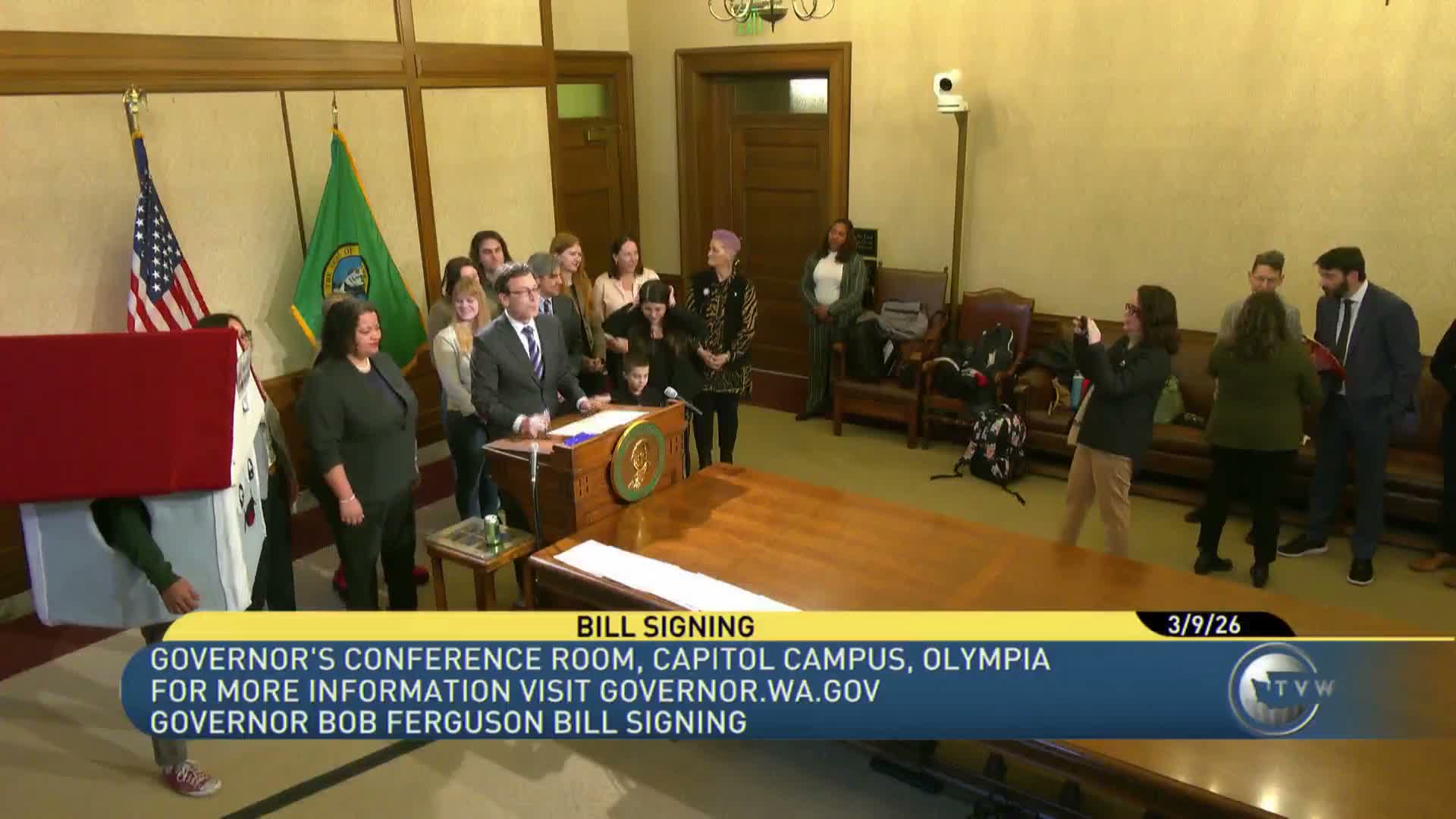
Bob Ferguson signed about a dozen bills into law during a ceremonial bill-signing at the state Capitol, highlighting measures aimed at expanding housing supply, updating veterans’ advisory appointments, tightening safeguards around artificial intelligence in government projects and clarifying supervision rules in health care.
Speaking to attendees and viewers, Bob Ferguson said, “we're here at the Capitol with a number of legislators, Julie Reed, whose bill I'll be signing shortly, and advocates for housing,” and described the signing as “the final stage” in the legislative process. He framed the housing measures as a priority and thanked lawmakers and advocates for bipartisan work to increase housing production across the state.
The measures signed included a package of housing-related bills intended to ease development and increase supply. House Bill 1687 removes state barriers to help the city of Seattle plan, construct or operate housing projects under the housing cooperation law. House Bill 18 59 allows faith-based organizations to develop higher-density housing when they mix affordable and market-rate units. House Bill 21 51 streamlines inspections and approvals for out-of-state modular housing manufacturers by expanding the pool of approved inspectors. House Bill 22 28 directs the State Building Code Council to convene an advisory committee to consider allowing scissor stairs in mid- and high-rise buildings, a design described during the ceremony as reducing footprint and materials use.
On veterans issues, Ferguson signed House Bill 15 41 (informally referred to at the event as the Jim Judd Act), which converts four Veterans Affairs Advisory Committee seats to at-large positions and adds military experience and broader personal-experience criteria to help ensure the committee better reflects the state’s veterans community. Family members of the bill’s namesake attended the signing.
Environmental and public-safety legislation included House Bill 21 99, which strengthens the Department of Natural Resources’ Derelict Vessel Removal Program by allowing DNR and authorized entities to act more quickly when owners cannot be located and to consider vessels derelict if they have been unregistered for two years or more.
The signing also included bills addressing privacy and technology oversight and health-care supervision. House Bill 26 06 updates performance measures for the Office of Privacy and Data Protection and adds oversight for state agency projects involving artificial intelligence. House Bill 21 55 was described at the event as clarifying state law so that only a human can practice nursing or hold a nursing title in Washington — protecting patients from models that might falsely claim to be licensed nurses. Ferguson said this was intended to protect Washingtonians from predatory AI models.
Ferguson also signed bills changing supervision and recertification rules: House Bill 21 13 broadens which licensed professionals may supervise certain radiologic procedures and permits virtual supervision to improve access, particularly in rural areas; and House Bill 25 40 adjusts emergency medical technician (EMT) recertification intervals, requiring recertification every three years generally and every six years for EMTs with 10 years of certified experience.
At each signing, the governor’s office acknowledged the bill’s prime sponsor and companion sponsors where noted and invited sponsors and advocates to join for photographs. Speakers repeatedly thanked the legislators and advocates who shepherded the bills through the legislative process. The ceremony closed with photos and brief remarks; the event included multiple stopped moments for group photos and recognition of families and advocates present.
Effective dates, specific implementation steps and vote tallies were not specified during the ceremony; representatives named at the event were recognized as prime or companion sponsors as noted. The signings were ceremonial and formalized bills the legislature had already passed.
Speaking to attendees and viewers, Bob Ferguson said, “we're here at the Capitol with a number of legislators, Julie Reed, whose bill I'll be signing shortly, and advocates for housing,” and described the signing as “the final stage” in the legislative process. He framed the housing measures as a priority and thanked lawmakers and advocates for bipartisan work to increase housing production across the state.
The measures signed included a package of housing-related bills intended to ease development and increase supply. House Bill 1687 removes state barriers to help the city of Seattle plan, construct or operate housing projects under the housing cooperation law. House Bill 18 59 allows faith-based organizations to develop higher-density housing when they mix affordable and market-rate units. House Bill 21 51 streamlines inspections and approvals for out-of-state modular housing manufacturers by expanding the pool of approved inspectors. House Bill 22 28 directs the State Building Code Council to convene an advisory committee to consider allowing scissor stairs in mid- and high-rise buildings, a design described during the ceremony as reducing footprint and materials use.
On veterans issues, Ferguson signed House Bill 15 41 (informally referred to at the event as the Jim Judd Act), which converts four Veterans Affairs Advisory Committee seats to at-large positions and adds military experience and broader personal-experience criteria to help ensure the committee better reflects the state’s veterans community. Family members of the bill’s namesake attended the signing.
Environmental and public-safety legislation included House Bill 21 99, which strengthens the Department of Natural Resources’ Derelict Vessel Removal Program by allowing DNR and authorized entities to act more quickly when owners cannot be located and to consider vessels derelict if they have been unregistered for two years or more.
The signing also included bills addressing privacy and technology oversight and health-care supervision. House Bill 26 06 updates performance measures for the Office of Privacy and Data Protection and adds oversight for state agency projects involving artificial intelligence. House Bill 21 55 was described at the event as clarifying state law so that only a human can practice nursing or hold a nursing title in Washington — protecting patients from models that might falsely claim to be licensed nurses. Ferguson said this was intended to protect Washingtonians from predatory AI models.
Ferguson also signed bills changing supervision and recertification rules: House Bill 21 13 broadens which licensed professionals may supervise certain radiologic procedures and permits virtual supervision to improve access, particularly in rural areas; and House Bill 25 40 adjusts emergency medical technician (EMT) recertification intervals, requiring recertification every three years generally and every six years for EMTs with 10 years of certified experience.
At each signing, the governor’s office acknowledged the bill’s prime sponsor and companion sponsors where noted and invited sponsors and advocates to join for photographs. Speakers repeatedly thanked the legislators and advocates who shepherded the bills through the legislative process. The ceremony closed with photos and brief remarks; the event included multiple stopped moments for group photos and recognition of families and advocates present.
Effective dates, specific implementation steps and vote tallies were not specified during the ceremony; representatives named at the event were recognized as prime or companion sponsors as noted. The signings were ceremonial and formalized bills the legislature had already passed.
View the Full Meeting & All Its Details
This article offers just a summary. Unlock complete video, transcripts, and insights as a Founder Member.
✓
Watch full, unedited meeting videos
✓
Search every word spoken in unlimited transcripts
✓
AI summaries & real-time alerts (all government levels)
✓
Permanent access to expanding government content
30-day money-back guarantee
