Austin oversight office offers to co‑design outreach strategy with CPRC; estimates 6–8 week timeline
March 20, 2026 | Austin, Travis County, Texas
This article was created by AI summarizing key points discussed. AI makes mistakes, so for full details and context, please refer to the video of the full meeting. Please report any errors so we can fix them. Report an error »
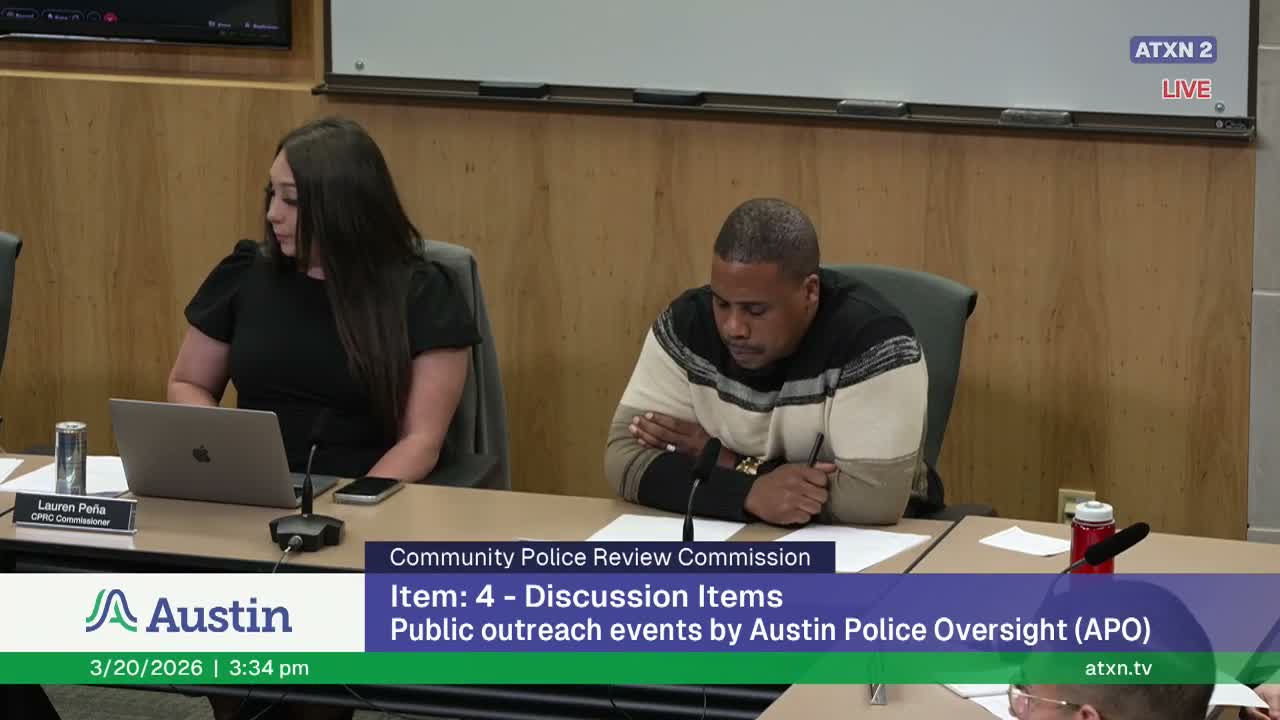
Sarah Peralta, Austin Police Oversight’s public information and marketing program manager, told the Community Police Review Commission on March 20 that APO organizes outreach around three pillars—legal directives, city leadership priorities and community input—and invited the CPRC to co‑design its own engagement rubric.
“Based on those three inputs, we design…where it’s relevant to y’all,” Peralta said, describing a process that begins with listening sessions and can include focus groups, interpreters and post‑event after‑action reporting. She said most city events require planning, promotion and accessibility work and estimated a typical planning window of six to eight weeks for a fully accessible event with language and ASL services.
Commissioners asked APO to help CPRC synchronize calendars and to connect the commission to community partners. One commissioner urged outreach to the Housing Authority of the City of Austin to host monthly meetings on housing authority properties; Peralta said APO could make introductions and facilitate landing spaces that often provide free community rooms. Commissioners also asked APO about outreach to LGBTQ communities and the role of the Joint Inclusion Commission; Peralta said APO engages those groups and attends large community events such as Pride.
APO staff also described routine event metrics and evaluation practices: debriefs after events, a SWOT approach to identify gaps, and tracking of participation numbers and web/social analytics. Peralta said APO’s goal for the coming year is about 60 participatory events and that each project includes a written project plan and documentation of feedback.
Commissioners discussed informal working groups and whether events require a formal quorum to plan; city staff advised that working groups or pairs of commissioners may organize events and bring proposals back to the full commission, provided the public is given notice when a vote is required.
The commission asked APO to share materials and to help CPRC bootstrap its outreach capacity. APO staff said complaints‑division staff will begin attending community engagement events to explain the complaint process in real time and that APO is available to help with badges, flyers and contact lists. The commission agreed to continue coordinating with APO and to put related agenda items on future meetings as needed.
“Based on those three inputs, we design…where it’s relevant to y’all,” Peralta said, describing a process that begins with listening sessions and can include focus groups, interpreters and post‑event after‑action reporting. She said most city events require planning, promotion and accessibility work and estimated a typical planning window of six to eight weeks for a fully accessible event with language and ASL services.
Commissioners asked APO to help CPRC synchronize calendars and to connect the commission to community partners. One commissioner urged outreach to the Housing Authority of the City of Austin to host monthly meetings on housing authority properties; Peralta said APO could make introductions and facilitate landing spaces that often provide free community rooms. Commissioners also asked APO about outreach to LGBTQ communities and the role of the Joint Inclusion Commission; Peralta said APO engages those groups and attends large community events such as Pride.
APO staff also described routine event metrics and evaluation practices: debriefs after events, a SWOT approach to identify gaps, and tracking of participation numbers and web/social analytics. Peralta said APO’s goal for the coming year is about 60 participatory events and that each project includes a written project plan and documentation of feedback.
Commissioners discussed informal working groups and whether events require a formal quorum to plan; city staff advised that working groups or pairs of commissioners may organize events and bring proposals back to the full commission, provided the public is given notice when a vote is required.
The commission asked APO to share materials and to help CPRC bootstrap its outreach capacity. APO staff said complaints‑division staff will begin attending community engagement events to explain the complaint process in real time and that APO is available to help with badges, flyers and contact lists. The commission agreed to continue coordinating with APO and to put related agenda items on future meetings as needed.
Don't Miss a Word: See the Full Meeting!
Go beyond summaries. Unlock every video, transcript, and key insight with a Founder Membership.
✓
Get instant access to full meeting videos
✓
Search and clip any phrase from complete transcripts
✓
Receive AI-powered summaries & custom alerts
✓
Enjoy lifetime, unrestricted access to government data
30-day money-back guarantee
