CPRC members debate case‑review workflow as CJIS access and turnover slow reviews
March 20, 2026 | Austin, Travis County, Texas
This article was created by AI summarizing key points discussed. AI makes mistakes, so for full details and context, please refer to the video of the full meeting. Please report any errors so we can fix them. Report an error »
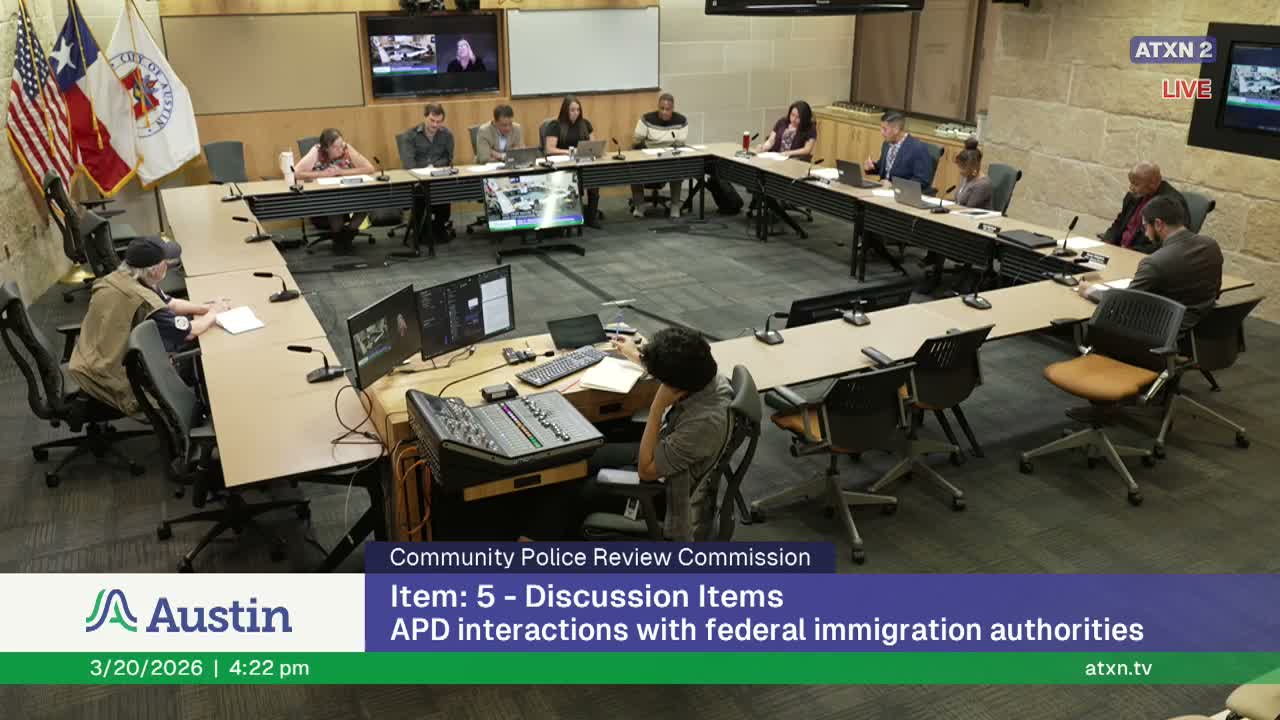
Commissioner Laura Franco led a detailed exchange on March 20 about barriers to the commission’s case‑review process, noting recurring technical and staffing issues that slow recommendations to the Austin Police Department and APO.
Franco said the working‑group workflow adopted in mid‑2025 is intended to distribute review work across three rotating groups, but in practice turnover, incomplete CJIS/CJBI access and large file volumes have created bottlenecks. "We have all this long process because we're not every single one of us that will make the process so much easier for APO to give us access to those files," Franco said, urging commissioners to complete background checks and CJIS certification so folders can be accessed without manual redaction steps.
Commissioners debated whether the three‑reviewer minimum should be relaxed for time‑sensitive cases and proposed alternatives: (a) a prioritized 'response team' of commissioners willing to review urgent cases quickly; (b) rotating assignments aligned with commissioners’ bandwidth; and (c) clearer documentation of steps and troubleshooting tips for new members so onboarding does not depend on a single chair. One commissioner recommended independent review followed by a short meeting to form a majority recommendation rather than simultaneous group meetings.
Staff said the criminal background check (CBI) is a prerequisite to CJIS training and that APO is working to provision secure computers and remediating database loading issues. APO staff confirmed that some redacted cases have been uploaded to the shared drive but that high file volumes and required redactions can delay availability.
Commissioners proposed concrete next steps: designate a priority review team for urgent cases, add a permanent agenda item for case presentations at each meeting, circulate a shared troubleshooting/documentation resource for new commissioners, and draft a resolution to request an open public system for shared lessons learned; one commissioner volunteered to draft a city‑council resolution asking for that public system. No formal change to the workflow was adopted; the commission agreed to test the priority‑team approach and report back.
Franco said the working‑group workflow adopted in mid‑2025 is intended to distribute review work across three rotating groups, but in practice turnover, incomplete CJIS/CJBI access and large file volumes have created bottlenecks. "We have all this long process because we're not every single one of us that will make the process so much easier for APO to give us access to those files," Franco said, urging commissioners to complete background checks and CJIS certification so folders can be accessed without manual redaction steps.
Commissioners debated whether the three‑reviewer minimum should be relaxed for time‑sensitive cases and proposed alternatives: (a) a prioritized 'response team' of commissioners willing to review urgent cases quickly; (b) rotating assignments aligned with commissioners’ bandwidth; and (c) clearer documentation of steps and troubleshooting tips for new members so onboarding does not depend on a single chair. One commissioner recommended independent review followed by a short meeting to form a majority recommendation rather than simultaneous group meetings.
Staff said the criminal background check (CBI) is a prerequisite to CJIS training and that APO is working to provision secure computers and remediating database loading issues. APO staff confirmed that some redacted cases have been uploaded to the shared drive but that high file volumes and required redactions can delay availability.
Commissioners proposed concrete next steps: designate a priority review team for urgent cases, add a permanent agenda item for case presentations at each meeting, circulate a shared troubleshooting/documentation resource for new commissioners, and draft a resolution to request an open public system for shared lessons learned; one commissioner volunteered to draft a city‑council resolution asking for that public system. No formal change to the workflow was adopted; the commission agreed to test the priority‑team approach and report back.
Don't Miss a Word: See the Full Meeting!
Go beyond summaries. Unlock every video, transcript, and key insight with a Founder Membership.
✓
Get instant access to full meeting videos
✓
Search and clip any phrase from complete transcripts
✓
Receive AI-powered summaries & custom alerts
✓
Enjoy lifetime, unrestricted access to government data
30-day money-back guarantee
