Assistant city manager outlines 36-month economic "road map" to accelerate Austin growth
March 20, 2026 | Austin, Travis County, Texas
This article was created by AI summarizing key points discussed. AI makes mistakes, so for full details and context, please refer to the video of the full meeting. Please report any errors so we can fix them. Report an error »
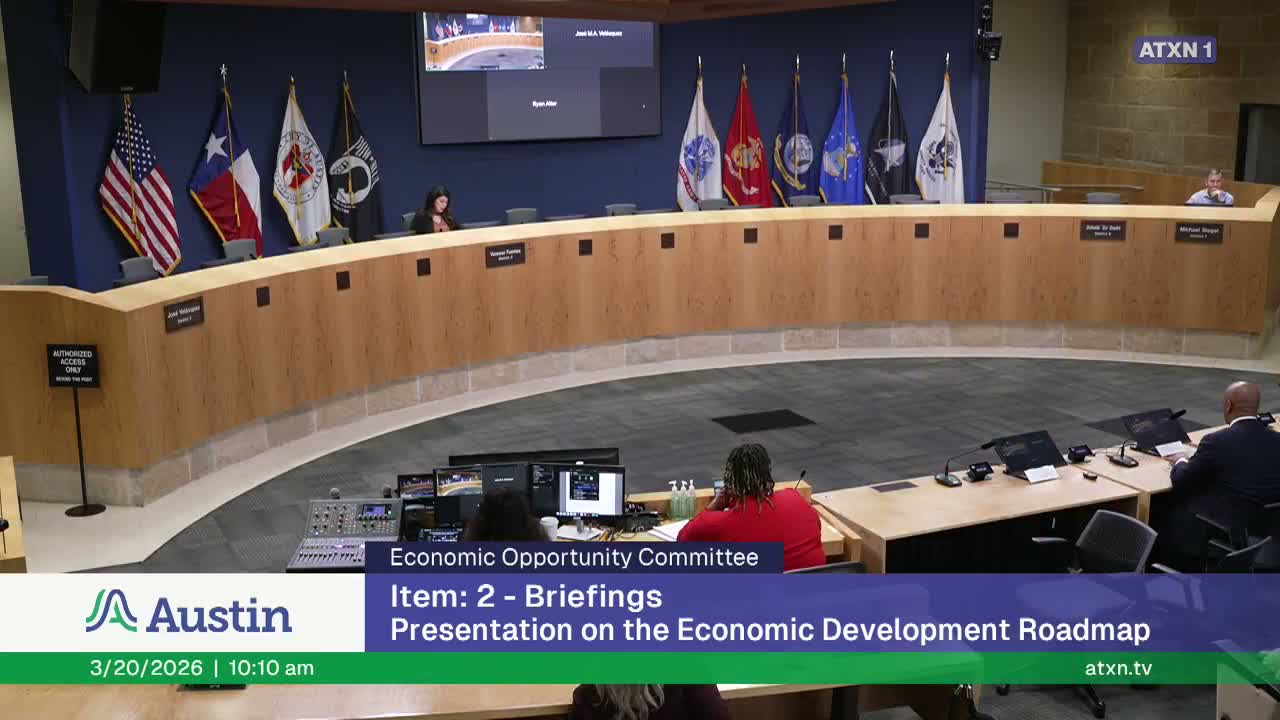
Assistant City Manager Eric Anthony Johnson on March 20 told the Economic Opportunity Committee that the city needs a coordinated, 36-month framework to restore momentum and build long-term economic resilience.
Johnson opened the committee meeting with a short video and said Austin remains competitive but is entering a period of "recalibration" driven by slower growth, suburban competition, infrastructure fatigue and a cooling tech sector. "We can no longer grow by accident," he said, calling the road map a "North Star" that emphasizes speed, alignment with partners and early wins.
The presentation set out concrete building blocks: an "Austin is open for business" approach, predictability and speed in approvals, leveraging partners rather than asking for new general-fund dollars, pilot programs, and workforce alignment. Johnson cited recent capital flows as evidence of strength: "Last year alone, Austin Property did 8,000,000,000 in venture capital," and said the city should pursue annual growth targets that would move development-generated revenue from roughly 0.75% toward 2% or more.
Johnson described the road map as implementation-focused rather than a static plan. It relies on stakeholder input (he said the city conducted more than 20 interviews and four working groups), a project-manager model for specific initiatives, and public tracking through committee and council briefings. He highlighted tools the city will consider, including a revolving loan program, commercial-space "buy down" pilots to preserve legacy and local businesses, and efforts to reduce permitting friction by improving upfront submittal quality.
Councilmember Mike Siegel pressed Johnson on housing priorities during the market slowdown and on opportunities to partner with enterprise departments such as Austin Energy and Austin Water. Johnson recommended prioritizing the "missing middle" and households at the 50% and 30% AMI bands to avoid a return to hyper-competitive, unaffordable markets and said the city should be open to innovative measures, including alternative power and AI-assisted permitting, to speed approvals.
The committee took no formal vote on the road map; Johnson said next steps include continued stakeholder alignment, establishing short- and long-term priorities, securing early wins, and regular public briefings on implementation progress.
The committee also approved the December 1, 2025 meeting minutes without objection earlier in the session.
Johnson opened the committee meeting with a short video and said Austin remains competitive but is entering a period of "recalibration" driven by slower growth, suburban competition, infrastructure fatigue and a cooling tech sector. "We can no longer grow by accident," he said, calling the road map a "North Star" that emphasizes speed, alignment with partners and early wins.
The presentation set out concrete building blocks: an "Austin is open for business" approach, predictability and speed in approvals, leveraging partners rather than asking for new general-fund dollars, pilot programs, and workforce alignment. Johnson cited recent capital flows as evidence of strength: "Last year alone, Austin Property did 8,000,000,000 in venture capital," and said the city should pursue annual growth targets that would move development-generated revenue from roughly 0.75% toward 2% or more.
Johnson described the road map as implementation-focused rather than a static plan. It relies on stakeholder input (he said the city conducted more than 20 interviews and four working groups), a project-manager model for specific initiatives, and public tracking through committee and council briefings. He highlighted tools the city will consider, including a revolving loan program, commercial-space "buy down" pilots to preserve legacy and local businesses, and efforts to reduce permitting friction by improving upfront submittal quality.
Councilmember Mike Siegel pressed Johnson on housing priorities during the market slowdown and on opportunities to partner with enterprise departments such as Austin Energy and Austin Water. Johnson recommended prioritizing the "missing middle" and households at the 50% and 30% AMI bands to avoid a return to hyper-competitive, unaffordable markets and said the city should be open to innovative measures, including alternative power and AI-assisted permitting, to speed approvals.
The committee took no formal vote on the road map; Johnson said next steps include continued stakeholder alignment, establishing short- and long-term priorities, securing early wins, and regular public briefings on implementation progress.
The committee also approved the December 1, 2025 meeting minutes without objection earlier in the session.
Don't Miss a Word: See the Full Meeting!
Go beyond summaries. Unlock every video, transcript, and key insight with a Founder Membership.
✓
Get instant access to full meeting videos
✓
Search and clip any phrase from complete transcripts
✓
Receive AI-powered summaries & custom alerts
✓
Enjoy lifetime, unrestricted access to government data
30-day money-back guarantee
