Denton planning commission work session reviews HB 3699 limits on right-of-way dedications
March 18, 2026 | Denton City, Denton County, Texas
This article was created by AI summarizing key points discussed. AI makes mistakes, so for full details and context, please refer to the video of the full meeting. Please report any errors so we can fix them. Report an error »
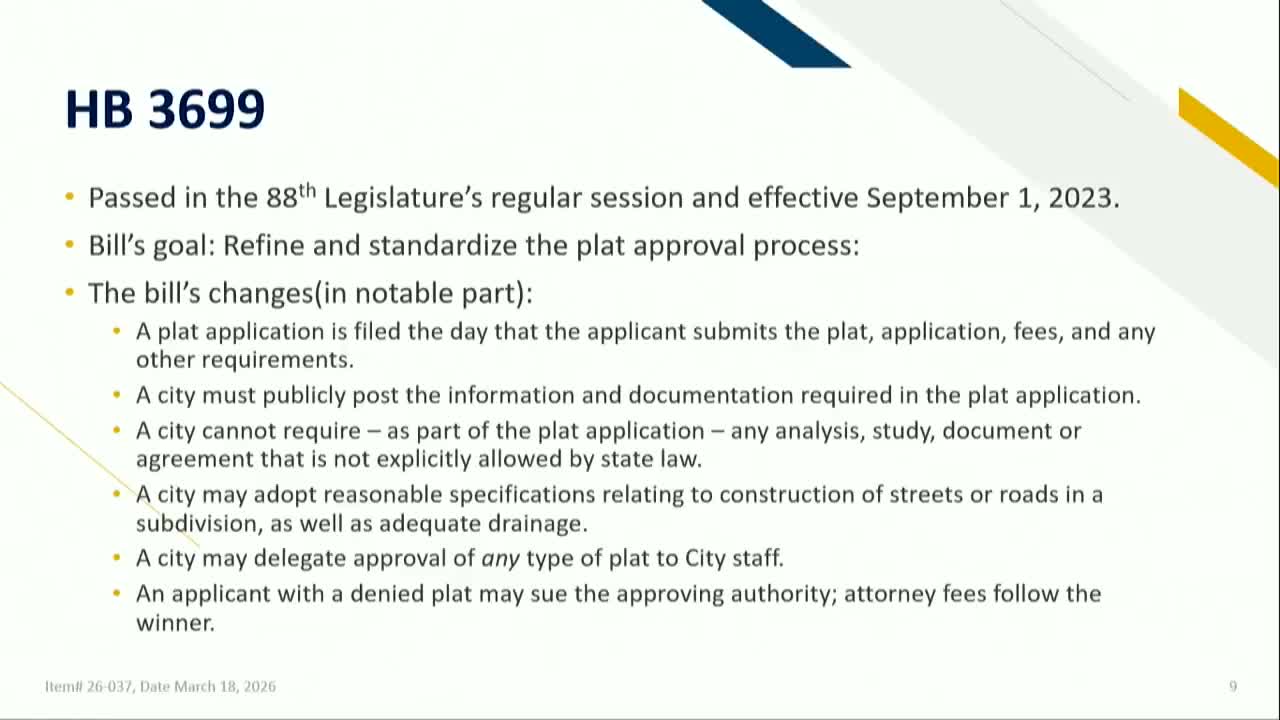
Deputy City Attorney Hillary McMahon told the Planning and Zoning Commission during a March 18 work session that House Bill 3699 (effective Sept. 2023) narrowed when cities may require right-of-way dedications at the plat stage and clarified when the plat "shot clock" begins. McMahon said the City of Denton responded by shifting requests for studies and right-of-way dedications to the zoning compliance plan stage and making the preliminary plat an optional step.
"The municipal authority may not require dedication of land for a future street or alley if the owner doesn't want to, or if it's not funded and approved in a capital improvement plan," McMahon said, summarizing the law's effect on plat conditioning. Using a recent plat example, she showed that mobility-plan classifications (for example a 135-foot total right-of-way, half of which equals 67.5 feet) explain why staff asks for particular dedications.
McMahon said staff has not seen litigation or meaningful operational complications from the change. "We moved the right-of-way request to the zoning compliance plan stage," she said, and "staff has experienced no pushback or challenge." She advised commissioners that plats remain ministerial approvals and recommended that commissioners, when voting against staff recommendations, explicitly state the criteria they believe staff missed.
Commissioners raised practical concerns about public transparency for finding project materials. Commissioner Dyer said residents often cannot find plats or project plans online; staff and McMahon replied that the City posts application checklists and a GIS project layer, but detailed plans require an eTRAKiT account. Staff offered to return with a demonstration and to consider an FAQ or short how-to video for the public.
McMahon also explained exactions and proportionality: a developer should be required to address impacts proportional to the project (for example, adding a turn lane if the development adds trips), and disagreements can be addressed by mobility-plan amendments, exaction proportionality appeals, or development agreements.
The work session closed without a formal vote; commissioners reconvened in chambers at 6:30 p.m. for the regular meeting.
"The municipal authority may not require dedication of land for a future street or alley if the owner doesn't want to, or if it's not funded and approved in a capital improvement plan," McMahon said, summarizing the law's effect on plat conditioning. Using a recent plat example, she showed that mobility-plan classifications (for example a 135-foot total right-of-way, half of which equals 67.5 feet) explain why staff asks for particular dedications.
McMahon said staff has not seen litigation or meaningful operational complications from the change. "We moved the right-of-way request to the zoning compliance plan stage," she said, and "staff has experienced no pushback or challenge." She advised commissioners that plats remain ministerial approvals and recommended that commissioners, when voting against staff recommendations, explicitly state the criteria they believe staff missed.
Commissioners raised practical concerns about public transparency for finding project materials. Commissioner Dyer said residents often cannot find plats or project plans online; staff and McMahon replied that the City posts application checklists and a GIS project layer, but detailed plans require an eTRAKiT account. Staff offered to return with a demonstration and to consider an FAQ or short how-to video for the public.
McMahon also explained exactions and proportionality: a developer should be required to address impacts proportional to the project (for example, adding a turn lane if the development adds trips), and disagreements can be addressed by mobility-plan amendments, exaction proportionality appeals, or development agreements.
The work session closed without a formal vote; commissioners reconvened in chambers at 6:30 p.m. for the regular meeting.
View the Full Meeting & All Its Details
This article offers just a summary. Unlock complete video, transcripts, and insights as a Founder Member.
✓
Watch full, unedited meeting videos
✓
Search every word spoken in unlimited transcripts
✓
AI summaries & real-time alerts (all government levels)
✓
Permanent access to expanding government content
30-day money-back guarantee
