Caroline County enacts three zoning bills, adds R‑3 townhouse district and allows mini‑storage in village centers
March 17, 2026 | Caroline County, Maryland
This article was created by AI summarizing key points discussed. AI makes mistakes, so for full details and context, please refer to the video of the full meeting. Please report any errors so we can fix them. Report an error »
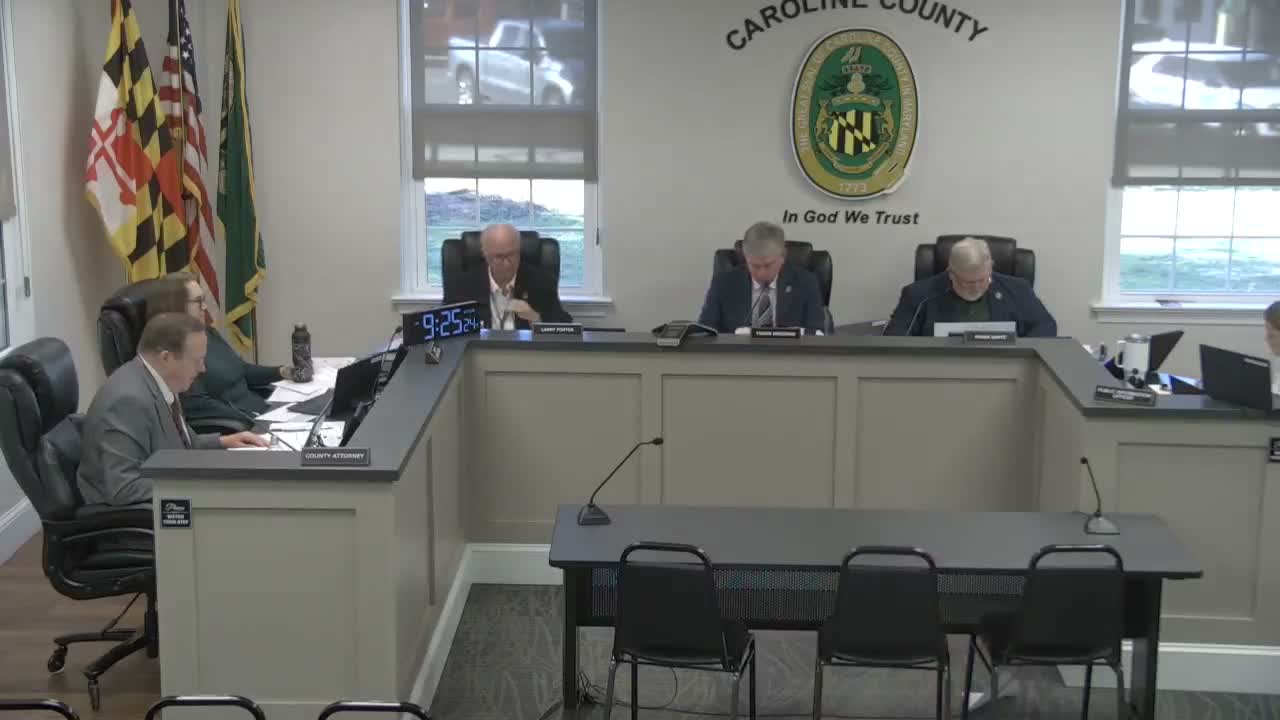
Caroline County commissioners unanimously enacted three zoning bills during their March 17 legislative session, establishing new procedures for routine map corrections, permitting mini‑storage in village centers by special use exception and restoring an R‑3 multiple‑family residential district with townhouse rules.
The board moved into a legislative session for third readings and took up the three bills that were introduced Feb. 10 and had a second reading and public hearing March 10. Matt Barrell summarized the schedule and the purpose of the measures: "All 3 of all 3 of these bills are on the exact same schedule..." (Matt Barrell).
Why it matters: the package makes three narrow but practical changes to local land‑use rules — an administrative correction process to fix clerical errors on zoning maps, the addition of mini‑storage as a permitted use by special exception in the Village Center (VC) district, and a reintroduction of an R‑3 multiple‑family residential district that establishes townhouse definitions and design standards. Collectively the bills aim to clarify local code and expand certain property‑use options.
Bill details and debate: Legislative Bill 2026‑001 creates a zoning‑map correction procedure for the planning director; county staff reported there were no public comments and commissioners moved to enact it without discussion. For Legislative Bill 2026‑002, Barrell said the change amends the Caroline County Table of Uses to allow warehouse/mini‑storage facilities in the VC district by special use exception and adds standards for the Board of Zoning Appeals to consider; commissioners again heard no public comment and enacted the bill.
Legislative Bill 2026‑003 prompted the most on‑record discussion. The bill reestablishes the R‑3 multiple‑family residential district, adds townhouse dwelling definitions and inserts R‑3 as a primary zoning district with related design regulations. Commissioners questioned where R‑3 zoning would realistically be used and raised practical constraints tied to utilities. One commissioner cautioned that townhouses built on well‑and‑septic are unlikely without municipal water and sewer: "I don't have a problem with this ... I just I just wanted to make that comment" (Speaker 4). Commissioners emphasized that any zoning change would still require planning commission recommendations and board approval.
Votes and next steps: Each bill was moved, seconded and passed by voice vote with the ayes prevailing. The enacted changes will be incorporated into the county zoning code and administrative procedures; county staff will implement the new application and review processes described in the bills.
What the record shows: The transcript records no public opposition during the readings, and the conversation focused on technical clarifications and infrastructure constraints for multifamily development. The board also noted that state permitting and Department of Environment requirements can present additional hurdles for projects that move forward under the new code provisions.
The board moved into a legislative session for third readings and took up the three bills that were introduced Feb. 10 and had a second reading and public hearing March 10. Matt Barrell summarized the schedule and the purpose of the measures: "All 3 of all 3 of these bills are on the exact same schedule..." (Matt Barrell).
Why it matters: the package makes three narrow but practical changes to local land‑use rules — an administrative correction process to fix clerical errors on zoning maps, the addition of mini‑storage as a permitted use by special exception in the Village Center (VC) district, and a reintroduction of an R‑3 multiple‑family residential district that establishes townhouse definitions and design standards. Collectively the bills aim to clarify local code and expand certain property‑use options.
Bill details and debate: Legislative Bill 2026‑001 creates a zoning‑map correction procedure for the planning director; county staff reported there were no public comments and commissioners moved to enact it without discussion. For Legislative Bill 2026‑002, Barrell said the change amends the Caroline County Table of Uses to allow warehouse/mini‑storage facilities in the VC district by special use exception and adds standards for the Board of Zoning Appeals to consider; commissioners again heard no public comment and enacted the bill.
Legislative Bill 2026‑003 prompted the most on‑record discussion. The bill reestablishes the R‑3 multiple‑family residential district, adds townhouse dwelling definitions and inserts R‑3 as a primary zoning district with related design regulations. Commissioners questioned where R‑3 zoning would realistically be used and raised practical constraints tied to utilities. One commissioner cautioned that townhouses built on well‑and‑septic are unlikely without municipal water and sewer: "I don't have a problem with this ... I just I just wanted to make that comment" (Speaker 4). Commissioners emphasized that any zoning change would still require planning commission recommendations and board approval.
Votes and next steps: Each bill was moved, seconded and passed by voice vote with the ayes prevailing. The enacted changes will be incorporated into the county zoning code and administrative procedures; county staff will implement the new application and review processes described in the bills.
What the record shows: The transcript records no public opposition during the readings, and the conversation focused on technical clarifications and infrastructure constraints for multifamily development. The board also noted that state permitting and Department of Environment requirements can present additional hurdles for projects that move forward under the new code provisions.
Don't Miss a Word: See the Full Meeting!
Go beyond summaries. Unlock every video, transcript, and key insight with a Founder Membership.
✓
Get instant access to full meeting videos
✓
Search and clip any phrase from complete transcripts
✓
Receive AI-powered summaries & custom alerts
✓
Enjoy lifetime, unrestricted access to government data
30-day money-back guarantee
