Planning Commission recommends El Camino Real widening to city council, 5–2; commissioners divided over bike protections and pedestrian bridge design
March 18, 2026 | Carlsbad, San Diego County, California
This article was created by AI summarizing key points discussed. AI makes mistakes, so for full details and context, please refer to the video of the full meeting. Please report any errors so we can fix them. Report an error »
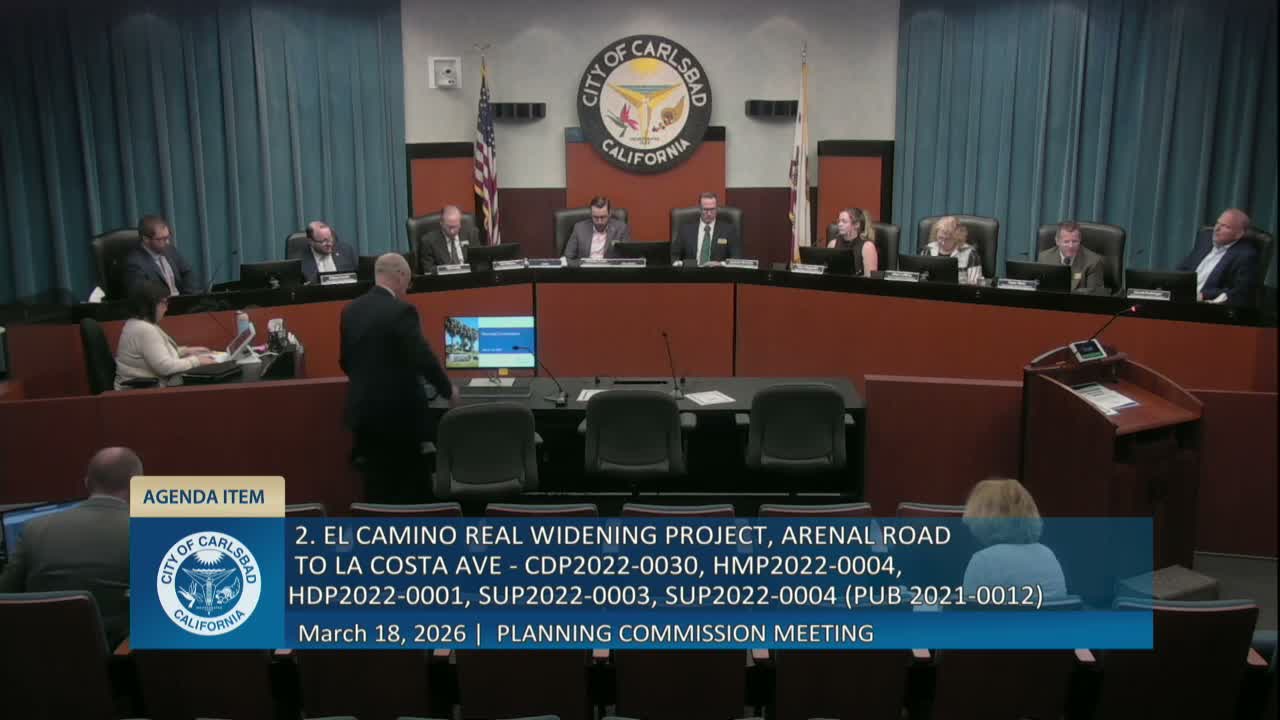
The Carlsbad Planning Commission on March 18 recommended that the City Council adopt the environmental documentation for and approve the entitlements for the El Camino Real widening project, a nearly 1‑mile capital improvement project in the southern part of the city. Staff presented the project as a corridor improvement that would add a third southbound vehicle lane between north of Arenal Road and La Costa Avenue, close a sidewalk gap along the lagoon, add two pedestrian bridges and overlooks, and provide landscaping.
Senior planner Scott Donald said the project would require five city permits — including a coastal development permit, a habitat management‑plan permit, two special‑use permits and a general‑plan open‑space waiver — and a subsequent Coastal Commission coastal development permit because part of the project lies within the Coastal Commission’s jurisdiction. "The project is consistent with all applicable standards," Donald said, and staff recommended two resolutions to council: one adopting the initial study/mitigated negative declaration (MND) and the second recommending the project entitlements.
Transportation director and city engineer Tom Frank and associate engineer Brandon Miles addressed design questions. Frank said the city consulted public‑safety responders when balancing lane widths and bicycle facilities and that some corridors receive separated class‑I pathways while this project proposes buffered Class II bike lanes in many locations. Miles explained the pedestrian bridges would be prefabricated truss spans attached with micropiles to avoid utilities and sensitive resources; staff estimated each bridge at about $600,000–$850,000 including delivery and installation, and noted each proposed bridge would be roughly 200 feet long.
The Coastal Commission had recommended adding vertical buffers between bicycle and vehicle lanes and low‑profile permanent fencing; staff said the city responded to each comment but does not recommend vertical buffers for this segment given local conditions. The environmental document identified potential impacts to biological, tribal cultural and paleontological resources but included mitigation measures and a mitigation monitoring and reporting program.
Commissioners threaded the debate: supporters said the project would complete missing pedestrian connections, improve corridor consistency and meet general‑plan standards; skeptics warned that widening could increase speeds and vehicle miles, and raised safety concerns about pedestrian bridges set away from the roadway and about the absence of physical bicycle barriers. Commissioner Foster said she agreed with the Coastal Commission on bike barriers and warned she would oppose the project without such protection; Commissioner Lafferty said the pedestrian bridges felt "isolating" and urged redesign to reduce distance from the roadway to aid emergency response and nighttime safety. Several commissioners nonetheless voted to recommend the two resolutions. The chair announced the motion carried "approved 5 with 2 no's." The transcript does not list individual recorded votes by name in the provided segments.
Senior planner Scott Donald said the project would require five city permits — including a coastal development permit, a habitat management‑plan permit, two special‑use permits and a general‑plan open‑space waiver — and a subsequent Coastal Commission coastal development permit because part of the project lies within the Coastal Commission’s jurisdiction. "The project is consistent with all applicable standards," Donald said, and staff recommended two resolutions to council: one adopting the initial study/mitigated negative declaration (MND) and the second recommending the project entitlements.
Transportation director and city engineer Tom Frank and associate engineer Brandon Miles addressed design questions. Frank said the city consulted public‑safety responders when balancing lane widths and bicycle facilities and that some corridors receive separated class‑I pathways while this project proposes buffered Class II bike lanes in many locations. Miles explained the pedestrian bridges would be prefabricated truss spans attached with micropiles to avoid utilities and sensitive resources; staff estimated each bridge at about $600,000–$850,000 including delivery and installation, and noted each proposed bridge would be roughly 200 feet long.
The Coastal Commission had recommended adding vertical buffers between bicycle and vehicle lanes and low‑profile permanent fencing; staff said the city responded to each comment but does not recommend vertical buffers for this segment given local conditions. The environmental document identified potential impacts to biological, tribal cultural and paleontological resources but included mitigation measures and a mitigation monitoring and reporting program.
Commissioners threaded the debate: supporters said the project would complete missing pedestrian connections, improve corridor consistency and meet general‑plan standards; skeptics warned that widening could increase speeds and vehicle miles, and raised safety concerns about pedestrian bridges set away from the roadway and about the absence of physical bicycle barriers. Commissioner Foster said she agreed with the Coastal Commission on bike barriers and warned she would oppose the project without such protection; Commissioner Lafferty said the pedestrian bridges felt "isolating" and urged redesign to reduce distance from the roadway to aid emergency response and nighttime safety. Several commissioners nonetheless voted to recommend the two resolutions. The chair announced the motion carried "approved 5 with 2 no's." The transcript does not list individual recorded votes by name in the provided segments.
Don't Miss a Word: See the Full Meeting!
Go beyond summaries. Unlock every video, transcript, and key insight with a Founder Membership.
✓
Get instant access to full meeting videos
✓
Search and clip any phrase from complete transcripts
✓
Receive AI-powered summaries & custom alerts
✓
Enjoy lifetime, unrestricted access to government data
30-day money-back guarantee
