Commission hears city briefing on tribal cultural‑resources rules and planned guidelines update
March 18, 2026 | Carlsbad, San Diego County, California
This article was created by AI summarizing key points discussed. AI makes mistakes, so for full details and context, please refer to the video of the full meeting. Please report any errors so we can fix them. Report an error »
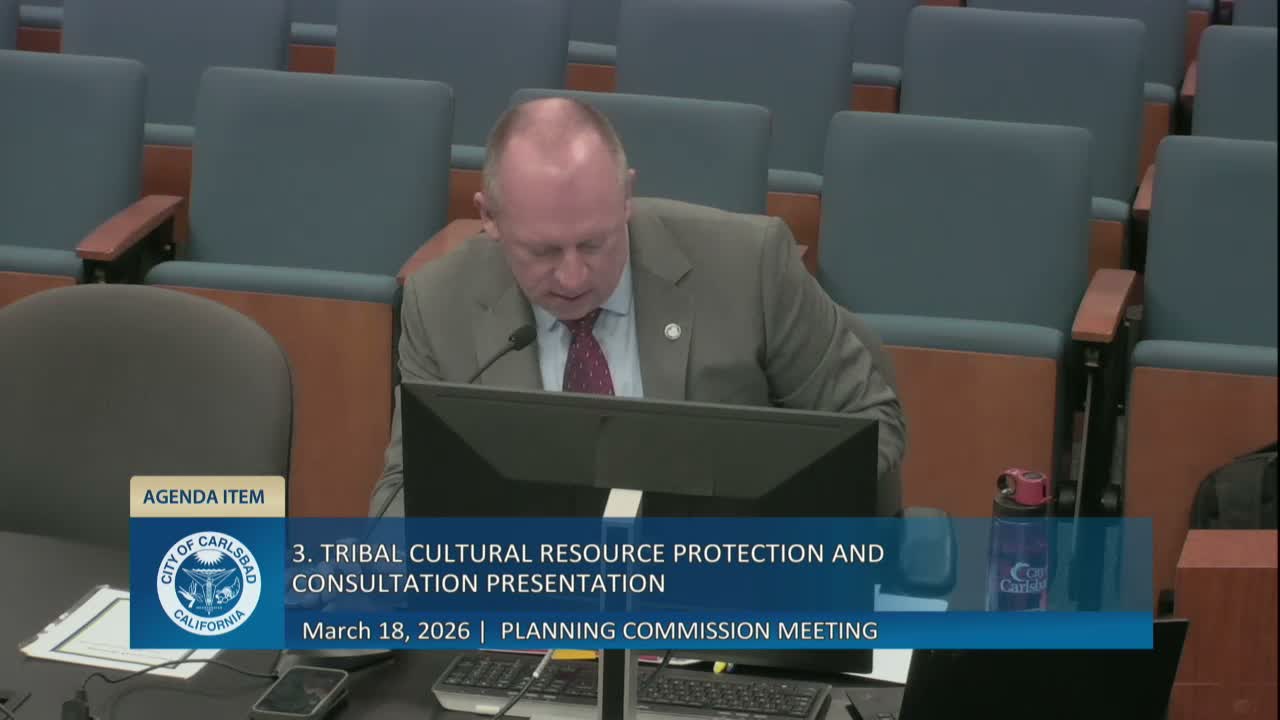
Principal planner Rob Eford and consultant Nikki Falvey (Helix Environmental Planning) gave an educational briefing on March 18 about tribal cultural resources, the legal framework for consultation and how the Planning Commission will interface with those processes.
Eford defined key terms—federally recognized tribes, California Native American contact lists (NAHC), and Traditionally and Culturally Affiliated (TCA) tribes—and explained how CEQA treats tribal cultural resources and archaeological resources. Falvey summarized CEQA criteria for significance, the AB 52 consultation process and the role of tribal monitoring. "Tribal consultation is the meaningful and timely process of seeking, discussing and considering the views of others," Falvey said, adding that tribes can opt into AB 52 consultation and must accept consultation within statutory timelines.
Commissioners asked whether a tribe can veto a project; staff said tribes do not have a legal veto but that lack of agreement on required mitigation could change an environmental document (for example, converting a mitigated negative declaration to an EIR), which can affect a project's approval path. Staff said Carlsbad currently has four tribes on its AB 52 opt‑in list (Cahuilla Band of Indians; Mesa Grande Band of Diegueno Mission Indians; Rincon Band of Luiseño Indians; San Luis Rey Band of Mission Indians) and that, more broadly, staff maintains a list of 21 traditionally and culturally affiliated tribes with which it consults when relevant.
Speakers described mitigation and treatment options if resources are found: avoidance/preservation in place, repatriation, curation/data recovery, tribal monitoring during ground‑disturbing work and restrictions/easements. Staff said tribal monitoring is generally paid by the project applicant and that monitoring can cease if an on‑site monitor determines that the stratigraphy is fill and unlikely to contain intact cultural materials.
Staff told commissioners the city is updating its tribal cultural‑resources guidelines this year to reflect regulatory changes and to incorporate tribal input and best practices; staff plans a public review period and additional outreach to tribes and stakeholders before returning to the commission with a draft for consideration.
Eford defined key terms—federally recognized tribes, California Native American contact lists (NAHC), and Traditionally and Culturally Affiliated (TCA) tribes—and explained how CEQA treats tribal cultural resources and archaeological resources. Falvey summarized CEQA criteria for significance, the AB 52 consultation process and the role of tribal monitoring. "Tribal consultation is the meaningful and timely process of seeking, discussing and considering the views of others," Falvey said, adding that tribes can opt into AB 52 consultation and must accept consultation within statutory timelines.
Commissioners asked whether a tribe can veto a project; staff said tribes do not have a legal veto but that lack of agreement on required mitigation could change an environmental document (for example, converting a mitigated negative declaration to an EIR), which can affect a project's approval path. Staff said Carlsbad currently has four tribes on its AB 52 opt‑in list (Cahuilla Band of Indians; Mesa Grande Band of Diegueno Mission Indians; Rincon Band of Luiseño Indians; San Luis Rey Band of Mission Indians) and that, more broadly, staff maintains a list of 21 traditionally and culturally affiliated tribes with which it consults when relevant.
Speakers described mitigation and treatment options if resources are found: avoidance/preservation in place, repatriation, curation/data recovery, tribal monitoring during ground‑disturbing work and restrictions/easements. Staff said tribal monitoring is generally paid by the project applicant and that monitoring can cease if an on‑site monitor determines that the stratigraphy is fill and unlikely to contain intact cultural materials.
Staff told commissioners the city is updating its tribal cultural‑resources guidelines this year to reflect regulatory changes and to incorporate tribal input and best practices; staff plans a public review period and additional outreach to tribes and stakeholders before returning to the commission with a draft for consideration.
Don't Miss a Word: See the Full Meeting!
Go beyond summaries. Unlock every video, transcript, and key insight with a Founder Membership.
✓
Get instant access to full meeting videos
✓
Search and clip any phrase from complete transcripts
✓
Receive AI-powered summaries & custom alerts
✓
Enjoy lifetime, unrestricted access to government data
30-day money-back guarantee
