Personnel subcommittee reviews New Castle County workers’ compensation policies; Risk Management fields questions on remote employees
March 17, 2026 | New Castle County, Delaware
This article was created by AI summarizing key points discussed. AI makes mistakes, so for full details and context, please refer to the video of the full meeting. Please report any errors so we can fix them. Report an error »
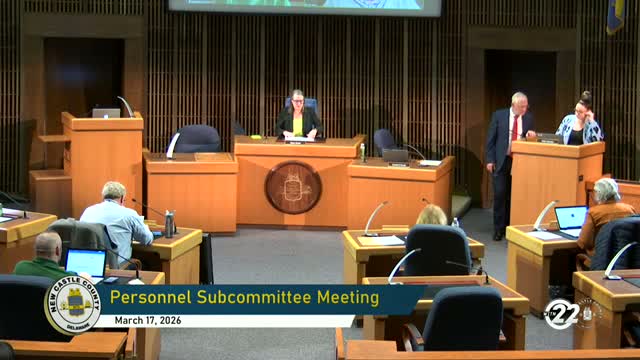
New Castle County’s Personnel Subcommittee met March 17, 2026, to review Chapter 8 of the county personnel handbook on workers’ compensation. Stephanie Tickle of New Castle County’s Office of Risk Management presented a high-level overview of the county program, explained reporting requirements and answered members’ questions.
Tickle told the subcommittee that workers’ compensation is a state‑mandated benefit that covers employees who receive a county paycheck, including part‑time, full‑time, seasonal, union and nonunion staff. ‘‘If you receive a paycheck from New Castle County as an employee, you are covered by our workers’ comp program,’’ she said. She added that independent contractors (those who provide a W‑9) and many volunteers are not covered.
The presentation listed the program’s main benefits: medical services and prescriptions (Tickle said these should be covered 100% and employees should not receive bills), temporary total or partial disability pay, permanent impairment and disfigurement benefits, death benefits for spouses or children and reimbursement for out‑of‑pocket costs such as mileage to medical appointments. Tickle described the county’s incident report (WC‑1) and a medical‑release form used to obtain records needed to evaluate claims, and she said supervisors may ask employees to sign the release but cannot require it.
Tickle emphasized the handbook’s reporting timeline: employees must report work‑related injuries or illnesses immediately and submit the incident report to the clerk of council no later than 24 hours. ‘‘Report it as soon as you can. As soon as you realize it’s an injury or it’s an illness related to your job, report it,’’ she said, describing the WC‑1 as a one‑page form the clerk will help complete.
On pay and leave, Tickle explained the county’s Leave Injury Illness (LII) pay code in PeopleSoft can supplement state benefits so employees may receive up to 100% of salary for eligible periods. She contrasted that with the state workers’ compensation benefit, which she described as ‘‘66 and 2/3’’ percent and said is capped by the state’s average weekly wage; she also noted county policy limits (for many employees LII is capped at three months and some groups have a one‑year cap under personnel policy 3.22). Regarding specifics she said, ‘‘So right now, it’s around 900 approximately a month,’’ when discussing the applicable state cap.
Tickle described the county’s emphasis on modified duty to help injured employees return to work in roles that match medical restrictions, saying early return to modified work can speed recovery. She said the county will accept work‑status recommendations from the employee’s medical provider and requires a work‑status note for returns after an absence caused by an occupational injury.
On medical providers, Tickle identified the county’s designated occupational clinic as Concentra (previously Pivot and Omega) and said it has been the county’s provider for more than 10 years. Employees may choose their own primary care provider but must notify that provider the visit is for a workers’ compensation claim so that billing follows the workers’ compensation fee schedule; Tickle noted some Delaware providers decline workers’ compensation cases because of differences in fee schedules.
Addressing legal support and workplace protections, Tickle said employees do not need an attorney to file a claim and that staff in Risk Management will assist: ‘‘An employee does not need an attorney,’’ she said. She also assured the committee the county will not retaliate against employees for filing claims: ‘‘Absolutely not. And I will yell and scream if it happens.’’
Committee members thanked Tickle for the overview and asked follow‑up questions about the prevalence of remote out‑of‑state employees (Pennsylvania, New Jersey, New York and Maryland). Tickle said the personnel policy limits remote work by job class and that she would need to gather specific counts and return that information to the committee.
Votes at a glance: The subcommittee moved to approve the minutes from the Jan. 20, 2026 meeting; a motion and second were recorded and members responded ‘‘Aye,’’ and the minutes were approved. The meeting concluded after a motion to adjourn was seconded and carried.
The subcommittee did not take other formal actions on policy changes during the March 17 meeting. Risk Management said it would follow up with the committee on the number and classification of remote out‑of‑state employees.
Tickle told the subcommittee that workers’ compensation is a state‑mandated benefit that covers employees who receive a county paycheck, including part‑time, full‑time, seasonal, union and nonunion staff. ‘‘If you receive a paycheck from New Castle County as an employee, you are covered by our workers’ comp program,’’ she said. She added that independent contractors (those who provide a W‑9) and many volunteers are not covered.
The presentation listed the program’s main benefits: medical services and prescriptions (Tickle said these should be covered 100% and employees should not receive bills), temporary total or partial disability pay, permanent impairment and disfigurement benefits, death benefits for spouses or children and reimbursement for out‑of‑pocket costs such as mileage to medical appointments. Tickle described the county’s incident report (WC‑1) and a medical‑release form used to obtain records needed to evaluate claims, and she said supervisors may ask employees to sign the release but cannot require it.
Tickle emphasized the handbook’s reporting timeline: employees must report work‑related injuries or illnesses immediately and submit the incident report to the clerk of council no later than 24 hours. ‘‘Report it as soon as you can. As soon as you realize it’s an injury or it’s an illness related to your job, report it,’’ she said, describing the WC‑1 as a one‑page form the clerk will help complete.
On pay and leave, Tickle explained the county’s Leave Injury Illness (LII) pay code in PeopleSoft can supplement state benefits so employees may receive up to 100% of salary for eligible periods. She contrasted that with the state workers’ compensation benefit, which she described as ‘‘66 and 2/3’’ percent and said is capped by the state’s average weekly wage; she also noted county policy limits (for many employees LII is capped at three months and some groups have a one‑year cap under personnel policy 3.22). Regarding specifics she said, ‘‘So right now, it’s around 900 approximately a month,’’ when discussing the applicable state cap.
Tickle described the county’s emphasis on modified duty to help injured employees return to work in roles that match medical restrictions, saying early return to modified work can speed recovery. She said the county will accept work‑status recommendations from the employee’s medical provider and requires a work‑status note for returns after an absence caused by an occupational injury.
On medical providers, Tickle identified the county’s designated occupational clinic as Concentra (previously Pivot and Omega) and said it has been the county’s provider for more than 10 years. Employees may choose their own primary care provider but must notify that provider the visit is for a workers’ compensation claim so that billing follows the workers’ compensation fee schedule; Tickle noted some Delaware providers decline workers’ compensation cases because of differences in fee schedules.
Addressing legal support and workplace protections, Tickle said employees do not need an attorney to file a claim and that staff in Risk Management will assist: ‘‘An employee does not need an attorney,’’ she said. She also assured the committee the county will not retaliate against employees for filing claims: ‘‘Absolutely not. And I will yell and scream if it happens.’’
Committee members thanked Tickle for the overview and asked follow‑up questions about the prevalence of remote out‑of‑state employees (Pennsylvania, New Jersey, New York and Maryland). Tickle said the personnel policy limits remote work by job class and that she would need to gather specific counts and return that information to the committee.
Votes at a glance: The subcommittee moved to approve the minutes from the Jan. 20, 2026 meeting; a motion and second were recorded and members responded ‘‘Aye,’’ and the minutes were approved. The meeting concluded after a motion to adjourn was seconded and carried.
The subcommittee did not take other formal actions on policy changes during the March 17 meeting. Risk Management said it would follow up with the committee on the number and classification of remote out‑of‑state employees.
Don't Miss a Word: See the Full Meeting!
Go beyond summaries. Unlock every video, transcript, and key insight with a Founder Membership.
✓
Get instant access to full meeting videos
✓
Search and clip any phrase from complete transcripts
✓
Receive AI-powered summaries & custom alerts
✓
Enjoy lifetime, unrestricted access to government data
30-day money-back guarantee
