State officials, county leaders warn HR 1 will shift billions in costs to counties and safety‑net providers
March 19, 2026 | California State Senate, Senate, Legislative, California
This article was created by AI summarizing key points discussed. AI makes mistakes, so for full details and context, please refer to the video of the full meeting. Please report any errors so we can fix them. Report an error »
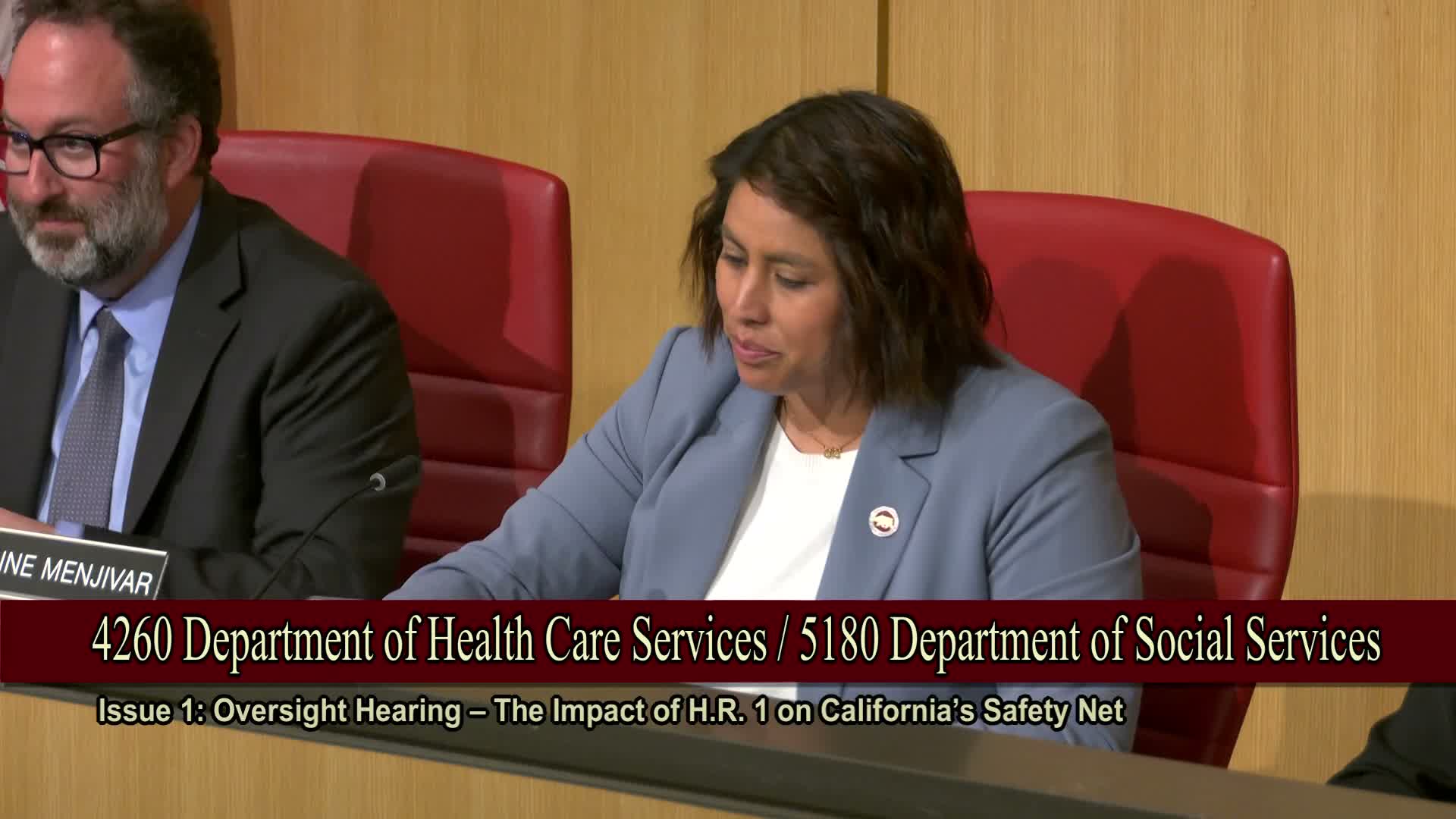
State officials, county leaders and hospital and clinic representatives told the California Senate Budget Subcommittee No. 3 on Thursday that the federal law known in testimony as HR 1 will sharply reduce federal support for Medi‑Cal and CalFresh and create an enormous fiscal and operational burden for counties and public safety‑net providers.
"HR 1 was enacted July 4, 2025 and imposes significant requirements on the Medicaid program, including work and community engagement requirements, more frequent redeterminations and reduced federal matching for certain populations," Michelle Boss, director of the Department of Health Care Services, said in a presentation to the panel. She summarized the governor's budget assumptions and the department's implementation plan and said the administration is investing in outreach and navigators to try to preserve coverage.
The state directors laid out a mix of projected savings and costs in the budget year tied to eligibility changes and implementation. "The estimated impact to general fund in 26/27 is a cost reduction of about $102,400,000" from the work and community engagement provisions, Boss said, while also warning of much larger state general fund exposure tied to reduced federal match and provider‑tax changes.
Jennifer Troyer, director of the California Department of Social Services, testified that HR 1 will expand CalFresh ABOD (able‑bodied adults without dependents) rules and sharply narrow waivers and exemptions. She said the governor's budget estimates a $1.6 billion reduction in CalFresh benefits in fiscal year 27/28 and that hundreds of thousands of recipients will face new eligibility screens.
County leaders described the downstream effects. "If we cannot keep people connected to food assistance and health care, we will see an unsettling increase in homelessness," Jackie Contreras, director of Los Angeles County Department of Public Social Services, said. She urged immediate release of $20 million the state previously set aside for CalFresh readiness and supported a broader County Welfare Directors Association ask for $373 million to expand eligibility workers statewide.
Los Angeles Health Services CEO Jorge Orozco said the county's public hospital system — which serves largely Medi‑Cal patients — projects an annual federal revenue loss of more than $700 million and a $2 billion deficit by 2028 without further state support. "We are the first stop for major emergencies in this county," Orozco said. "These costs are simply being shifted downward from the federal level, to the state, to the counties, to the safety‑net healthcare systems like ours." He urged multi‑year appropriations directed at public hospitals.
County executives from Santa Clara, Tulare and San Bernardino described parallel pressures: increased eligibility‑processing workload, higher uninsured rates, and a need to reestablish or expand county indigent care programs that many jurisdictions scaled back after the Affordable Care Act. Santa Clara County Executive James Williams noted Measure A local revenue will not cover projected losses and urged the Legislature to preserve enrollment and deepen state‑county partnership.
Analysts from the Legislative Analyst's Office and independent expert Len Fionnocchio underscored that HR1 interacts with California's 1991 realignment and AB 85 redirections, leaving counties with less flexible health realignment revenue to absorb the projected surge in indigent care demand. The LAO representative said their modeling suggests the ACA expansion population is particularly exposed and that by 2030 nearly 2 million people could be disenrolled from Medi‑Cal under HR1's rules.
Frontline staff and providers warned about implementation realities. Christopher Balma, an eligibility worker with SEIU in Ventura County, told the committee that many county offices are already understaffed and that training for new screening and follow‑up procedures will take months. "Our workload may double or even triple," Balma said. Community clinics and public hospitals described compound losses if both coverage declines and the state's elimination of prospective payment system (PPS) reimbursement for certain state‑only populations proceed.
State officials described steps to automate exemption screening and to use existing data sources where possible, including consented bank‑record verification tools and matches with EDD and other state data; they also acknowledged federal guidance gaps and uncertainty in some estimates. Department of Finance said it is tracking the previously‑budgeted contingent $20 million for counties and will provide updates ahead of the May revise.
Committee members pressed on near‑term choices: whether to adopt a temporary CalFresh match waiver to prevent counties from losing both state and federal matching dollars, how much one‑time or ongoing state funding counties will need to avoid layoffs, and whether PPS protections and parity for public hospitals should be enacted to prevent service reductions.
The hearing closed with public commenters and advocacy groups urging the Legislature to pursue progressive revenue options, expand CalFood/CFAP and CalFresh outreach and to avoid balancing the budget on the backs of low‑income families. Several county and provider witnesses asked the subcommittee to prioritize immediate administrative funding for eligibility work, a temporary match waiver and targeted public hospital support to blunt the most acute effects of HR1 implementation.
Next steps cited at the hearing include ongoing interagency coordination, additional technical guidance from federal agencies, budget deliberations ahead of the May revise, and further subcommittee attention to provider‑tax and financing issues that the administration said will be examined in later hearings.
"HR 1 was enacted July 4, 2025 and imposes significant requirements on the Medicaid program, including work and community engagement requirements, more frequent redeterminations and reduced federal matching for certain populations," Michelle Boss, director of the Department of Health Care Services, said in a presentation to the panel. She summarized the governor's budget assumptions and the department's implementation plan and said the administration is investing in outreach and navigators to try to preserve coverage.
The state directors laid out a mix of projected savings and costs in the budget year tied to eligibility changes and implementation. "The estimated impact to general fund in 26/27 is a cost reduction of about $102,400,000" from the work and community engagement provisions, Boss said, while also warning of much larger state general fund exposure tied to reduced federal match and provider‑tax changes.
Jennifer Troyer, director of the California Department of Social Services, testified that HR 1 will expand CalFresh ABOD (able‑bodied adults without dependents) rules and sharply narrow waivers and exemptions. She said the governor's budget estimates a $1.6 billion reduction in CalFresh benefits in fiscal year 27/28 and that hundreds of thousands of recipients will face new eligibility screens.
County leaders described the downstream effects. "If we cannot keep people connected to food assistance and health care, we will see an unsettling increase in homelessness," Jackie Contreras, director of Los Angeles County Department of Public Social Services, said. She urged immediate release of $20 million the state previously set aside for CalFresh readiness and supported a broader County Welfare Directors Association ask for $373 million to expand eligibility workers statewide.
Los Angeles Health Services CEO Jorge Orozco said the county's public hospital system — which serves largely Medi‑Cal patients — projects an annual federal revenue loss of more than $700 million and a $2 billion deficit by 2028 without further state support. "We are the first stop for major emergencies in this county," Orozco said. "These costs are simply being shifted downward from the federal level, to the state, to the counties, to the safety‑net healthcare systems like ours." He urged multi‑year appropriations directed at public hospitals.
County executives from Santa Clara, Tulare and San Bernardino described parallel pressures: increased eligibility‑processing workload, higher uninsured rates, and a need to reestablish or expand county indigent care programs that many jurisdictions scaled back after the Affordable Care Act. Santa Clara County Executive James Williams noted Measure A local revenue will not cover projected losses and urged the Legislature to preserve enrollment and deepen state‑county partnership.
Analysts from the Legislative Analyst's Office and independent expert Len Fionnocchio underscored that HR1 interacts with California's 1991 realignment and AB 85 redirections, leaving counties with less flexible health realignment revenue to absorb the projected surge in indigent care demand. The LAO representative said their modeling suggests the ACA expansion population is particularly exposed and that by 2030 nearly 2 million people could be disenrolled from Medi‑Cal under HR1's rules.
Frontline staff and providers warned about implementation realities. Christopher Balma, an eligibility worker with SEIU in Ventura County, told the committee that many county offices are already understaffed and that training for new screening and follow‑up procedures will take months. "Our workload may double or even triple," Balma said. Community clinics and public hospitals described compound losses if both coverage declines and the state's elimination of prospective payment system (PPS) reimbursement for certain state‑only populations proceed.
State officials described steps to automate exemption screening and to use existing data sources where possible, including consented bank‑record verification tools and matches with EDD and other state data; they also acknowledged federal guidance gaps and uncertainty in some estimates. Department of Finance said it is tracking the previously‑budgeted contingent $20 million for counties and will provide updates ahead of the May revise.
Committee members pressed on near‑term choices: whether to adopt a temporary CalFresh match waiver to prevent counties from losing both state and federal matching dollars, how much one‑time or ongoing state funding counties will need to avoid layoffs, and whether PPS protections and parity for public hospitals should be enacted to prevent service reductions.
The hearing closed with public commenters and advocacy groups urging the Legislature to pursue progressive revenue options, expand CalFood/CFAP and CalFresh outreach and to avoid balancing the budget on the backs of low‑income families. Several county and provider witnesses asked the subcommittee to prioritize immediate administrative funding for eligibility work, a temporary match waiver and targeted public hospital support to blunt the most acute effects of HR1 implementation.
Next steps cited at the hearing include ongoing interagency coordination, additional technical guidance from federal agencies, budget deliberations ahead of the May revise, and further subcommittee attention to provider‑tax and financing issues that the administration said will be examined in later hearings.
View the Full Meeting & All Its Details
This article offers just a summary. Unlock complete video, transcripts, and insights as a Founder Member.
✓
Watch full, unedited meeting videos
✓
Search every word spoken in unlimited transcripts
✓
AI summaries & real-time alerts (all government levels)
✓
Permanent access to expanding government content
30-day money-back guarantee
