CalRecycle tells senators edible‑food grants lack sustained funding; bag‑in‑a‑box fees set above HDPE rates
March 19, 2026 | California State Senate, Senate, Legislative, California
This article was created by AI summarizing key points discussed. AI makes mistakes, so for full details and context, please refer to the video of the full meeting. Please report any errors so we can fix them. Report an error »
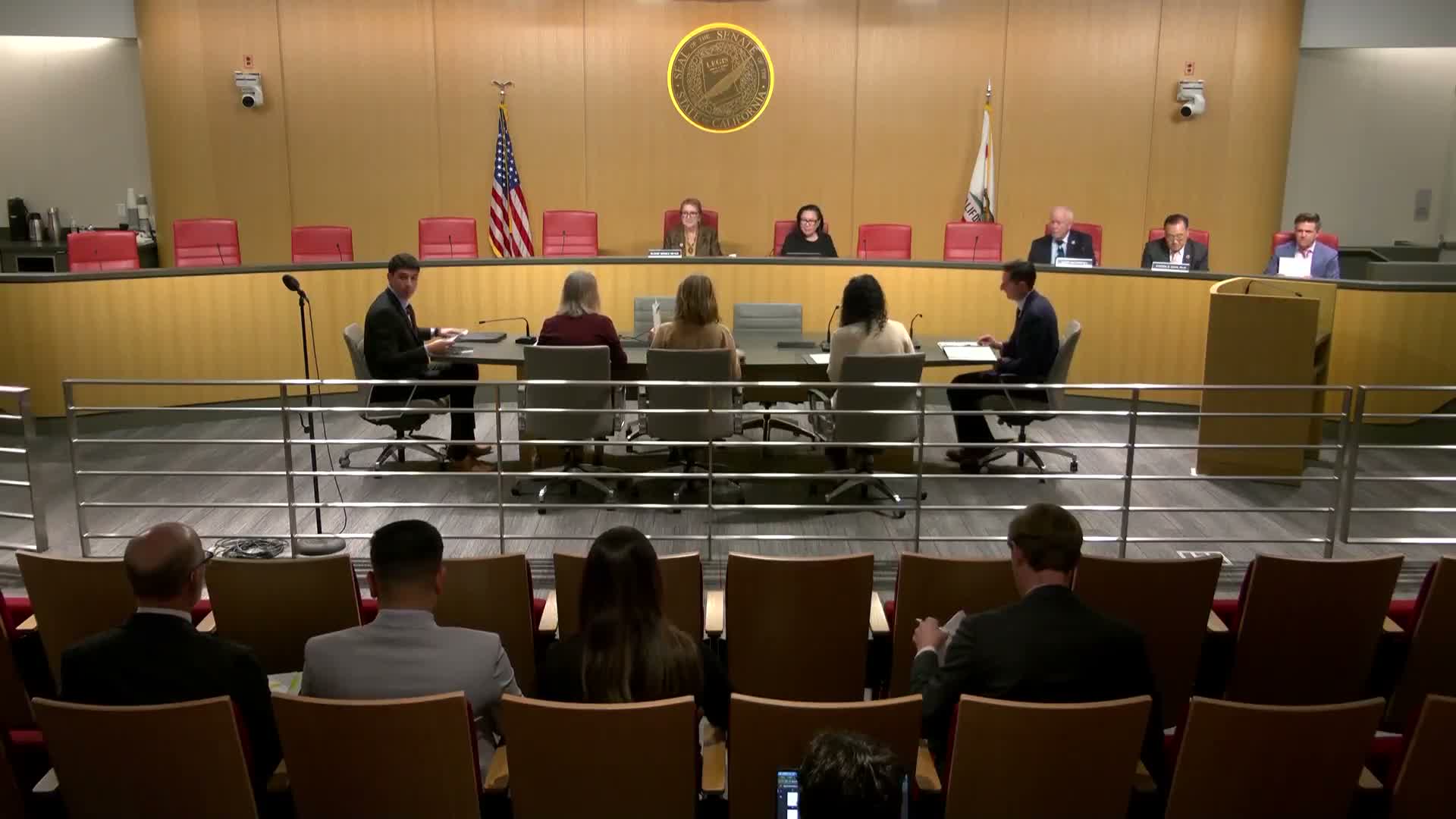
CalRecycle representatives said the department's 2026–27 priorities include landfill response, composting, compliance assistance and fraud prevention for the beverage container recycling program, but several implementation gaps remain.
Director Zoe Heller told the Senate Budget Subcommittee No. 2 that the Governor's proposed 2026–27 budget includes roughly 987 positions (transcript reads "9 87") and about $1.9 billion for CalRecycle across 30 funds. Heller said prior investments in edible food recovery have recovered more than 300,000,000 meals but that the agency does not have a sustained funding mechanism in place to continue those specific grant programs without legislative appropriation under existing statutory authority (SB 1383).
On producer fees, Heller and Chief Deputy Mindy McIntyre described how processing payments and fees are set by statute and a formula that the department applies. Because wine, distilled spirits and related packaging (including bag‑in‑a‑box and Tetra Pak cartons) were added to the beverage program under SB 1013, CalRecycle calculated material‑specific processing fees. Heller cited approximately $0.32 per container for bag‑in‑a‑box packaging and about $0.02 per container for multilayer pouches and paperboard cartons, compared with roughly $0.00867 per container for HDPE — reflecting higher recycling costs where specialized infrastructure is limited.
Heller said these higher fees are intended to reflect the current cost of recycling and to encourage investment in infrastructure; the department is directed by statute to use surveys and a formula to set processing payments and cannot unilaterally change that statutory formula. Mindy McIntyre described CalRecycle's role in gathering data and plugging it into the formula.
Committee members pressed agencies on SB 54 producer responsibility goals (a source‑reduction target of 20–25% by 2032) and asked for CalRecycle's needs‑assessment numbers for packaging generation (Heller said she would provide generation figures in follow‑up). Senators also discussed the state's investment in organics infrastructure (Heller cited more than $350,000,000 invested since 2019) and the role of community composting and anaerobic digestion pathways for inedible food waste.
Public‑interest groups supported more ongoing funding for edible food recovery and community composting in later testimony; StopWaste asked the committee to consider a $29 million ongoing commitment for edible food grant programs. The committee held CalRecycle items open for further negotiation.
Sources: Department testimony and public witness statements as recorded in the hearing transcript.
Director Zoe Heller told the Senate Budget Subcommittee No. 2 that the Governor's proposed 2026–27 budget includes roughly 987 positions (transcript reads "9 87") and about $1.9 billion for CalRecycle across 30 funds. Heller said prior investments in edible food recovery have recovered more than 300,000,000 meals but that the agency does not have a sustained funding mechanism in place to continue those specific grant programs without legislative appropriation under existing statutory authority (SB 1383).
On producer fees, Heller and Chief Deputy Mindy McIntyre described how processing payments and fees are set by statute and a formula that the department applies. Because wine, distilled spirits and related packaging (including bag‑in‑a‑box and Tetra Pak cartons) were added to the beverage program under SB 1013, CalRecycle calculated material‑specific processing fees. Heller cited approximately $0.32 per container for bag‑in‑a‑box packaging and about $0.02 per container for multilayer pouches and paperboard cartons, compared with roughly $0.00867 per container for HDPE — reflecting higher recycling costs where specialized infrastructure is limited.
Heller said these higher fees are intended to reflect the current cost of recycling and to encourage investment in infrastructure; the department is directed by statute to use surveys and a formula to set processing payments and cannot unilaterally change that statutory formula. Mindy McIntyre described CalRecycle's role in gathering data and plugging it into the formula.
Committee members pressed agencies on SB 54 producer responsibility goals (a source‑reduction target of 20–25% by 2032) and asked for CalRecycle's needs‑assessment numbers for packaging generation (Heller said she would provide generation figures in follow‑up). Senators also discussed the state's investment in organics infrastructure (Heller cited more than $350,000,000 invested since 2019) and the role of community composting and anaerobic digestion pathways for inedible food waste.
Public‑interest groups supported more ongoing funding for edible food recovery and community composting in later testimony; StopWaste asked the committee to consider a $29 million ongoing commitment for edible food grant programs. The committee held CalRecycle items open for further negotiation.
Sources: Department testimony and public witness statements as recorded in the hearing transcript.
Don't Miss a Word: See the Full Meeting!
Go beyond summaries. Unlock every video, transcript, and key insight with a Founder Membership.
✓
Get instant access to full meeting videos
✓
Search and clip any phrase from complete transcripts
✓
Receive AI-powered summaries & custom alerts
✓
Enjoy lifetime, unrestricted access to government data
30-day money-back guarantee
