Senate approves $20 million DPS appropriation after heated debate over immigration enforcement
March 19, 2026 | 2026 Legislature Arizona, Arizona
This article was created by AI summarizing key points discussed. AI makes mistakes, so for full details and context, please refer to the video of the full meeting. Please report any errors so we can fix them. Report an error »
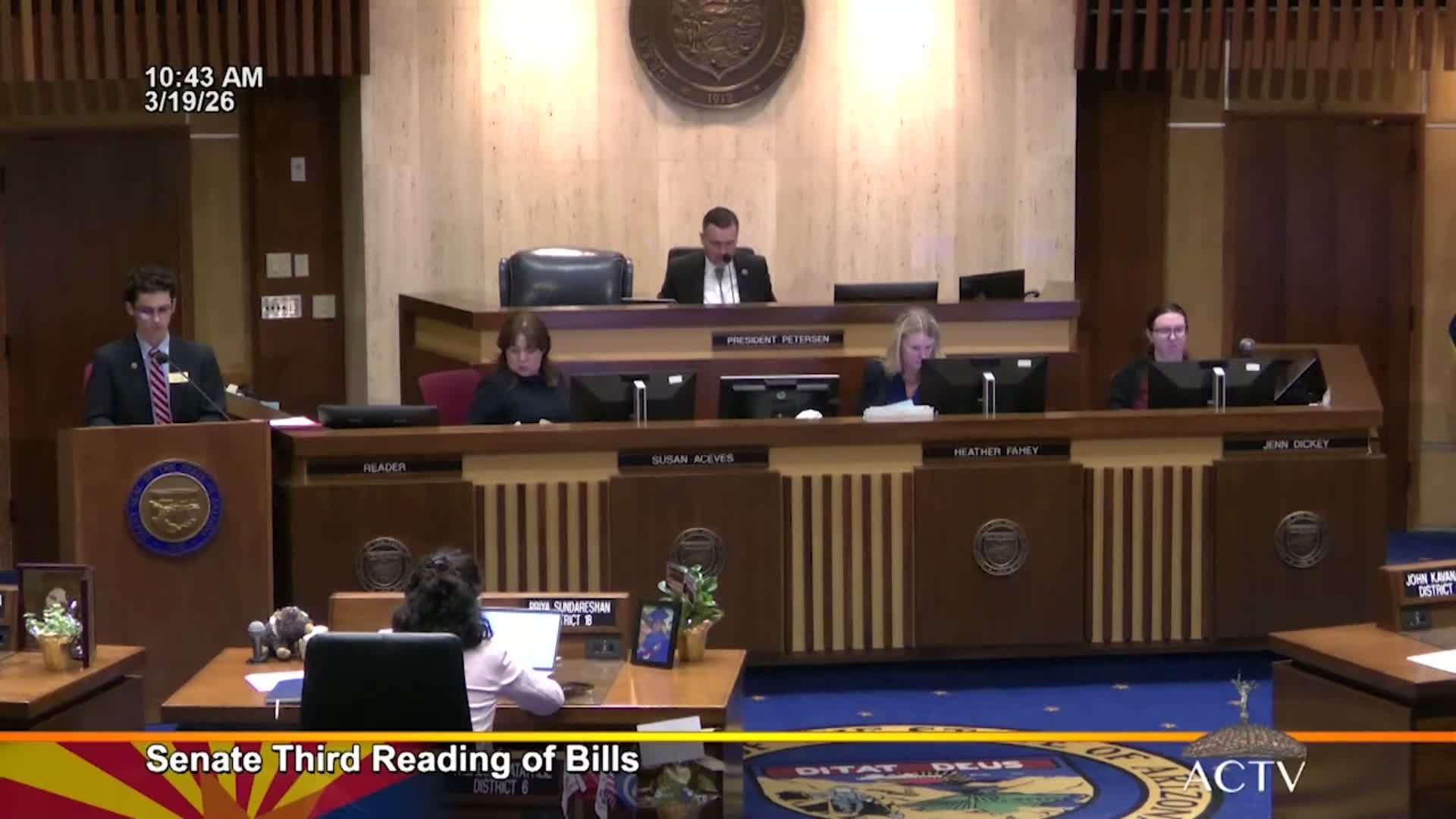
The Arizona Senate approved SB 11‑56 on March 19, sending a $20 million appropriation for Department of Public Safety border‑related activities to the House after a 17‑10 recorded vote with three senators not voting.
Opponents on the Senate floor said the appropriation was not requested by DPS, would disproportionately target immigrant communities and would divert limited state general funds from education, health care and child care. “This $20,000,000 appropriation will be used to strengthen anti‑immigrant sentiments across our state,” said Senator Miranda, who explained her no vote, adding that the money “was not requested,” and urging colleagues to oppose the measure.
Senator Diaz also urged a no vote, saying the funds were unnecessary and noting existing FY‑27 baseline allocations for border support. “These funds were not requested by the Department of Public Safety,” Diaz said, arguing the additional spending would target immigrant communities.
Supporters framed the measure as a needed reimbursement and local assistance. Senator Rogers said the funding would reimburse small rural counties that have borne costs already, citing an average daily expense figure for holding individuals: “This seeks to reimburse them for the disproportionate share of the burden that they’ve already carried,” she said before voting aye to underscore safety needs in her district, including roads and county costs tied to border incidents.
Several lawmakers framed their votes along broader policy lines. Senator Kavanaugh said state cooperation with state and local law enforcement was vital, arguing federal enforcement alone was not sufficient; Senator Finchem, among others, characterized the measure as a response to what he called open borders and voted yes.
The debate included repeated references to fiscal constraints and competing priorities. Opponents urged using scarce general funds for schools and health care rather than additional border spending, and several senators asked for federal reimbursement of prior border costs before authorizing new state spending.
The Senate clerk recorded the aye/no tally after debate; the secretary was instructed to transmit the bill to the House.
Opponents on the Senate floor said the appropriation was not requested by DPS, would disproportionately target immigrant communities and would divert limited state general funds from education, health care and child care. “This $20,000,000 appropriation will be used to strengthen anti‑immigrant sentiments across our state,” said Senator Miranda, who explained her no vote, adding that the money “was not requested,” and urging colleagues to oppose the measure.
Senator Diaz also urged a no vote, saying the funds were unnecessary and noting existing FY‑27 baseline allocations for border support. “These funds were not requested by the Department of Public Safety,” Diaz said, arguing the additional spending would target immigrant communities.
Supporters framed the measure as a needed reimbursement and local assistance. Senator Rogers said the funding would reimburse small rural counties that have borne costs already, citing an average daily expense figure for holding individuals: “This seeks to reimburse them for the disproportionate share of the burden that they’ve already carried,” she said before voting aye to underscore safety needs in her district, including roads and county costs tied to border incidents.
Several lawmakers framed their votes along broader policy lines. Senator Kavanaugh said state cooperation with state and local law enforcement was vital, arguing federal enforcement alone was not sufficient; Senator Finchem, among others, characterized the measure as a response to what he called open borders and voted yes.
The debate included repeated references to fiscal constraints and competing priorities. Opponents urged using scarce general funds for schools and health care rather than additional border spending, and several senators asked for federal reimbursement of prior border costs before authorizing new state spending.
The Senate clerk recorded the aye/no tally after debate; the secretary was instructed to transmit the bill to the House.
View the Full Meeting & All Its Details
This article offers just a summary. Unlock complete video, transcripts, and insights as a Founder Member.
✓
Watch full, unedited meeting videos
✓
Search every word spoken in unlimited transcripts
✓
AI summaries & real-time alerts (all government levels)
✓
Permanent access to expanding government content
30-day money-back guarantee
