Deloitte demos DataUSA and PeoplePrism to committee, warns about bias and accuracy limits
March 19, 2026 | 2026 Legislature Arizona, Arizona
This article was created by AI summarizing key points discussed. AI makes mistakes, so for full details and context, please refer to the video of the full meeting. Please report any errors so we can fix them. Report an error »
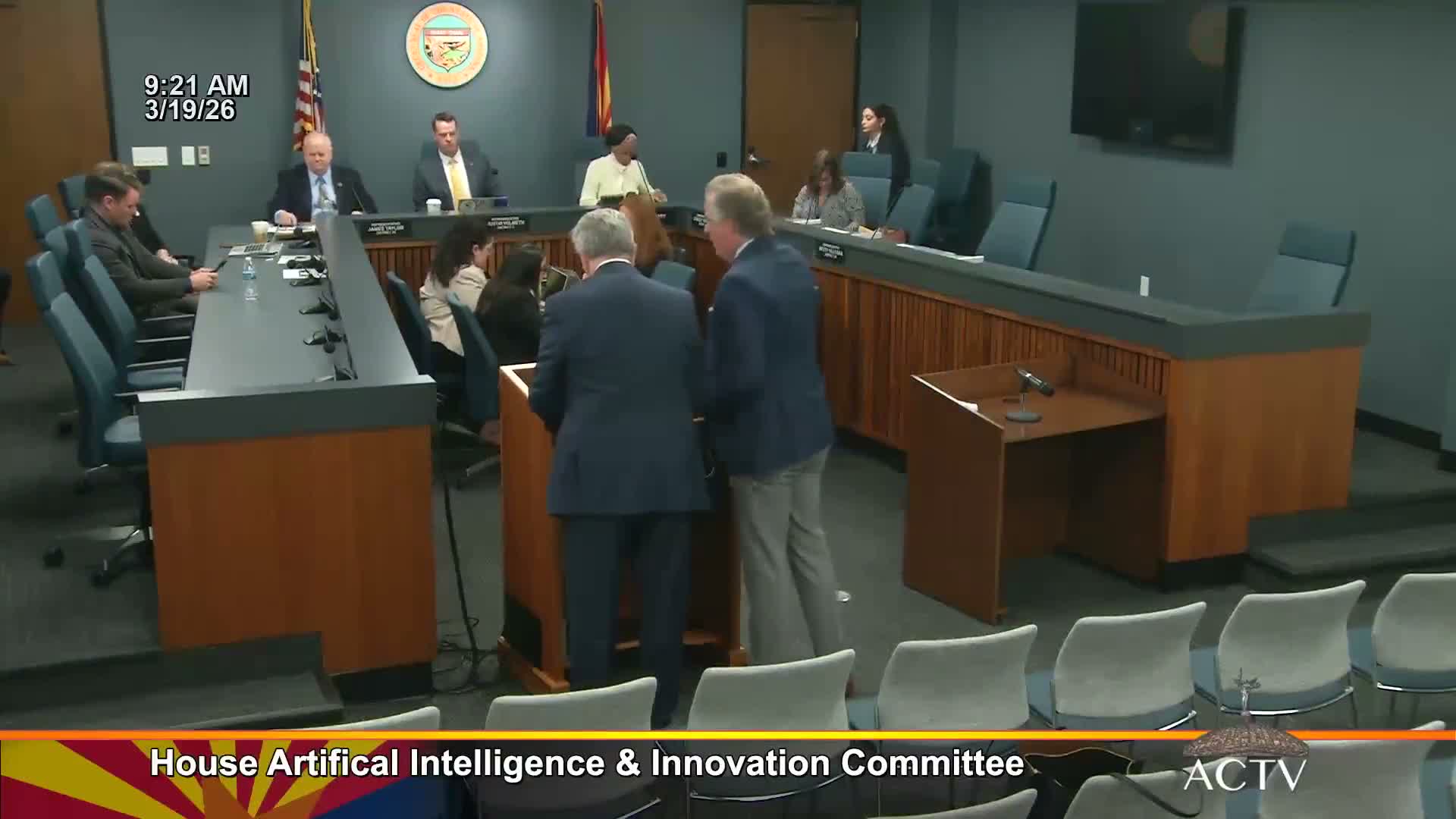
Deloitte representatives told the Arizona House Committee on Artificial Intelligence and Innovation that states can combine public data and private data sources into platforms that help target outreach and improve service delivery — but warned that models can be biased and are not fully accurate.
Josh Nisbett, managing partner for Deloitte in Arizona, framed the firm's public-sector work and introduced a demonstration of DataUSA and PeoplePrism. "Think about these questions... How do we use AI responsibly around sensitive citizen data? Who is accountable when AI makes a bad decision?" he asked.
Chris Steno, a data scientist with Deloitte, walked the committee through the company's approach: DataUSA aggregates public federal, state and local data; PeoplePrism is an AI layer that can create predictive models at scale. Steno said the dataset includes roughly 330,000,000 U.S. records and about "5,200,000 adults" for Arizona in the demonstrator. Using toggles he showed how the platform can identify 309,000 veterans in-state and run a predictive model that estimated 1,700 of those veterans may be at risk of foreclosure.
Steno cautioned that predictive models depend on the underlying data and are not perfectly accurate. He described an example asthma model that, using nonmedical inputs, changed an expected prevalence from "1 in 10" to about "1 in 2" in model output, noting "I'm still wrong 50% of the time." He said Deloitte's approach is to use these models to narrow outreach cohorts rather than make binary eligibility decisions.
Representatives pressed on data provenance, accuracy and the treatment of minors. Steno said DataUSA and purchased third-party lists form the dataset, and that Deloitte applies the strictest state privacy rules across jurisdictions in its work. On minors, he said models operate at the household level (the dataset may show a household has children without naming them) and outreach must target the household rather than children directly.
On safeguards, Steno described Deloitte's multi-pillar "trustworthy data and AI" framework that reviews data reliability, access controls and infrastructure security. He offered to provide follow-up materials and to return for a longer briefing.
The committee ended the presentation because of a floor deadline but signaled interest in a fuller follow-up session.
Josh Nisbett, managing partner for Deloitte in Arizona, framed the firm's public-sector work and introduced a demonstration of DataUSA and PeoplePrism. "Think about these questions... How do we use AI responsibly around sensitive citizen data? Who is accountable when AI makes a bad decision?" he asked.
Chris Steno, a data scientist with Deloitte, walked the committee through the company's approach: DataUSA aggregates public federal, state and local data; PeoplePrism is an AI layer that can create predictive models at scale. Steno said the dataset includes roughly 330,000,000 U.S. records and about "5,200,000 adults" for Arizona in the demonstrator. Using toggles he showed how the platform can identify 309,000 veterans in-state and run a predictive model that estimated 1,700 of those veterans may be at risk of foreclosure.
Steno cautioned that predictive models depend on the underlying data and are not perfectly accurate. He described an example asthma model that, using nonmedical inputs, changed an expected prevalence from "1 in 10" to about "1 in 2" in model output, noting "I'm still wrong 50% of the time." He said Deloitte's approach is to use these models to narrow outreach cohorts rather than make binary eligibility decisions.
Representatives pressed on data provenance, accuracy and the treatment of minors. Steno said DataUSA and purchased third-party lists form the dataset, and that Deloitte applies the strictest state privacy rules across jurisdictions in its work. On minors, he said models operate at the household level (the dataset may show a household has children without naming them) and outreach must target the household rather than children directly.
On safeguards, Steno described Deloitte's multi-pillar "trustworthy data and AI" framework that reviews data reliability, access controls and infrastructure security. He offered to provide follow-up materials and to return for a longer briefing.
The committee ended the presentation because of a floor deadline but signaled interest in a fuller follow-up session.
Don't Miss a Word: See the Full Meeting!
Go beyond summaries. Unlock every video, transcript, and key insight with a Founder Membership.
✓
Get instant access to full meeting videos
✓
Search and clip any phrase from complete transcripts
✓
Receive AI-powered summaries & custom alerts
✓
Enjoy lifetime, unrestricted access to government data
30-day money-back guarantee
