Company demo shows camera‑based AI for early smoke detection; committee asks about coverage and costs
March 19, 2026 | 2026 Legislature Arizona, Arizona
This article was created by AI summarizing key points discussed. AI makes mistakes, so for full details and context, please refer to the video of the full meeting. Please report any errors so we can fix them. Report an error »
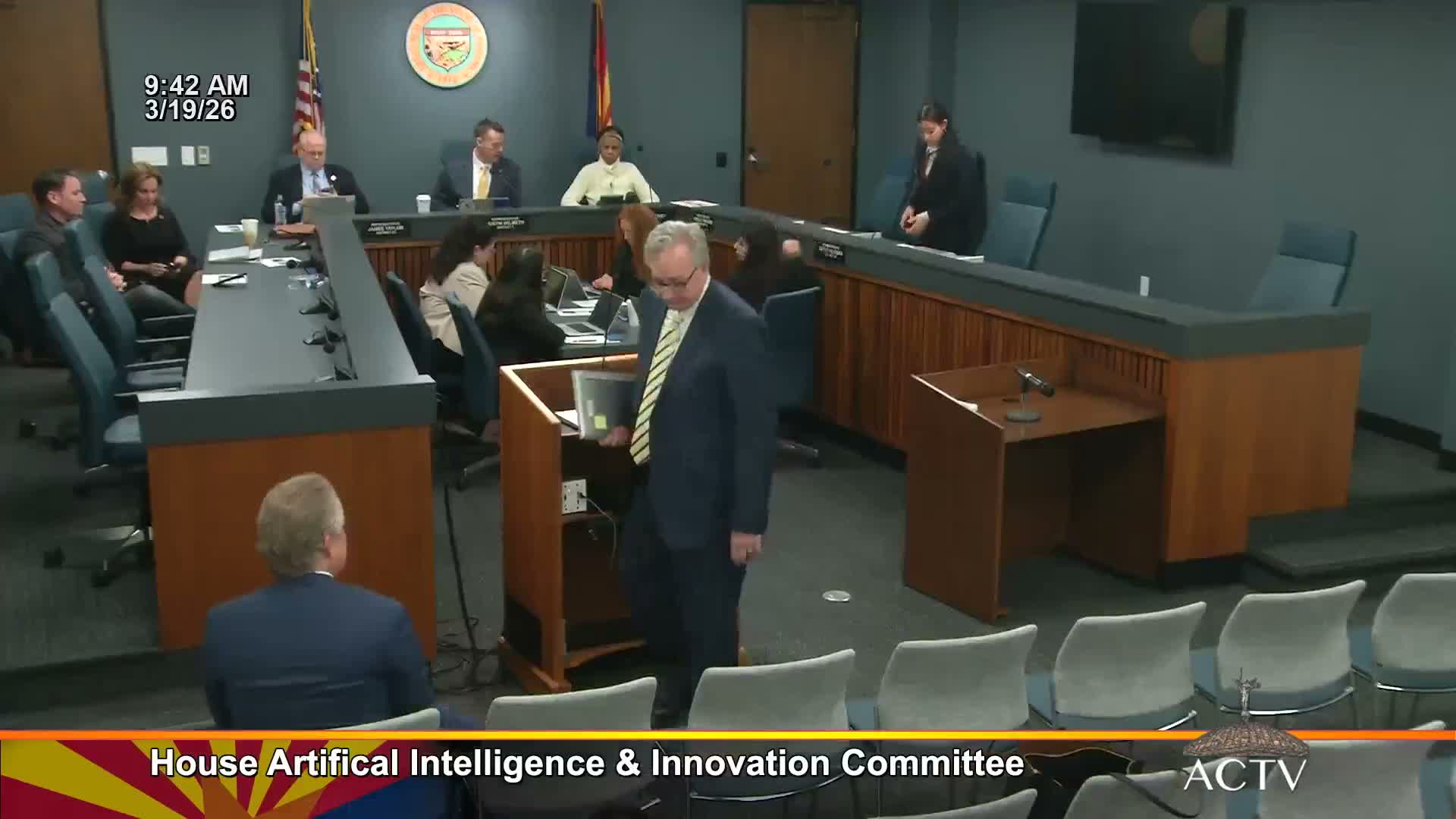
Pano AI representatives told the House committee that a network of panoramic cameras and an AI smoke-detection system can help emergency managers find fires earlier and improve initial response decisions.
Mikaela Baker, government affairs manager for Pano AI, described the system: each station has two high-definition rotating cameras that stitch a panoramic image every 60 seconds and run AI to detect smoke. Baker said the AI typically monitors a roughly 10-mile radius and can detect smoke up to about 40 miles in favorable conditions; she emphasized a human-in-the-loop verification center that vets alerts 24 hours a day.
"We install them on the top of high points on towers... Every 60 seconds, they're stitching together a panoramic image that we then overlay that AI onto," Baker said, describing detection and delivery of alerts via text or email with mapping and video for first responders. To protect privacy, Pano applies "hard pixelation" to homes or driveways visible in the view shed.
Baker said Pano planned to have over 85 camera stations across Arizona by the end of the year, with 87-plus fire resources and about 410 active individual users onboarded. She described deployment as typically subscription-based with five-year contracts, paid by a mix of federal grants, state/local funds, utilities or private customers.
Committee members asked about coverage requirements and weather limitations. Baker said effective coverage depends on topography and camera placement and that triangulation spacing is roughly every 10 miles; heavy cloud or rain reduces range, though detection sometimes works through clouds. On funding she said the company works with Department of Interior grants, utilities (APS, TEP, Unisource) and municipal customers.
Members praised potential operational benefits — faster incident location, better decision-making about aircraft and evacuation — and discussed future integration with predictive analytics for fire spread. Baker emphasized the system is a tool to support responders, not a replacement for human judgment.
The committee adjourned for a floor deadline with interest expressed in the technology and requests for more deployment numbers and cost details.
Mikaela Baker, government affairs manager for Pano AI, described the system: each station has two high-definition rotating cameras that stitch a panoramic image every 60 seconds and run AI to detect smoke. Baker said the AI typically monitors a roughly 10-mile radius and can detect smoke up to about 40 miles in favorable conditions; she emphasized a human-in-the-loop verification center that vets alerts 24 hours a day.
"We install them on the top of high points on towers... Every 60 seconds, they're stitching together a panoramic image that we then overlay that AI onto," Baker said, describing detection and delivery of alerts via text or email with mapping and video for first responders. To protect privacy, Pano applies "hard pixelation" to homes or driveways visible in the view shed.
Baker said Pano planned to have over 85 camera stations across Arizona by the end of the year, with 87-plus fire resources and about 410 active individual users onboarded. She described deployment as typically subscription-based with five-year contracts, paid by a mix of federal grants, state/local funds, utilities or private customers.
Committee members asked about coverage requirements and weather limitations. Baker said effective coverage depends on topography and camera placement and that triangulation spacing is roughly every 10 miles; heavy cloud or rain reduces range, though detection sometimes works through clouds. On funding she said the company works with Department of Interior grants, utilities (APS, TEP, Unisource) and municipal customers.
Members praised potential operational benefits — faster incident location, better decision-making about aircraft and evacuation — and discussed future integration with predictive analytics for fire spread. Baker emphasized the system is a tool to support responders, not a replacement for human judgment.
The committee adjourned for a floor deadline with interest expressed in the technology and requests for more deployment numbers and cost details.
Don't Miss a Word: See the Full Meeting!
Go beyond summaries. Unlock every video, transcript, and key insight with a Founder Membership.
✓
Get instant access to full meeting videos
✓
Search and clip any phrase from complete transcripts
✓
Receive AI-powered summaries & custom alerts
✓
Enjoy lifetime, unrestricted access to government data
30-day money-back guarantee
