Residents press council on proposed data centers, citing water and local‑benefit concerns
March 16, 2026 | Grove City, Franklin County, Ohio
This article was created by AI summarizing key points discussed. AI makes mistakes, so for full details and context, please refer to the video of the full meeting. Please report any errors so we can fix them. Report an error »
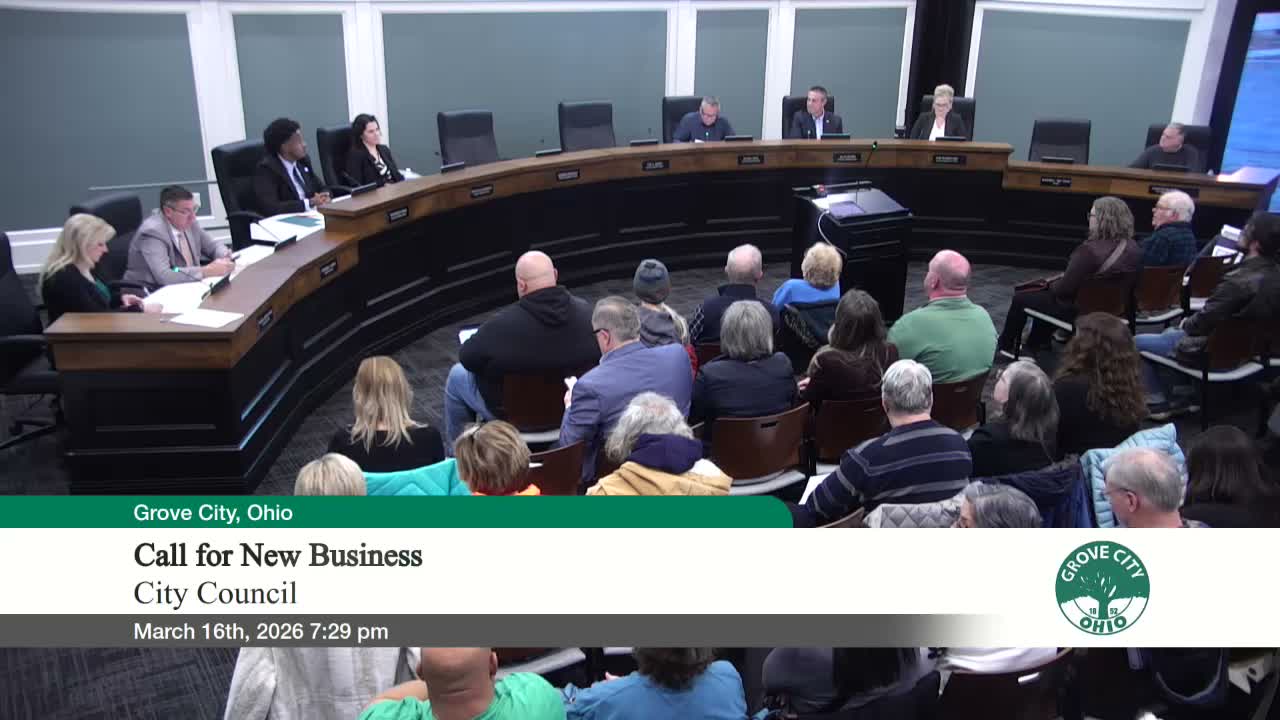
Residents raised objections and questions about proposed data center projects near Grove City during the meeting's public comment period, telling council they are worried about environmental and economic effects if large server parks are sited near neighborhoods.
Lorraine Harris asked council for clarification about exact locations and was told no formal applications had been filed with the city and that administration staff could share general areas under consideration. The chair and staff encouraged residents to contact city staffer Kyle Rausch for more detail.
Andrew Olashchuk, who said he had researched data center impacts for the past year, urged council to oppose locating large data centers near homes, contending that many large data center projects do not deliver widespread local job benefits and instead seek tax incentives. Olashchuk presented numerical comparisons stressing water use and energy demands — he stated that a local Ohio corn farm might use 3,000–5,000 gallons per day for irrigation, and asserted that a data center can use “5,000,000 per day.” Those figures were presented as claims and were not independently substantiated during the meeting.
Barbara Sims described long personal ties to the area and said data centers would be an “abomination” near Grove City neighborhoods; she referenced potential sites such as Wrench Road and Hyer Road in 104 (as reported in her remarks), and asked that council hear neighborhood concerns.
City staffer Kyle Rausch said the developer had scheduled community open‑house meetings (not city‑run) to answer questions; staff will not be leading those sessions. He said one meeting had been arranged for March from 5–7 p.m. at the Mid‑Ohio Food Collective (the Mid‑Ohio Food Bank facility) and that the developer was responsible for outreach and notices for that event.
There was no formal council action on data centers at this meeting. The discussion was limited to public comment and staff statements that developers planned local meetings; councilmembers encouraged residents to attend developer sessions and to follow up with city staff for factual details.
Why it matters: Data center projects raise local land‑use, utilities and fiscal questions for cities that host them. Residents flagged potential impacts on water supply, electricity demand and local job creation; those concerns could influence future zoning decisions or negotiations if developers file formal applications.
Lorraine Harris asked council for clarification about exact locations and was told no formal applications had been filed with the city and that administration staff could share general areas under consideration. The chair and staff encouraged residents to contact city staffer Kyle Rausch for more detail.
Andrew Olashchuk, who said he had researched data center impacts for the past year, urged council to oppose locating large data centers near homes, contending that many large data center projects do not deliver widespread local job benefits and instead seek tax incentives. Olashchuk presented numerical comparisons stressing water use and energy demands — he stated that a local Ohio corn farm might use 3,000–5,000 gallons per day for irrigation, and asserted that a data center can use “5,000,000 per day.” Those figures were presented as claims and were not independently substantiated during the meeting.
Barbara Sims described long personal ties to the area and said data centers would be an “abomination” near Grove City neighborhoods; she referenced potential sites such as Wrench Road and Hyer Road in 104 (as reported in her remarks), and asked that council hear neighborhood concerns.
City staffer Kyle Rausch said the developer had scheduled community open‑house meetings (not city‑run) to answer questions; staff will not be leading those sessions. He said one meeting had been arranged for March from 5–7 p.m. at the Mid‑Ohio Food Collective (the Mid‑Ohio Food Bank facility) and that the developer was responsible for outreach and notices for that event.
There was no formal council action on data centers at this meeting. The discussion was limited to public comment and staff statements that developers planned local meetings; councilmembers encouraged residents to attend developer sessions and to follow up with city staff for factual details.
Why it matters: Data center projects raise local land‑use, utilities and fiscal questions for cities that host them. Residents flagged potential impacts on water supply, electricity demand and local job creation; those concerns could influence future zoning decisions or negotiations if developers file formal applications.
Don't Miss a Word: See the Full Meeting!
Go beyond summaries. Unlock every video, transcript, and key insight with a Founder Membership.
✓
Get instant access to full meeting videos
✓
Search and clip any phrase from complete transcripts
✓
Receive AI-powered summaries & custom alerts
✓
Enjoy lifetime, unrestricted access to government data
30-day money-back guarantee
