Technology Commission backs application rationalization after adding KPI and stakeholder-engagement requirements
March 19, 2026 | Austin, Travis County, Texas
This article was created by AI summarizing key points discussed. AI makes mistakes, so for full details and context, please refer to the video of the full meeting. Please report any errors so we can fix them. Report an error »
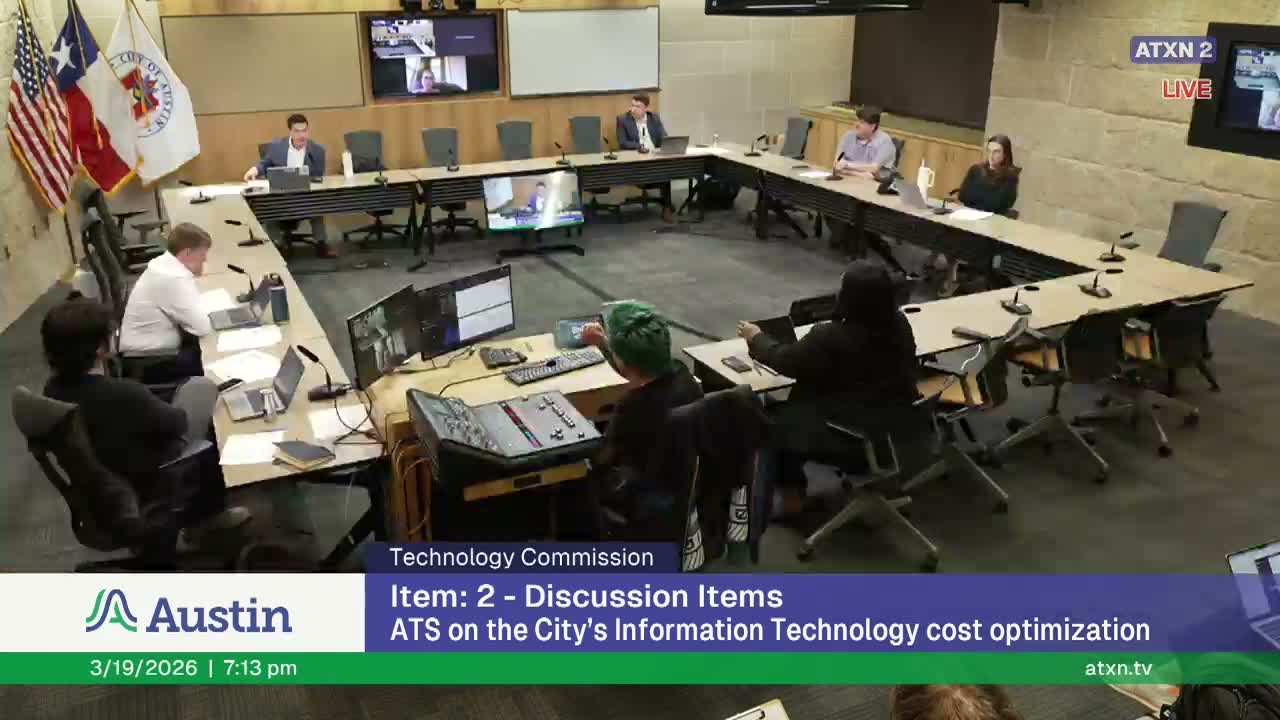
The City of Austin Technology Commission on Thursday recommended continued funding for a citywide application rationalization process led by Austin Technology Services (ATS), but amended its recommendation to require measurable performance metrics and a structured, inclusive stakeholder engagement process.
Carika Lakey, director of Austin Technology Services and the city's chief information officer, told the commission the phase-1 Gartner assessment identified duplicate functions, inconsistent standards and higher-than-peer spending, and recommended aligning technology staff into ATS to create shared services, strengthen cybersecurity and reduce costs. Lakey said the rationalization work with consultants NEOS and Parzalvo has identified consolidation opportunities for hundreds of applications and is in phase 5, with cost-savings analysis due later this month and final reporting expected in April.
"We began work with Gartner Consulting Services in June 2025," Lakey said. "The goals were to reduce cost, strengthen our governance, streamline and modernize our application portfolio, and improve the overall operational effectiveness of technology." Lakey said most staff would remain embedded with the departments they support, and that a separate operational-technology mapping effort will address utilities and airports.
The commission's decision followed an extended public-comment segment in which roughly a dozen city employees and union representatives asked the commission to pause funding for consultant work tied to the consolidation and to vote against the recommendation. David Cruz, a member of AFSCME Local 1624's board, said the union supports application rationalization but opposes what he called a "high-risk reorganization" of personnel without a transparent cost-benefit analysis and a validated return on investment.
"We are supportive of efficiency services. What we are not supportive of is a high risk reorganization that will provide questionable efficiency gains that have not weighed operational, reputational, and fiscal risks," Cruz said.
Several employees testified that removing embedded IT experts from departments would slow emergency response and degrade public-safety operations. "This kind of rapid response can't be achieved by submitting a ticket with an IT centralized group," said David Gimich, who said he has done GIS and emergency-response mapping for the city for 14 years. "These decisions help save lives."
Commissioners acknowledged those concerns and said the written recommendation should be scoped to application rationalization rather than personnel decisions. Commissioner Privech moved to retitle and narrow the recommendation to "citywide application rationalization" and to replace the word "governance" with "standards." Commissioner Eastwood proposed—and the commission accepted—language requiring the city to establish and track KPIs such as percentage of IT spend centralized, reduction in redundant applications, IT staffing alignment, cybersecurity maturity improvements, and overall cost savings benchmarked against peer cities.
Commissioner Heritage successfully proposed adding a directive that the city manager direct ATS to implement "a structured and inclusive stakeholder engagement process as part of the citywide technology rationalization project, ensuring meaningful input is gathered from a diverse cross section of city staff across departments, areas of expertise, levels of seniority, including frontline users, technical staff, and program administrators."
After the amendments were adopted, the commission read the revised recommendation into the record and voted to approve it. Chair Steven Apodaca said the revised text was intended to emphasize application modernization while building in accountability and staff involvement.
What passed: The Technology Commission recommended that the Austin City Council allocate continued funding in the FY26 budget for the citywide technology optimization project to support application rationalization, system integration and operational efficiencies. It also asked that sustained funding be supported by ongoing KPIs and stakeholder feedback and that ATS implement a structured stakeholder-engagement process.
Votes at a glance: Commissioners voted to approve several other recommendations on Thursday, including continued funding for public computer access and digital-inclusion library services; exploration of public-private partnership models to support broadband and digital-equity efforts (a P3 resolution); continued GTOPS funding (a $400,000 recommendation for FY27); funding to upskill city staff in AI tools; and continued support for the City website refresh project.
Next steps: Commissioners said ATS and city staff will return with milestone reports and KPI data as the rationalization work proceeds. Dan (GTOPS staff) said GTOPS awardees are expected to be announced by April 8 or possibly in May.
Reported authorities and documents referenced at the meeting include a city manager memorandum dated 11/05/2025 on efficiency and optimization and a phase-1 assessment prepared by Gartner Consulting Services (the Gartner assessment cited by ATS).
Carika Lakey, director of Austin Technology Services and the city's chief information officer, told the commission the phase-1 Gartner assessment identified duplicate functions, inconsistent standards and higher-than-peer spending, and recommended aligning technology staff into ATS to create shared services, strengthen cybersecurity and reduce costs. Lakey said the rationalization work with consultants NEOS and Parzalvo has identified consolidation opportunities for hundreds of applications and is in phase 5, with cost-savings analysis due later this month and final reporting expected in April.
"We began work with Gartner Consulting Services in June 2025," Lakey said. "The goals were to reduce cost, strengthen our governance, streamline and modernize our application portfolio, and improve the overall operational effectiveness of technology." Lakey said most staff would remain embedded with the departments they support, and that a separate operational-technology mapping effort will address utilities and airports.
The commission's decision followed an extended public-comment segment in which roughly a dozen city employees and union representatives asked the commission to pause funding for consultant work tied to the consolidation and to vote against the recommendation. David Cruz, a member of AFSCME Local 1624's board, said the union supports application rationalization but opposes what he called a "high-risk reorganization" of personnel without a transparent cost-benefit analysis and a validated return on investment.
"We are supportive of efficiency services. What we are not supportive of is a high risk reorganization that will provide questionable efficiency gains that have not weighed operational, reputational, and fiscal risks," Cruz said.
Several employees testified that removing embedded IT experts from departments would slow emergency response and degrade public-safety operations. "This kind of rapid response can't be achieved by submitting a ticket with an IT centralized group," said David Gimich, who said he has done GIS and emergency-response mapping for the city for 14 years. "These decisions help save lives."
Commissioners acknowledged those concerns and said the written recommendation should be scoped to application rationalization rather than personnel decisions. Commissioner Privech moved to retitle and narrow the recommendation to "citywide application rationalization" and to replace the word "governance" with "standards." Commissioner Eastwood proposed—and the commission accepted—language requiring the city to establish and track KPIs such as percentage of IT spend centralized, reduction in redundant applications, IT staffing alignment, cybersecurity maturity improvements, and overall cost savings benchmarked against peer cities.
Commissioner Heritage successfully proposed adding a directive that the city manager direct ATS to implement "a structured and inclusive stakeholder engagement process as part of the citywide technology rationalization project, ensuring meaningful input is gathered from a diverse cross section of city staff across departments, areas of expertise, levels of seniority, including frontline users, technical staff, and program administrators."
After the amendments were adopted, the commission read the revised recommendation into the record and voted to approve it. Chair Steven Apodaca said the revised text was intended to emphasize application modernization while building in accountability and staff involvement.
What passed: The Technology Commission recommended that the Austin City Council allocate continued funding in the FY26 budget for the citywide technology optimization project to support application rationalization, system integration and operational efficiencies. It also asked that sustained funding be supported by ongoing KPIs and stakeholder feedback and that ATS implement a structured stakeholder-engagement process.
Votes at a glance: Commissioners voted to approve several other recommendations on Thursday, including continued funding for public computer access and digital-inclusion library services; exploration of public-private partnership models to support broadband and digital-equity efforts (a P3 resolution); continued GTOPS funding (a $400,000 recommendation for FY27); funding to upskill city staff in AI tools; and continued support for the City website refresh project.
Next steps: Commissioners said ATS and city staff will return with milestone reports and KPI data as the rationalization work proceeds. Dan (GTOPS staff) said GTOPS awardees are expected to be announced by April 8 or possibly in May.
Reported authorities and documents referenced at the meeting include a city manager memorandum dated 11/05/2025 on efficiency and optimization and a phase-1 assessment prepared by Gartner Consulting Services (the Gartner assessment cited by ATS).
Don't Miss a Word: See the Full Meeting!
Go beyond summaries. Unlock every video, transcript, and key insight with a Founder Membership.
✓
Get instant access to full meeting videos
✓
Search and clip any phrase from complete transcripts
✓
Receive AI-powered summaries & custom alerts
✓
Enjoy lifetime, unrestricted access to government data
30-day money-back guarantee
