Jackson council keeps parklet program, sets $2,000 annual fee and three-space limit after heated public debate
March 16, 2026 | Jackson, Teton County, Wyoming
This article was created by AI summarizing key points discussed. AI makes mistakes, so for full details and context, please refer to the video of the full meeting. Please report any errors so we can fix them. Report an error »
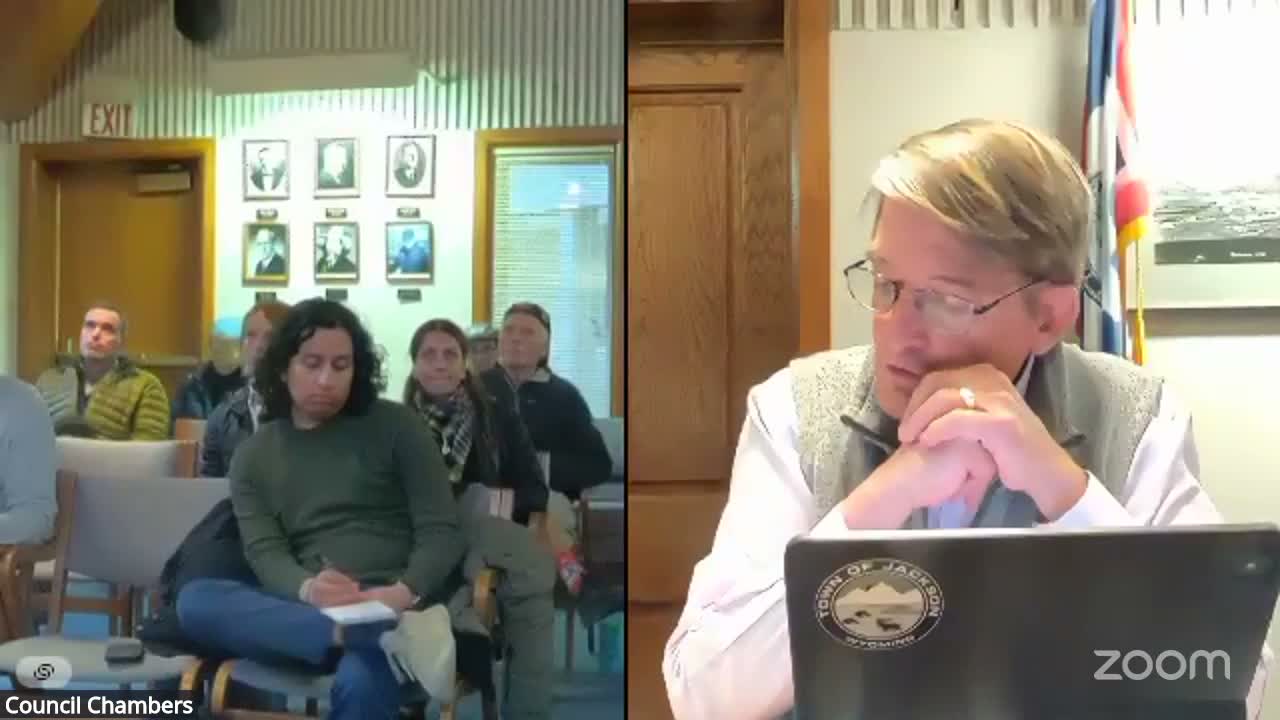
Jackson — The Town Council on March 16 voted to continue the temporary downtown parklet program this summer, adopt an annual fee of $2,000 per parking space and retain a three-space-per-parklet maximum after hours of public comment and council discussion.
Councilor Schechter moved the staff-backed motion to shift payment to an annual per-space fee, set the fee at $2,000 per parking space, and keep a three-space maximum for each parklet; a second was recorded and the motion passed 3–2. The change takes effect for the 2026 permitting cycle; councilors said they expect to revisit overall parking valuation and program rules in the fall budget process.
Why it mattered: staff told the council the downtown core contains 552 parking spaces and parklets occupy 18 of those spaces (about 3.26 percent). Town staff recommended moving to an annual, per-space fee to make costs more equitable between parklets that occupy one parking space and those that occupy two or three. The $2,000 figure was presented as a moderate increase over the program’s early years and as a compromise between no fee and much higher proposed rates.
Public comment was sharply divided. Business owners and operators said parklets helped them survive COVID-era shutdowns and continue to draw pedestrian activity downtown. “The parklets have been a tremendous value add,” said Nicole Gill, owner of Jackson Drug (speaker recorded in public comment), citing increased foot traffic and summer revenue. Several restaurant owners described the program as critical to handling peak-season demand.
Opponents raised fairness concerns for businesses that have invested in permanent indoor seating and have paid building and mitigation fees. One longtime restaurateur warned that parklets create an uneven competitive advantage for businesses that can deploy outdoor decks, calling that imbalance “inequitable.”
Council discussion centered on equity, administrative burden and whether to limit the program’s scope. Councilors debated fee levels (staff noted a $94-per-day construction staging comparator), whether to cap the total number of parklet spaces downtown, and administrative options such as first-come/lottery allocation. Ultimately, councilors moved forward with the staff recommendation on annual fees and the three-space maximum while removing a proposed immediate cap mechanism; councilors said staff will return in the fall with more data and a fuller discussion of parking valuation.
What happens next: staff will implement the new annual fee structure for 2026 permits and return to council with fall recommendations and any proposed limits or allocation mechanisms for 2027. The council also discussed potential guardrails to make the program fairer in future years.
(Attributions: staff presentation and fee proposal from Susan Sarwada, director of external affairs; motion text and vote moved by Councilor Schechter; public comments from business owners and operators were recorded during the March 16 public comment period.)
Councilor Schechter moved the staff-backed motion to shift payment to an annual per-space fee, set the fee at $2,000 per parking space, and keep a three-space maximum for each parklet; a second was recorded and the motion passed 3–2. The change takes effect for the 2026 permitting cycle; councilors said they expect to revisit overall parking valuation and program rules in the fall budget process.
Why it mattered: staff told the council the downtown core contains 552 parking spaces and parklets occupy 18 of those spaces (about 3.26 percent). Town staff recommended moving to an annual, per-space fee to make costs more equitable between parklets that occupy one parking space and those that occupy two or three. The $2,000 figure was presented as a moderate increase over the program’s early years and as a compromise between no fee and much higher proposed rates.
Public comment was sharply divided. Business owners and operators said parklets helped them survive COVID-era shutdowns and continue to draw pedestrian activity downtown. “The parklets have been a tremendous value add,” said Nicole Gill, owner of Jackson Drug (speaker recorded in public comment), citing increased foot traffic and summer revenue. Several restaurant owners described the program as critical to handling peak-season demand.
Opponents raised fairness concerns for businesses that have invested in permanent indoor seating and have paid building and mitigation fees. One longtime restaurateur warned that parklets create an uneven competitive advantage for businesses that can deploy outdoor decks, calling that imbalance “inequitable.”
Council discussion centered on equity, administrative burden and whether to limit the program’s scope. Councilors debated fee levels (staff noted a $94-per-day construction staging comparator), whether to cap the total number of parklet spaces downtown, and administrative options such as first-come/lottery allocation. Ultimately, councilors moved forward with the staff recommendation on annual fees and the three-space maximum while removing a proposed immediate cap mechanism; councilors said staff will return in the fall with more data and a fuller discussion of parking valuation.
What happens next: staff will implement the new annual fee structure for 2026 permits and return to council with fall recommendations and any proposed limits or allocation mechanisms for 2027. The council also discussed potential guardrails to make the program fairer in future years.
(Attributions: staff presentation and fee proposal from Susan Sarwada, director of external affairs; motion text and vote moved by Councilor Schechter; public comments from business owners and operators were recorded during the March 16 public comment period.)
View the Full Meeting & All Its Details
This article offers just a summary. Unlock complete video, transcripts, and insights as a Founder Member.
✓
Watch full, unedited meeting videos
✓
Search every word spoken in unlimited transcripts
✓
AI summaries & real-time alerts (all government levels)
✓
Permanent access to expanding government content
30-day money-back guarantee
