Rockwall council approves 77.86‑acre planned development for Collier family amid neighborhood protests
March 16, 2026 | Rockwall City, Rockwall County, Texas
This article was created by AI summarizing key points discussed. AI makes mistakes, so for full details and context, please refer to the video of the full meeting. Please report any errors so we can fix them. Report an error »
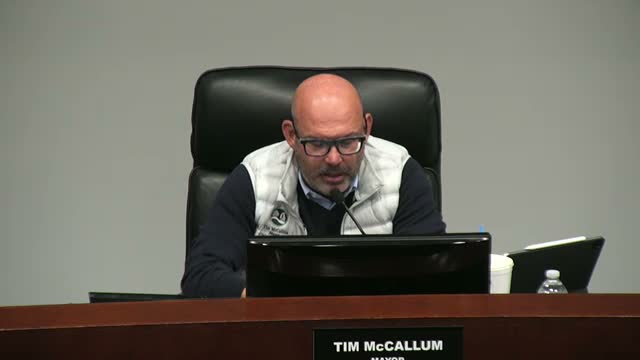
The Rockwall City Council voted 6–1 on March 16 to rezone a 77.86‑acre tract on the city's east side to a Planned Development that allows limited light‑industrial and commercial uses, after a lengthy public hearing in which nearby residents described worries about noise, trains and falling property values.
The developer, Clay Collier, and Matt Wavering, president of the Rockwall Economic Development Corporation, told the council the project is intended as a multi‑phase corporate campus anchored by a sheet‑metal processing facility and, eventually, a corporate headquarters. "We've been around since 1957," Collier said, describing the firm as a third‑generation family company. He added the company recently secured a large retail customer, saying, "Lowe's is gonna provide our new patented edging in all the stores this year." Collier and the EDC emphasized there would be no public incentives tied to the project.
Council members pressed the applicant about truck routing, whether trains would operate at night and how the city would limit uses on undeveloped portions of the site. City staff and the developer said the freight operations and rail spur would be routed inside the building and that the applicant had removed or restricted certain land uses from the draft PD ordinance to reduce off‑site impacts. "By putting a PD in place, it gives us the ability to control what goes here," Mayor Tim McCall said during debate, urging the protections a PD allows compared with straight zoning.
Dozens of residents who live near the proposed site turned out to oppose the rezoning. Longtime resident Vanita Stanley said she had lived on Airport Road for decades and pleaded with council members not to approve industrial activity adjacent to homes: "I don't think you people are realizing what this is gonna do to our homes," she said, describing concerns about noise and trains that already pass the neighborhood. Other speakers warned that industrial traffic and increased rail activity could lower property values and affect sleep and health.
Council discussion focused on tradeoffs between protecting neighborhoods and securing local economic investment. Several council members said the PD approach is preferable to straight industrial zoning because it lets the council remove uses and require a later PD development plan for the undeveloped portions (labeled Subdistricts B and C), ensuring additional public review before new uses proceed.
The motion to approve Z2026‑007 was moved by Mayor Tim McCall and seconded by a council member; the final roll call produced a 6–1 result with Councilwoman Jeffers recorded in dissent. Staff had noted the Planning & Zoning Commission recommended approval 4–1; staff also said the council's PD ordinance would require future site plans and allow the council discretion on additional development steps.
Next steps: the PD ordinance will be finalized as adopted, and future development proposals for subdistricts B and C will come back before planning and council as discretionary development plan submissions, at which point neighbors will have another opportunity to comment.
The developer, Clay Collier, and Matt Wavering, president of the Rockwall Economic Development Corporation, told the council the project is intended as a multi‑phase corporate campus anchored by a sheet‑metal processing facility and, eventually, a corporate headquarters. "We've been around since 1957," Collier said, describing the firm as a third‑generation family company. He added the company recently secured a large retail customer, saying, "Lowe's is gonna provide our new patented edging in all the stores this year." Collier and the EDC emphasized there would be no public incentives tied to the project.
Council members pressed the applicant about truck routing, whether trains would operate at night and how the city would limit uses on undeveloped portions of the site. City staff and the developer said the freight operations and rail spur would be routed inside the building and that the applicant had removed or restricted certain land uses from the draft PD ordinance to reduce off‑site impacts. "By putting a PD in place, it gives us the ability to control what goes here," Mayor Tim McCall said during debate, urging the protections a PD allows compared with straight zoning.
Dozens of residents who live near the proposed site turned out to oppose the rezoning. Longtime resident Vanita Stanley said she had lived on Airport Road for decades and pleaded with council members not to approve industrial activity adjacent to homes: "I don't think you people are realizing what this is gonna do to our homes," she said, describing concerns about noise and trains that already pass the neighborhood. Other speakers warned that industrial traffic and increased rail activity could lower property values and affect sleep and health.
Council discussion focused on tradeoffs between protecting neighborhoods and securing local economic investment. Several council members said the PD approach is preferable to straight industrial zoning because it lets the council remove uses and require a later PD development plan for the undeveloped portions (labeled Subdistricts B and C), ensuring additional public review before new uses proceed.
The motion to approve Z2026‑007 was moved by Mayor Tim McCall and seconded by a council member; the final roll call produced a 6–1 result with Councilwoman Jeffers recorded in dissent. Staff had noted the Planning & Zoning Commission recommended approval 4–1; staff also said the council's PD ordinance would require future site plans and allow the council discretion on additional development steps.
Next steps: the PD ordinance will be finalized as adopted, and future development proposals for subdistricts B and C will come back before planning and council as discretionary development plan submissions, at which point neighbors will have another opportunity to comment.
Don't Miss a Word: See the Full Meeting!
Go beyond summaries. Unlock every video, transcript, and key insight with a Founder Membership.
✓
Get instant access to full meeting videos
✓
Search and clip any phrase from complete transcripts
✓
Receive AI-powered summaries & custom alerts
✓
Enjoy lifetime, unrestricted access to government data
30-day money-back guarantee
