Prince George supervisors trim proposed water/sewer increases by removing excess debt payment and declining two new utility positions
March 17, 2026 | Prince George County, Virginia
This article was created by AI summarizing key points discussed. AI makes mistakes, so for full details and context, please refer to the video of the full meeting. Please report any errors so we can fix them. Report an error »
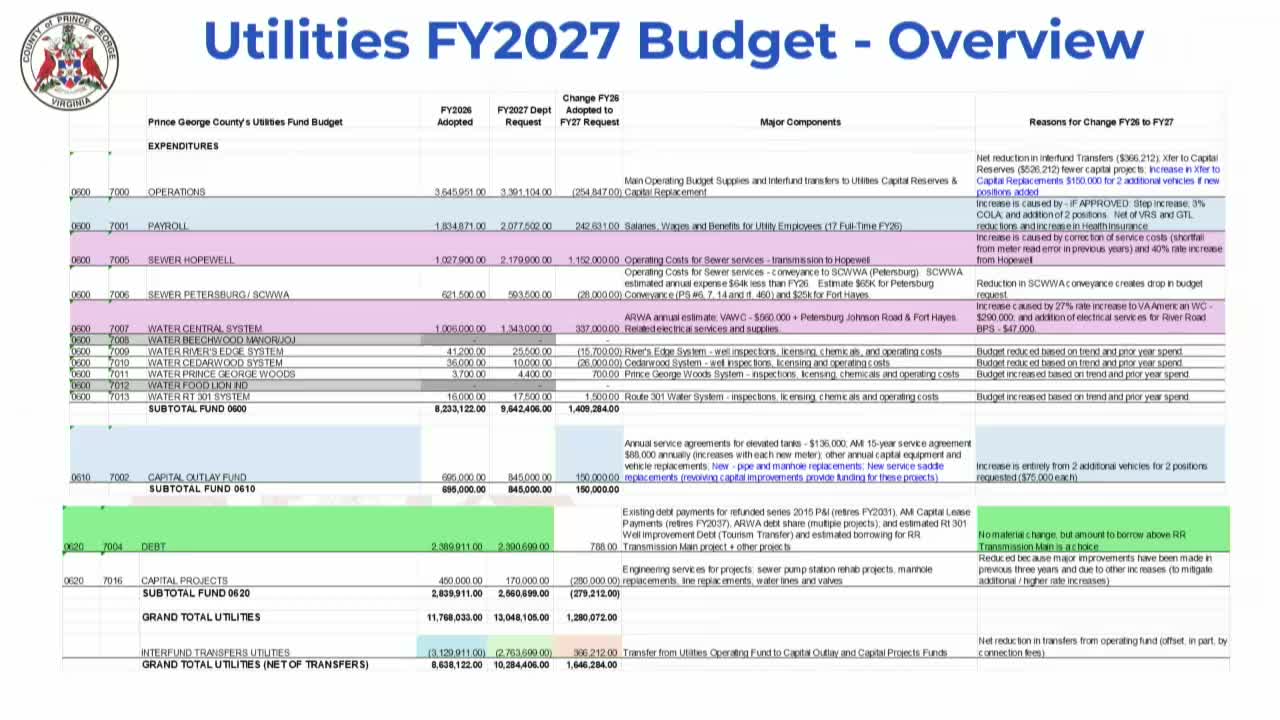
Prince George County supervisors discussed the utilities enterprise fund at length and signaled consensus to remove a budgeted ‘‘excess’’ debt payment and to hold off on funding two requested utility staff positions, actions that materially reduce the proposed water and sewer rate increases for FY27.
Staff framed the choices as levers that affect customer rates: the proposed FY27 budget included a debt payment amount that assumed readiness to borrow for projects not yet ready to proceed; removing that $777,197 line item would reduce planned rate increases across tiered water and sewer rates (staff showed examples where tier‑1 water increases would fall substantially if the debt payment and an equipment hire were removed). Supervisors asked whether removing the debt allocation represented a permanent change; staff explained the board could reallocate or reinstate funds later but that removing the excess payment for FY27 materially lowers the immediate rate impact.
Positions and equipment: Utilities requested two new positions (a waterworks manager and an 8‑1‑1 locator) totaling roughly $194,798 in salaries and benefits and vehicle needs (two pickup trucks estimated at $75,000 each in the original request). The board declined to fund the manager and expressed reluctance to approve the manager position; sentiment on the 8‑1‑1 locator was mixed and several members requested a more detailed cost/benefit calculation before committing.
Why it matters: Utilities are an enterprise fund, meaning customer fees drive operations and capital. Changes to how the county budgets debt service and staff affect customer bills, capital planning and the timing of infrastructure projects such as the River Road transmission main. Staff emphasized the need to develop formal enterprise fund policies (reserves, cash‑balance targets) before making permanent structural changes.
Representative quote: “If you removed the extra debt payment of over 700,000 the water rate, tier 1 would drop from 10% to 4%,” a staff presenter told the board as an example of the lever's impact.
Next steps: Staff will update rate tables and return with refined scenarios that reflect the board's direction (remove the excess debt payment, do not fund the two positions in FY27) and continue to analyze how those choices affect long‑term capital financing and borrowing capacity.
Staff framed the choices as levers that affect customer rates: the proposed FY27 budget included a debt payment amount that assumed readiness to borrow for projects not yet ready to proceed; removing that $777,197 line item would reduce planned rate increases across tiered water and sewer rates (staff showed examples where tier‑1 water increases would fall substantially if the debt payment and an equipment hire were removed). Supervisors asked whether removing the debt allocation represented a permanent change; staff explained the board could reallocate or reinstate funds later but that removing the excess payment for FY27 materially lowers the immediate rate impact.
Positions and equipment: Utilities requested two new positions (a waterworks manager and an 8‑1‑1 locator) totaling roughly $194,798 in salaries and benefits and vehicle needs (two pickup trucks estimated at $75,000 each in the original request). The board declined to fund the manager and expressed reluctance to approve the manager position; sentiment on the 8‑1‑1 locator was mixed and several members requested a more detailed cost/benefit calculation before committing.
Why it matters: Utilities are an enterprise fund, meaning customer fees drive operations and capital. Changes to how the county budgets debt service and staff affect customer bills, capital planning and the timing of infrastructure projects such as the River Road transmission main. Staff emphasized the need to develop formal enterprise fund policies (reserves, cash‑balance targets) before making permanent structural changes.
Representative quote: “If you removed the extra debt payment of over 700,000 the water rate, tier 1 would drop from 10% to 4%,” a staff presenter told the board as an example of the lever's impact.
Next steps: Staff will update rate tables and return with refined scenarios that reflect the board's direction (remove the excess debt payment, do not fund the two positions in FY27) and continue to analyze how those choices affect long‑term capital financing and borrowing capacity.
Don't Miss a Word: See the Full Meeting!
Go beyond summaries. Unlock every video, transcript, and key insight with a Founder Membership.
✓
Get instant access to full meeting videos
✓
Search and clip any phrase from complete transcripts
✓
Receive AI-powered summaries & custom alerts
✓
Enjoy lifetime, unrestricted access to government data
30-day money-back guarantee
