Tennessee panel advances bill to criminalize remaining after final deportation order amid constitutional concerns
March 12, 2026 | 2026 Legislature TN, Tennessee
This article was created by AI summarizing key points discussed. AI makes mistakes, so for full details and context, please refer to the video of the full meeting. Please report any errors so we can fix them. Report an error »
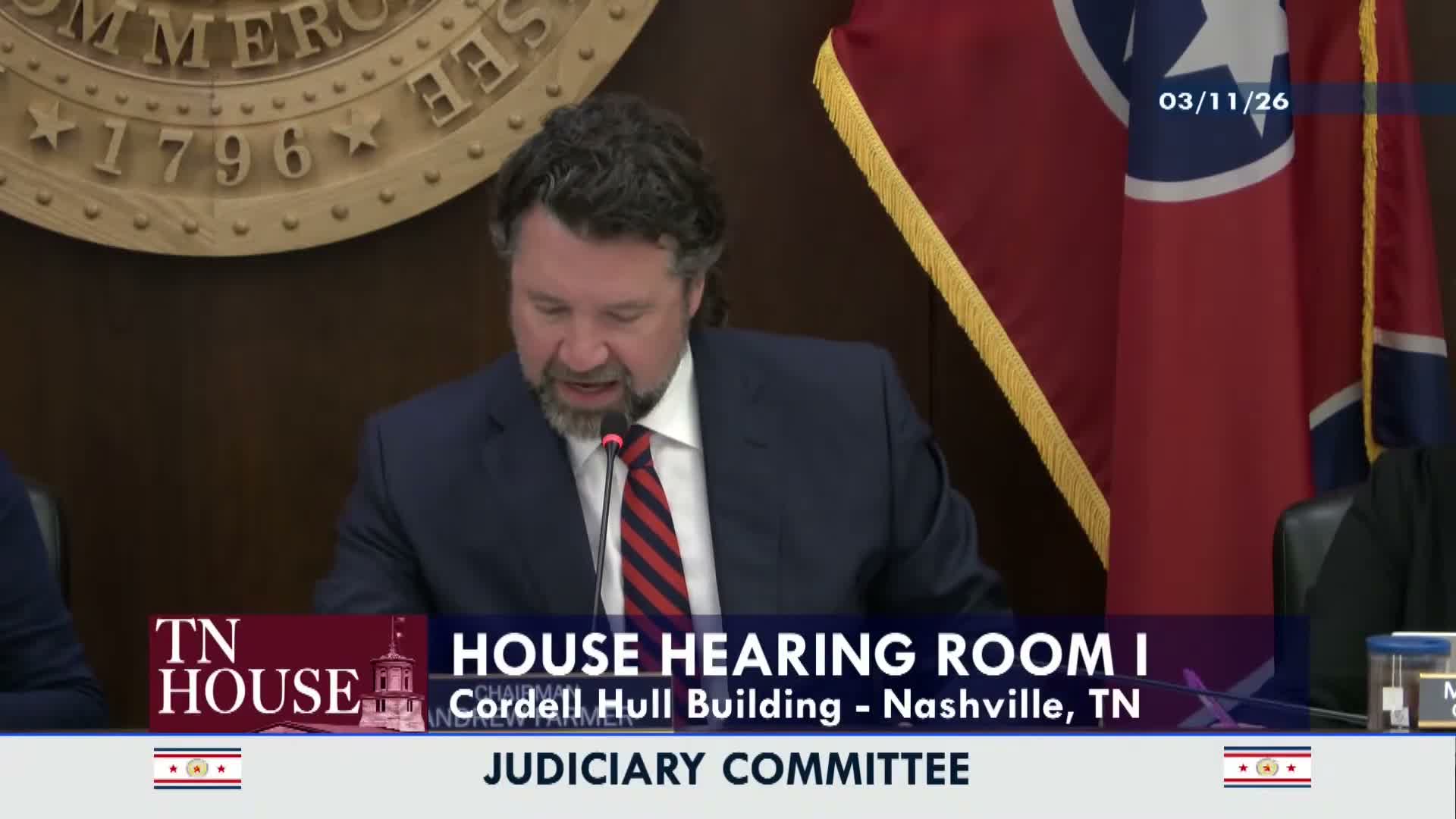
Chairman Farmer presided as the House Judiciary Committee debated House Bill 17 04, which would make it a Class A misdemeanor for an individual to remain in Tennessee more than 90 days after a final order of removal. Sponsor Leader Lambert said the measure targets those who have exhausted immigration remedies and urged members to support criminal penalties for remaining in the state.
The committee heard two public witnesses in opposition. Steven Puckett of Hendersonville testified: "I am speaking in opposition to this legislation," arguing the measure "turns this legislation into a pro trafficking and pro racketeering bill" by empowering exploitative importation networks and creating enforcement and entrapment risks for migrants. Amanda Hernandez urged rejection, saying "immigration enforcement is a matter of federal law" and referenced Arizona v. United States as a controlling precedent that limits states’ authority to criminalize presence.
Legal staff answered member questions about how the statute would operate in criminal court. Michelle Fogarty of legal services summarized the bill’s elements: "Section 1 creates a criminal offense of intentionally failing or refusing to depart from the state within a period of 90 days from the date of a final order of removal," and noted that prosecution would require proof of both a final order and an intentional failure to depart. Fogarty also said indigent defendants charged with criminal offenses are entitled to state‑provided counsel and that courts typically provide interpreters in criminal proceedings.
Members pressed constitutional concerns, with several asking whether the statute would be preempted by federal immigration law; speakers cited Arizona v. United States in the discussion. After debate and procedural votes, the committee voted 15 ayes and 5 nos to send HB1704, as amended, to Calendar and Rules.
The bill’s next steps: HB1704 advances to Calendar and Rules where further floor scheduling and legal review are likely. No committee amendments beyond the adopted amendment were recorded in the hearing.
The committee heard two public witnesses in opposition. Steven Puckett of Hendersonville testified: "I am speaking in opposition to this legislation," arguing the measure "turns this legislation into a pro trafficking and pro racketeering bill" by empowering exploitative importation networks and creating enforcement and entrapment risks for migrants. Amanda Hernandez urged rejection, saying "immigration enforcement is a matter of federal law" and referenced Arizona v. United States as a controlling precedent that limits states’ authority to criminalize presence.
Legal staff answered member questions about how the statute would operate in criminal court. Michelle Fogarty of legal services summarized the bill’s elements: "Section 1 creates a criminal offense of intentionally failing or refusing to depart from the state within a period of 90 days from the date of a final order of removal," and noted that prosecution would require proof of both a final order and an intentional failure to depart. Fogarty also said indigent defendants charged with criminal offenses are entitled to state‑provided counsel and that courts typically provide interpreters in criminal proceedings.
Members pressed constitutional concerns, with several asking whether the statute would be preempted by federal immigration law; speakers cited Arizona v. United States in the discussion. After debate and procedural votes, the committee voted 15 ayes and 5 nos to send HB1704, as amended, to Calendar and Rules.
The bill’s next steps: HB1704 advances to Calendar and Rules where further floor scheduling and legal review are likely. No committee amendments beyond the adopted amendment were recorded in the hearing.
View the Full Meeting & All Its Details
This article offers just a summary. Unlock complete video, transcripts, and insights as a Founder Member.
✓
Watch full, unedited meeting videos
✓
Search every word spoken in unlimited transcripts
✓
AI summaries & real-time alerts (all government levels)
✓
Permanent access to expanding government content
30-day money-back guarantee
